



The latest Nansen snapshot covering June 12 to July 12 shows roughly 87.8 million monthly transactions, 1.7 million active addresses, and transaction costs that remain close to negligible. At the same time, BlackRock’s BUIDL fund reached approximately $902.7 million on Avalanche, sAVAX continued to accumulate inside the BENQI staking system, and Avalanche L1 economics became increasingly accessible following Avalanche9000.
This is not a retail-driven expansion built around memecoins or rapidly rising DEX volume. In fact, trading activity remains one of the weaker areas of the current snapshot. It is an institutional and infrastructure-led expansion, supported by tokenized assets, liquid staking, stablecoin liquidity, and specialized Avalanche L1s.
Avalanche is not simply processing more activity. It is becoming a home for larger, more specialized, and more capital-intensive use cases.
All onchain figures in this article are based on the Nansen ecosystem analysis covering June 12 to July 12, 2026. This article is for informational purposes only and is not financial advice.
Network adoption is broadening
The adoption story is larger than a single weekly wallet figure. Avalanche added 707,000 new C-Chain addresses during Q2 2026, compared with 118,000 during Q1. That represents nearly six times as many new addresses quarter over quarter. The latest monthly snapshot also shows approximately 1.7 million active addresses and an estimated 87.8 million transactions.
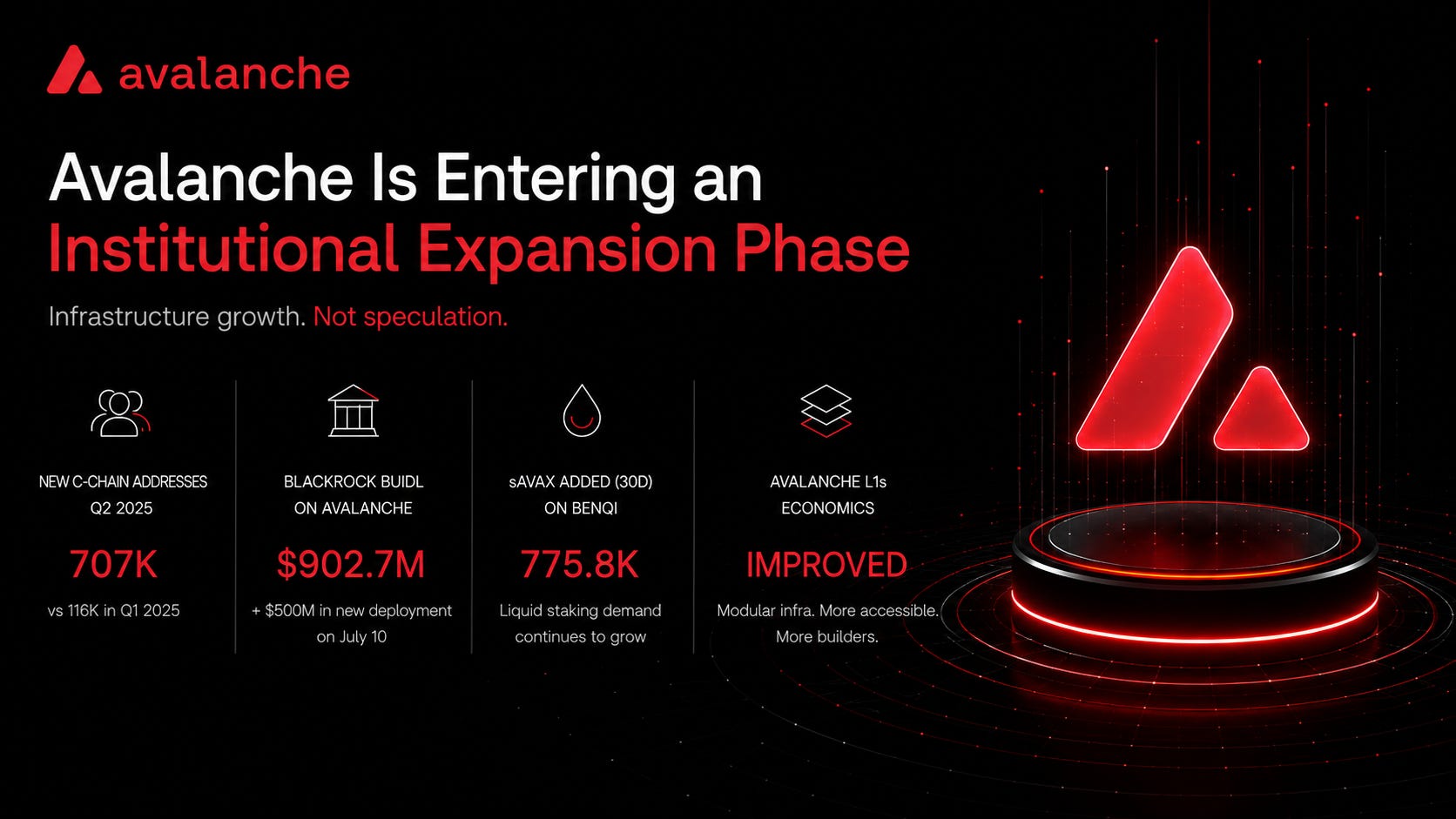
Those figures suggest that Avalanche is reaching more users while maintaining the low cost environment required for consumer applications, payments, gaming, and high frequency onchain activity. The report places the median transaction fee near $0.00001, approximately 96 percent lower following recent network upgrades.
Raw address growth should still be interpreted carefully. A newly created address is not automatically a retained user, and activity can include automated wallets, one-time interactions, or incentive-driven behavior. The more important confirmation will be whether these addresses continue transacting and begin using applications across C-Chain and Avalanche L1s.
The direction, however, is encouraging. Avalanche is onboarding meaningfully more addresses while keeping transaction costs almost invisible to the end user.
BUIDL has become the clearest institutional signal
The strongest development in the current dataset is BlackRock’s BUIDL fund.
Nansen tracked approximately $902.7 million of BUIDL on Avalanche as of July 12. The balance more than doubled during the preceding week after a new holder received approximately $500 million on July 10.
This was not a gradual increase spread evenly across thousands of wallets. It was a concentrated institutional deployment. The new address alone represented roughly 55 percent of the BUIDL balance tracked on Avalanche, while the asset had seven holders and three active addresses during the period.
That concentration should be acknowledged, but it does not reduce the significance of the deployment. It shows that Avalanche can support regulated financial products at a scale approaching $1 billion for a single tokenized fund.
The important part is simple: Avalanche is already being used to move and hold institutional capital at a serious scale.
It also shows that Avalanche is being used for more than trading and consumer apps. More institutional products are starting to use the network as part of the plumbing for tokenized assets.
Capital flows are mixed
The latest flows do not tell one simple story. WAVAX saw about $3.1 million move onto exchanges over seven days, but that was only 0.7 times its usual level. Fresh wallets added roughly $378,900, while Top PnL wallets added another $44,900. Nansen did not pick up any meaningful whale or Smart Money activity during the period.
So there is some exchange side pressure, but nothing that looks particularly aggressive.
USDC is more interesting. Around $70.8 million moved into exchange wallets over seven days, about 2.6 times the average, while Top PnL wallets added another $5.2 million.
It is too early to know what that USDC will be used for. It could sit on exchanges, move into trading or market making, or eventually find its way back onchain. For now, it simply tells us that a meaningful amount of stablecoin liquidity is being repositioned.
That is why the case for Avalanche right now is less about AVAX buying pressure and more about what is happening around the network: institutional assets, new users, staking and infrastructure.
sAVAX continues to attract participation
Liquid staking is still one of the more consistent parts of the Avalanche ecosystem. The BENQI sAVAX contract added roughly 775,800 sAVAX over 30 days, including 238,700 in the latest week. Fresh wallets also added around $412,300 of sAVAX over seven days, about 2.8 times the normal level.
At the same time, the Aave related sAVAX pool fell by approximately 451,800 sAVAX over 30 days.
That suggests staking demand is holding up even as some sAVAX is being pulled out of lending or leveraged positions. In other words, people are still choosing to keep AVAX productive, but they may be taking less risk with it.
That is an important distinction. sAVAX lets holders stay exposed to AVAX and staking while keeping their capital usable across DeFi.
BTC.b is still an important part of Avalanche DeFi
BTC.b remains one of the larger pools of non native capital on Avalanche.
The latest snapshot shows around 30,809 holders, a $179.8 million market cap, and $43.6 million in seven day volume. About $1.5 million of BTC.b left exchange wallets during the week.
At the same time, Top PnL wallets reduced their BTC.b positions by roughly $5 million.
So there are two things happening at once. Some BTC.b is moving away from exchanges, while profitable traders are cutting exposure. Neither move is large enough on its own to define the trend.
Bitcoin liquidity is still active on Avalanche and continues to be used across lending, liquidity and other DeFi markets. BTC.b gives the ecosystem another source of capital beyond AVAX and stablecoins.
DeFi has not caught up with the institutional story yet
The report puts Avalanche application TVL at around $3.1 billion, down 5.6 percent over 30 days. Monthly DEX volume came in at $899.5 million, down 64.7 percent, while application fees fell 30.4 percent to $5.2 million.
So while institutional assets and infrastructure are moving forward, the broader DeFi market is still quieter.
More addresses are coming in, RWA activity is growing and network costs remain extremely low, but those gains have not yet translated into stronger trading activity or broader DeFi usage.
The next step is seeing whether that new activity starts spreading through the rest of the ecosystem.
An expansion led by infrastructure
The strongest parts of the current Avalanche story are becoming easier to identify.
New C-Chain address creation accelerated sharply during Q2. sAVAX continues to attract deposits. Transaction costs remain extremely low, and Avalanche9000 has made it much easier to launch specialized Avalanche L1s.
The growth is still concentrated. One address accounted for roughly $500 million of the BUIDL balance, DEX volume has fallen sharply, and WAVAX flows do not yet show broad accumulation.
But the direction of travel is different from a typical speculative cycle.
Avalanche is seeing more activity around tokenized assets, staking and dedicated blockchain infrastructure. The next test is whether that starts bringing deeper liquidity, returning users and more sustained activity across Avalanche L1s.

Looking to join the global community live? Registration is now open for Avalanche Summit NYC. Secure your pass today for 2 days of exclusive keynotes and networking.