



Avalanche is entering a different kind of growth phase.
The latest Nansen snapshot, covering June 12 to July 12, shows 87.8 million monthly transactions, 1.7 million active addresses and transaction costs that remain close to negligible. At the same time, BlackRock’s BUIDL fund reached $902.7 million on Avalanche, sAVAX continued accumulating within the BENQI staking system, and the economics of launching dedicated Avalanche L1s became significantly more accessible following Avalanche9000.
This is not primarily a retail-driven expansion built around memecoins, speculative trading or rapidly rising DEX activity. In fact, decentralized exchange volume remains one of the weaker areas of the current dataset. The stronger signals are appearing elsewhere: regulated tokenized assets, stablecoin positioning, liquid staking participation, lower infrastructure costs and specialized networks designed for specific financial or consumer markets.
That distinction matters because Avalanche is not simply processing more transactions. It is becoming infrastructure for larger, more specialized and more capital-intensive use cases. At one end, BlackRock’s BUIDL fund demonstrates the network’s ability to support institutional capital and tokenized financial products. At the other, FIFA Blockchain demonstrates how the same underlying architecture can support consumer experiences for a global audience.
The emerging Avalanche thesis is therefore broader than growth in a single metric. It is the development of an onchain infrastructure layer capable of supporting both regulated financial markets and mass-consumer applications.
Network adoption is broadening
Avalanche added approximately 707,000 new C-Chain addresses during Q2 2026, compared with 118,000 during Q1. That represents nearly six times as many new addresses quarter over quarter. The latest monthly snapshot also shows 1.7 million active addresses and an estimated 87.8 million transactions across the network.
These figures suggest that Avalanche is reaching more users while preserving the low-cost environment required for payments, gaming, consumer applications and other forms of high-frequency onchain activity. According to the report, the median transaction fee is now close to $0.00001, following an estimated 96 percent reduction after recent network upgrades.
Low fees don’t automatically create adoption, but high fees guarantee failure for mainstream apps. When infrastructure gets this cheap and invisible, developers can focus on building actual products without forcing users to worry about gas markets.
The address data should still be interpreted carefully. A newly created wallet is not necessarily a retained user, and rising activity can include automated addresses, incentive-driven behavior or one-time interactions. The stronger confirmation will come from cohort retention: whether new addresses continue transacting, use multiple applications and move between C-Chain and Avalanche L1s over time.
Even with that limitation, the direction remains constructive. Avalanche is onboarding significantly more addresses without sacrificing the low-cost environment required for consumer-scale activity.
BUIDL has become the clearest institutional signal
The strongest institutional development in the current dataset is the growth of BlackRock’s BUIDL fund on Avalanche.
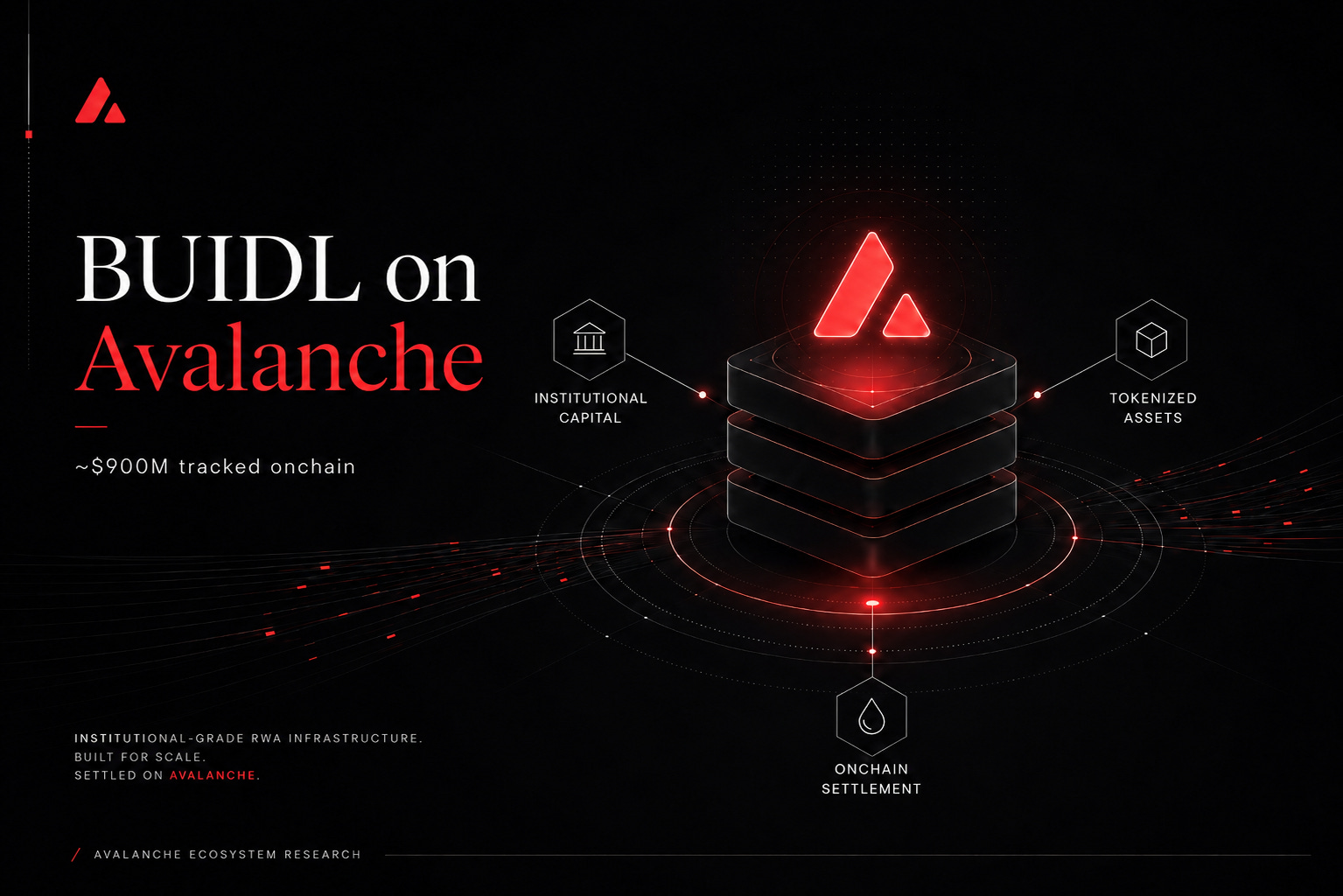
Nansen tracked $902.7 million of BUIDL on the network as of July 12. The balance more than doubled during the preceding week after a new holder received $500 million on July 10.
This was not a gradual increase distributed across thousands of users. It was a concentrated institutional deployment. The new address alone represented roughly 55 percent of the BUIDL balance tracked on Avalanche, while the asset recorded only seven holders and three active addresses during the measured period.
That concentration needs to be acknowledged because it changes how the number should be interpreted. BUIDL’s growth does not yet represent broad distribution or widespread retail demand. It represents the arrival of a small number of large institutional positions.
However, concentration does not make the deployment insignificant. It demonstrates that Avalanche can support the issuance, transfer and maintenance of a regulated tokenized fund at a scale approaching $1 billion. For institutional infrastructure, the number of holders may initially matter less than the value being settled, the reliability of the network and the ability to meet the operational requirements of regulated financial products.
The most important conclusion is therefore not that BUIDL has already achieved broad adoption. It is that meaningful institutional capital can operate on Avalanche infrastructure.
That places the network in a different competitive category. Avalanche is no longer competing only for crypto-native traders, gaming applications and DeFi liquidity. It is increasingly competing to become infrastructure for tokenized funds, regulated securities, treasury products and other forms of onchain financial settlement.
The capital-flow picture remains selective
The broader capital-flow data is more measured and prevents the institutional thesis from becoming overly bullish.
WAVAX recorded $3.1 million in exchange inflows over seven days, but this was only 0.7 times its normal level. Fresh wallets added $378,900, while Top PnL wallets added another $44,900. Some WAVAX moved toward exchanges, but the amount remained below average and there was no clear evidence of aggressive whale distribution or strong accumulation.
USDC showed a much larger positioning change. Exchange wallets received $70.8 million over seven days, around 2.6 times the average level, while Top PnL wallets added approximately $5.2 million.
This does not prove that the capital will eventually move into AVAX or Avalanche-based applications. Stablecoins can be positioned for several reasons, including trading, market making, treasury management, collateral deployment or liquidity provision. The eventual destination of those funds still needs to be monitored.
The current expansion thesis is therefore not based on immediate AVAX buying pressure or a broad speculative rotation into the ecosystem. It is based on institutional asset growth, increasing address creation, productive staking demand and improving infrastructure economics.
That is a slower and less visible form of expansion, but potentially a more durable one.
sAVAX reflects productive participation
Liquid staking remains one of the clearest signs of committed participation within Avalanche.
The BENQI sAVAX token contract added 775,800 sAVAX over 30 days, including 238,700 during the most recent week. Fresh wallets added $412,300 of sAVAX over seven days, around 2.8 times the normal level.
At the same time, the Aave-related sAVAX pool declined by almost 451,800 sAVAX over 30 days.
Together, these movements suggest two different behaviors. Demand for liquid staking remains active, while some leveraged or lending-based exposure involving sAVAX is being reduced. Users appear willing to maintain productive exposure to AVAX even as parts of the DeFi leverage layer unwind.
This distinction is important. Purely speculative demand often disappears when incentives decline or market conditions weaken. Liquid staking is more closely connected to the underlying network because it combines validator participation with onchain liquidity. Holders can contribute to network security while retaining the ability to use their capital across lending markets, liquidity pools and other applications.
The movement into sAVAX does not guarantee long-term conviction, but it represents a more productive form of participation than idle token holding or short-term trading activity.
BTC.b remains meaningful, although flows are mixed
BTC.b continues to extend Avalanche’s capital base beyond native AVAX liquidity.
The latest snapshot shows 30,809 BTC.b holders, a market capitalization of $179.8 million and $43.6 million in seven-day volume. Exchange wallets recorded $1.5 million in outflows, which can be consistent with self-custody or deployment into DeFi.
However, Top PnL wallets reduced BTC.b exposure by approximately $5 million over the same period.
The signal is therefore mixed rather than uniformly bullish. Some Bitcoin liquidity is leaving exchanges, while profitable wallets appear to be reducing exposure. Nevertheless, the size of the holder base and the level of trading activity indicate that BTC.b remains an active component of Avalanche DeFi.
Its strategic importance extends beyond the token itself. BTC.b allows Bitcoin capital to participate in lending, liquidity provision and other onchain financial activity without requiring users to rely exclusively on native AVAX liquidity. A broader capital base can make Avalanche applications more useful and reduce the ecosystem’s dependence on a single asset.
The challenge is turning that liquidity into sustained productive activity rather than temporary movement between exchanges, wallets and incentive-driven markets.
Avalanche9000 changed the economics of expansion
Avalanche9000 materially changed the cost structure of launching and operating a dedicated Avalanche L1.
According to the report, L1 deployment costs declined by approximately 99.9 percent, while C-Chain fees fell by roughly 96 percent. The previous requirement for every L1 validator to stake 2,000 AVAX was also removed, significantly lowering the operational barrier for teams building specialized networks.
These changes expand the range of organizations that can realistically operate their own execution environments. Financial institutions, gaming studios, marketplaces, payment providers and regulated applications can design networks around specific technical, commercial or compliance requirements without forcing every use case onto a single general-purpose chain.
Projects such as Dexalot, DeFi Kingdoms, GUNZ and Henesys illustrate how Avalanche L1s can be configured around very different markets. Some prioritize gaming and consumer activity. Others focus on financial infrastructure, trading or application-specific execution.
Lower costs, however, should not be confused with automatic success. Making L1 deployment easier may increase experimentation, but it may also produce networks with limited users, weak economic activity or insufficient long-term demand.
The next meaningful metric is therefore not simply the number of Avalanche L1s launched. It is how many retain users, attract developers, generate recurring transactions and build sustainable business models.
Avalanche9000 reduced the cost of entry. The ecosystem must now prove that lower entry costs can translate into durable network activity.
BlackRock and FIFA reveal the two directions of the Avalanche thesis
The clearest way to understand Avalanche’s current expansion is to examine two deployments serving fundamentally different audiences.
BlackRock’s BUIDL fund represents the institutional direction. It demonstrates that Avalanche can support regulated financial products, tokenized assets and large capital deployments approaching $1 billion.
FIFA Blockchain represents the mass-consumer direction.
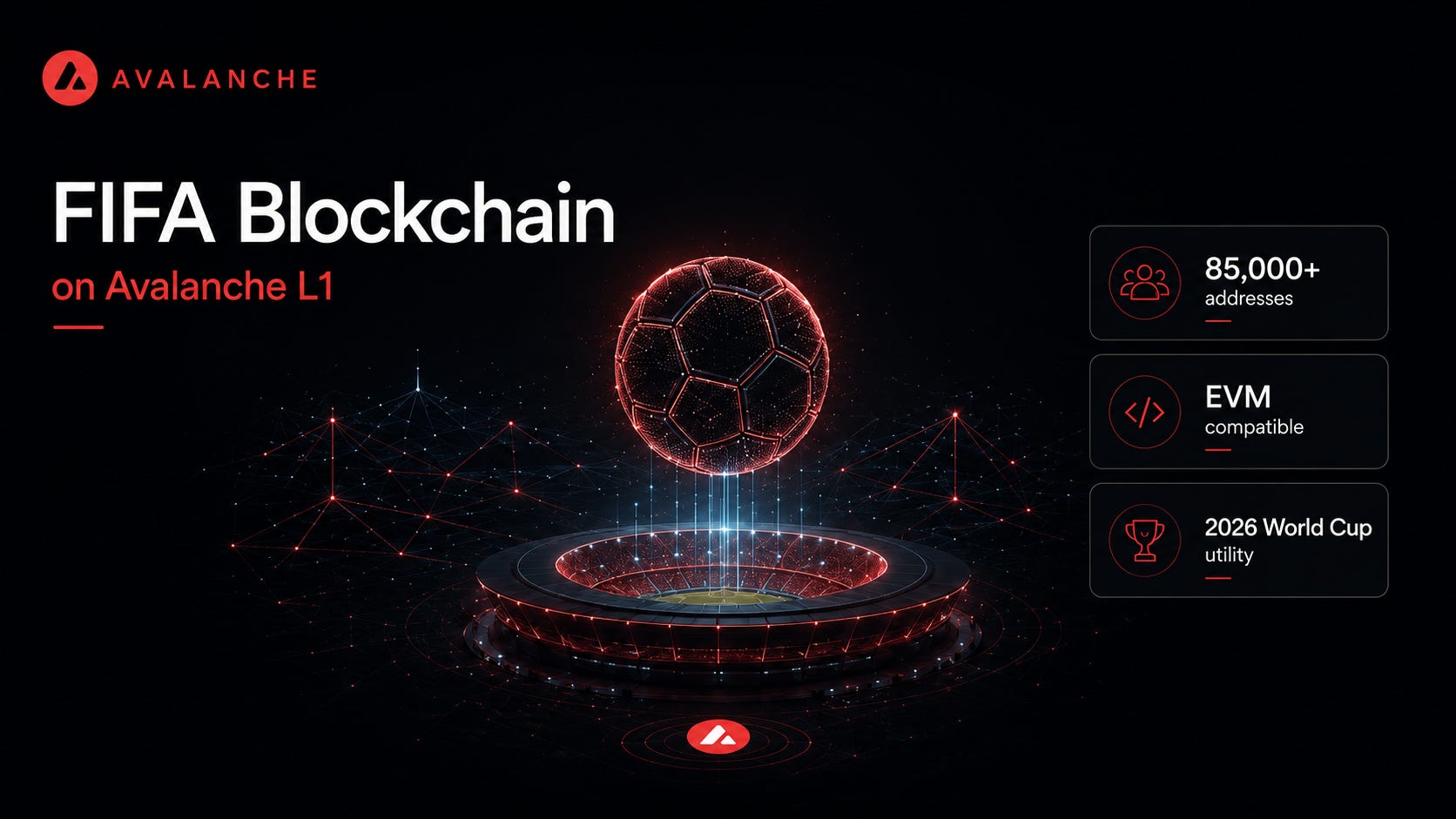
Built as a dedicated, EVM-compatible Avalanche L1, FIFA Blockchain supports FIFA Collect, digital ownership and emerging fan experiences. More than 85,000 addresses were reportedly created following its launch, providing an early indication of how a globally recognized organization can onboard users into an onchain environment without making blockchain the central part of the experience.
The difference between these two adoption paths is important.
Institutional adoption is likely to arrive through settlement, tokenized funds, securities, treasury products and regulated financial infrastructure. Consumers are more likely to arrive through products they already understand: entertainment, access, identity, loyalty, collectibles and ownership.
The 2026 World Cup provides a practical example of the consumer model. FIFA Collect’s Right to Buy and Right to Ticket assets connect verifiable digital ownership with access to official match tickets. Users are not being asked to adopt blockchain as an ideology or learn how network infrastructure operates. They are interacting with a recognizable product connected to one of the world’s largest sporting events.
This is where FIFA fits within the wider Nansen analysis.
The increase in active addresses and the reduction in transaction costs show that Avalanche is becoming technically capable of supporting broader consumer activity. FIFA provides a real-world example of what that direction could look like. BlackRock, meanwhile, shows how the same underlying infrastructure can serve the opposite end of the market: concentrated institutional capital operating through regulated tokenized assets.
BlackRock brings financial institutions onchain, while FIFA puts blockchain beneath everyday consumer products. Together, they prove the Avalanche L1 model can support both capital-heavy markets and mass-market applications.
That may become Avalanche’s most important competitive advantage.
Expansion remains real, but uneven
The cleanest verdict is infrastructure-led expansion with institutional momentum and uneven onchain breadth.
BUIDL has grown to approximately $902.7 million on Avalanche. New C-Chain address creation accelerated sharply during Q2. Liquid staking demand remains visible through sAVAX. Transaction costs remain extremely low, while Avalanche9000 has made specialized network deployment materially more accessible.
FIFA Blockchain also demonstrates that Avalanche’s infrastructure thesis is not limited to institutional finance. The same architecture can support global consumer products in which blockchain operates beneath the experience rather than becoming the experience itself.
At the same time, the weaknesses in the dataset should not be ignored.
A single address accounts for roughly $500 million of the BUIDL balance. DEX volume has declined substantially. WAVAX flows are neutral rather than strongly accumulative. Smart Money and whale activity remain limited, while Top PnL wallets reduced their BTC.b exposure.
This means Avalanche has not yet converted its infrastructure progress into uniformly strong activity across every part of the ecosystem. Institutional assets are growing, but holder distribution remains concentrated. Address creation is accelerating, but retention still needs to be demonstrated. L1 economics have improved, but individual networks must prove that they can generate lasting demand.
These are not reasons to dismiss the expansion. They define its next stage.
Avalanche has shown that it can attract large institutional deployments, support productive staking, reduce the cost of launching specialized networks and provide infrastructure for global consumer brands. The challenge now is converting those foundations into retained users, deeper liquidity, active applications and recurring economic activity across the wider ecosystem.
The network is moving beyond a consolidation story, but it is not yet experiencing expansion everywhere at once.
Its progress is being led by infrastructure first: tokenized assets, specialized networks, low-cost execution and productive capital. Broader market activity may follow, but it has not fully arrived yet.
That is what makes the current phase significant.
Avalanche is not relying on speculation to manufacture the appearance of growth. It is building the infrastructure that could support the next generation of tokenized markets and consumer-scale onchain applications.

Looking to join the global community live? Registration is now open for Avalanche Summit NYC. Secure your pass today for 2 days of exclusive keynotes and networking.