




While most of the crypto conversation revolves around prices and narratives, something far more consequential has been taking shape on Avalanche. Banks, asset managers, governments, and payment processors are deploying live financial infrastructure on the network. These are production systems processing real capital at scale.
Japan’s largest tokenization platform has committed over $2 billion in assets to Avalanche infrastructure. Wyoming issued the first publicly purchasable state-backed stablecoin in U.S. history. Two regulated investment products tracking AVAX are now trading on Nasdaq. The institutional era for Avalanche has arrived.
Payments, FX, and Stablecoins
One of the clearest signs of institutional seriousness is where real money moves first: payments and foreign exchange.
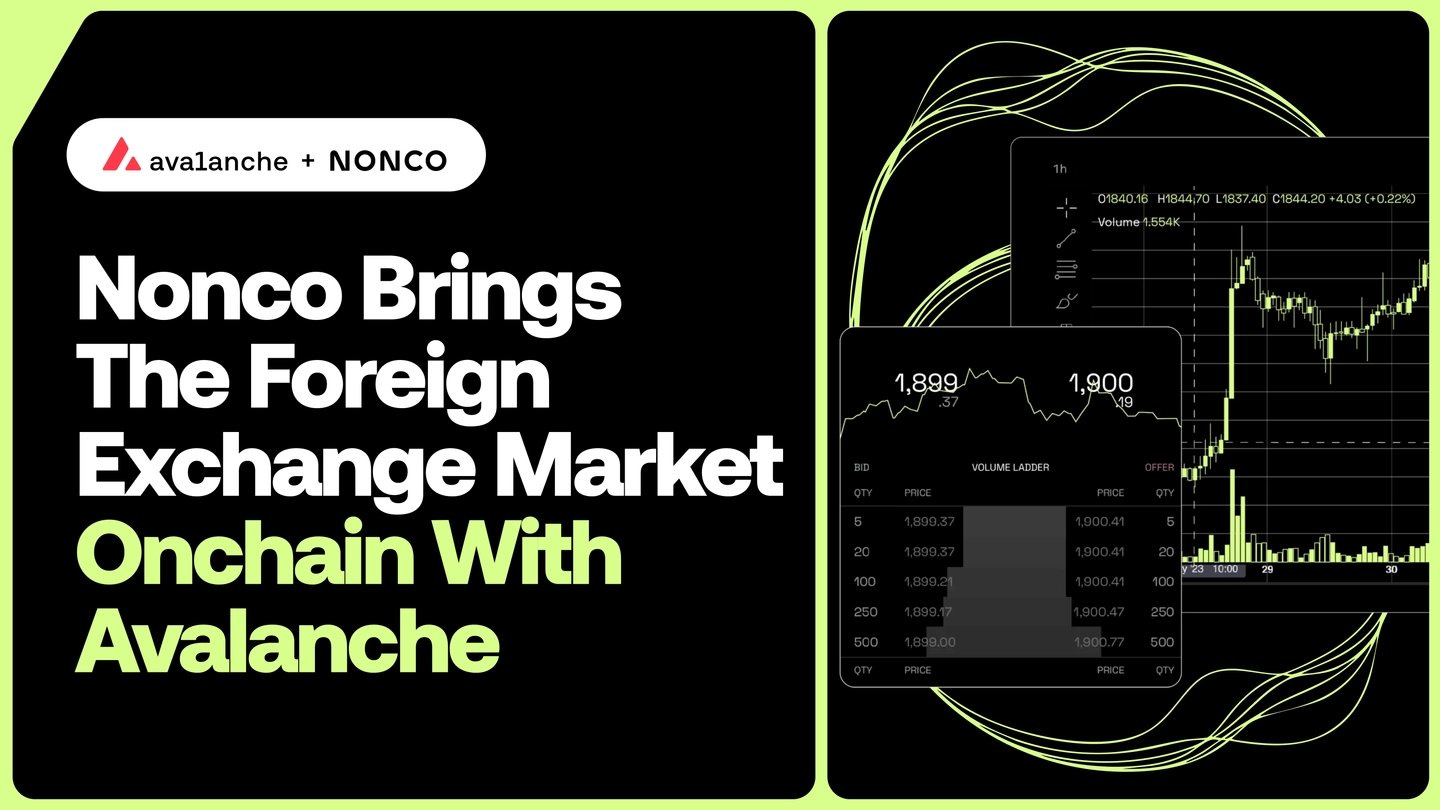
Nonco, backed by VanEck, launched the first institutional-grade FX trading protocol on Avalanche, connecting traditional liquidity providers with on-chain users through a request-for-quote model. The platform already serves over 350 institutional counterparts including U.S. ETFs, liquid funds, and global payment processors.
On the stablecoin front, Wyoming made history on January 7, 2026, launching the Frontier Stable Token (FRNT), the first U.S. state-issued stablecoin available for public retail purchase. FRNT is fully collateralized at 102%, backed by U.S. dollars and short-term Treasuries, with reserves managed by Franklin Templeton. Avalanche is one of the seven networks where FRNT operates, with Rain, a Visa-powered payment platform, handling access on-chain. Wyoming is directing the net reserve interest income to the state’s School Foundation Program, turning blockchain infrastructure into a public revenue stream. North Dakota has already announced plans for its own stablecoin initiative off the back of FRNT’s launch.
Visa also expanded its stablecoin settlement platform to support Avalanche-based stablecoins, plugging blockchain settlement into infrastructure that processes 65,000 transactions per second globally. Elsewhere, BDACS and Woori Bank launched a Korean won-backed stablecoin (KRW1) on Avalanche, while TIS Inc., Japan’s largest credit card processor, deployed a multi-token platform supporting stablecoins, tokenized deposits, and digital securities.
In February 2026, FinChain, the Web3 arm of Fosun Wealth Holdings, launched FUSD on Avalanche’s C-Chain, marking Asia’s first yield-bearing real-world-asset-backed stablecoin. FUSD passes through native yield from underlying reserves held at institutions including BNY Mellon and ChinaAMC. Avalanche was selected for its sub-second finality, DeFi liquidity infrastructure, and compliance tooling suited to permissioned institutional access.

Tokenized Treasuries and Fund Infrastructure
BlackRock’s BUIDL fund, built with Securitize, now holds over $2.8 billion in tokenized U.S. Treasuries and has become the first institutional tokenized fund to integrate directly with DeFi, through Euler Finance on Avalanche. Investors can use tokenized treasuries as collateral for on-chain lending.
Franklin Templeton’s BENJI, VanEck’s VBILL, WisdomTree’s tokenized funds, and Wellington and Libeara’s ULTRA are all live on Avalanche, giving institutions a range of regulated, on-chain treasury and liquidity management options. OpenTrade has layered on top of this infrastructure, enabling neobanks to offer stablecoin yield products backed by money market funds, ETFs, and private credit.
Credit, Structured Finance, and Real Assets
Apollo Global Management, with $671 billion in AUM, launched its Apollo Diversified Credit Securitize Fund (ACRED) on Avalanche, offering tokenized access to Apollo’s credit strategies with T+0 settlement. KKR, ParaFi Capital, and SkyBridge Capital have similarly tokenized portions of major investment funds on the network.
In the structured finance space, Intain operates a tokenized mortgage-backed securities and asset-backed securities platform on a custom Avalanche L1. By tokenizing the securitization process, deal sizes can reach viability at $10 to $50 million rather than the traditional $500 million minimum. Transaction costs drop from 3 to 5 percent to 1 to 2 percent of deal size, and settlement happens in seconds. Intain partnered with FIS to launch the Digital Liquidity Gateway, supporting loan trading and securitization for approximately 2,000 U.S. regional and community banks.

On the real estate side, Homium launched tokenized home equity loans, Republic issued a tokenized profit-sharing note with over $30 million in subscriptions, and Balcony is digitizing more than 370,000 property records in Bergen County, New Jersey, representing roughly $240 billion in real estate value. Dinari launched a custom Avalanche L1 for tokenized U.S. public equities with 24/7 trading, fractional shares, and instant settlement.
Progmat’s $2 Billion Migration: Japan Goes On-Chain
The most significant institutional announcement of early 2026 came from Japan. On February 26, Progmat, Japan’s largest security token platform backed by major megabank groups, announced a full migration of its platform from Corda5 to a dedicated Avalanche L1 deployed via AvaCloud.
The migration covers assets totaling over ¥439.6 billion (~$2.8 billion), making it one of the largest tokenized asset migrations in Asia’s financial history. Progmat accounts for approximately 63 percent of cumulative security token issuance volume in Japan and 53.8 percent of total projects nationwide. Full migration is expected by the end of June 2026.
The rationale for choosing Avalanche comes down to three things: a sovereign, compliant environment with its own governance rules through a dedicated L1, EVM compatibility that opens Japanese digital securities to foreign institutional investors for the first time, and sub-second finality enabling near-instant settlement.
Alongside the migration, Progmat is commercializing cross-chain settlement through Project Keystone, enabling Delivery versus Payment settlement between security tokens and stablecoins across Japan, the United States, Europe, and South Korea. Japan’s digital securities market is projected to exceed $7 billion by the end of 2026, and Progmat’s move positions Avalanche as the primary infrastructure layer for that growth.

AVAX Enters Regulated Markets
The first quarter of 2026 brought Avalanche’s native token its first U.S.-listed exchange-traded products, a milestone previously achieved only by Bitcoin and Ethereum among smart contract platforms.
On January 26, VanEck launched VAVX on Nasdaq, the first U.S.-listed ETP providing direct exposure to AVAX with potential staking rewards included. On March 12, Grayscale launched GAVA on Nasdaq, a staking ETF offering combined price exposure and staking yield (averaging 7.36% annually in 2025) through a regulated structure that requires no direct token custody.
VAVX and GAVA together create a regulated pathway for pension funds, asset managers, and registered investment advisors to access Avalanche without needing on-chain infrastructure.
Why Institutions Keep Choosing Avalanche
Several factors come up consistently across these deployments. Custom L1 architecture lets organizations launch permissioned environments with tailored compliance and governance rules while staying interoperable with the broader ecosystem. Sub-second finality is critical for payment systems and institutional trading. Full EVM compatibility reduces implementation friction by leveraging existing tooling, audit firms, and developer talent. Following the Octane upgrade, C-Chain fees remain consistently low even at scale. AvaCloud’s managed infrastructure enables rapid L1 deployment without managing validators or monitoring systems from scratch.
What This Means for Builders
The institutional wave creates real opportunities for developers building on Avalanche: portfolio management tools for tokenized real-world assets, analytics for on-chain credit instruments, compliance and reporting infrastructure, bridges between institutional and retail products, and off-chain asset data feeds.
The financial infrastructure of the next decade is being built now. For a deeper breakdown of every deployment covered here, including the full technical details on Progmat’s Project Keystone, FRNT’s reserve structure, and how BUIDL’s DeFi integration works, the full version is linked below.
Ready to build on Avalanche? Explore AvaCloud and Avalanche Dev Tools and start today.
For the full detailed breakdown of every deployment covered in this article, read the full version here.
Dive into the Avalanche ecosystem today! Download the Core Wallet and unlock a world of seamless DeFi, NFTs, and more.
This is so true and one of the reasons why avalanche is the best place for institutions to grow.
The institutions are here on Avalanche!