



For years, cross-border payments have been one of blockchain’s most promising use cases, yet most activity in the industry has revolved around trading, NFTs, and speculative assets. Behind the scenes, however, Avalanche has been steadily building infrastructure designed to move real money between businesses, institutions, and consumers around the world.
On June 18, 2026, Avalanche announced the Avalanche Payments Collective (APC), a coalition of 28 organizations spanning every layer of the global payments stack. On paper, it may look like another industry consortium. In reality, many of these companies were already building on Avalanche long before the APC was given a name.
Franklin Templeton, VanEck, Anchorage Digital, Paxos, Kraken, and 23 other organizations now form part of the collective. Together, they represent institutions operating across dozens of countries, managing significant amounts of capital, and navigating some of the most heavily regulated sectors in finance.
The Problem With Moving Money
Sending money across borders is slow, expensive, and fragile. A payment between two businesses in different countries might pass through five or six correspondent banks, take several days to settle, and lose value along the way to fees and foreign exchange spreads.
This affects every multinational business, every money transfer operator, every supplier waiting on an invoice, every worker receiving pay from a foreign employer. The global payments industry processes trillions of dollars every year through infrastructure largely designed before the internet existed.
What the APC Is
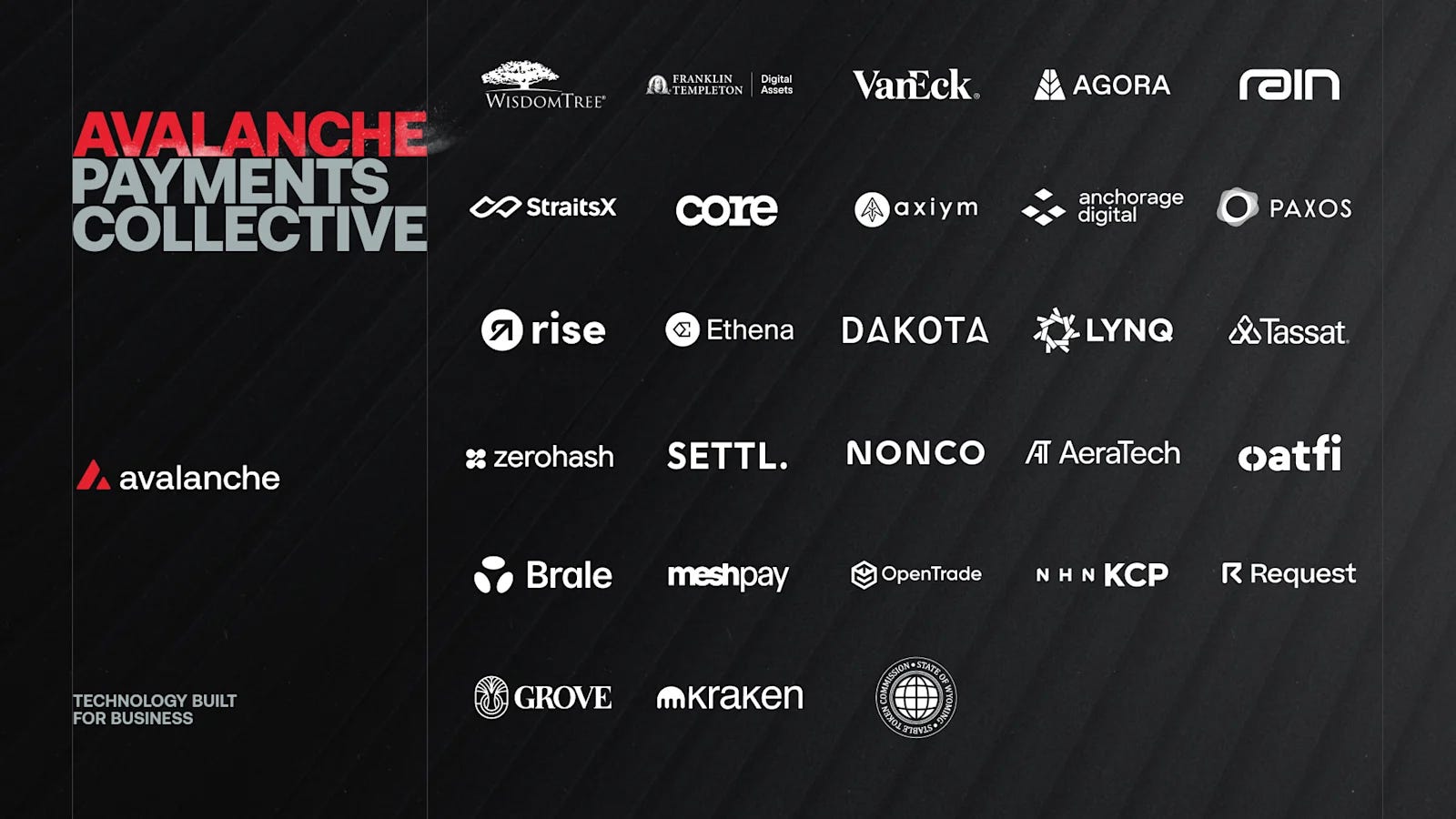
The Avalanche Payments Collective is an ecosystem of specialized organizations, each covering a specific layer of the global payments stack, all building on Avalanche as a shared foundation.
Together, its members support payment flows across more than 150 countries, 96 currencies, and approximately 22 billion payout endpoints spanning bank accounts, cards, and mobile wallets.
Settlement: Tassat‘s Lynq network runs on a dedicated Avalanche Layer 1 and connects more than 30 major financial institutions including Fireblocks, Galaxy, and Wintermute. It settles transactions in seconds and carries more than $2.5 trillion in transaction history. SETTL, Zerohash, and Dakota extend those capabilities across institutional, banking, and enterprise payment workflows.
Stablecoins: Agora, Paxos, Ethena, and the Wyoming Stable Token Commission each provide digital dollar infrastructure on Avalanche. Wyoming’s FRNT is the first fully reserved stablecoin issued directly by a US state government, allowing money to move on weekends and public holidays when traditional banking is closed.

Cross-border liquidity: One of the biggest costs in international payments is pre-funding accounts in every country you operate in, keeping idle cash sitting in dozens of bank accounts just to guarantee payouts. Axiym solves this with on-demand liquidity infrastructure, letting licensed money service businesses access capital at the moment they need it rather than months in advance. Axiym has processed more than $1.4 billion in volume on Avalanche, serving platforms that collectively move more than $25 billion annually across 150+ countries. Nonco handles the foreign exchange side, connecting more than 350 liquidity providers to stablecoin markets and settling both sides of a currency trade simultaneously.
Treasury and yield: Franklin Templeton‘s BENJI token gives treasury teams 24/7 access to a regulated US government money market fund, redeemable on-chain. VanEck‘s VBILL offers tokenized short-term Treasury exposure and can be used as collateral in lending markets. OpenTrade and Grove add yield and credit infrastructure for businesses that want their settlement reserves working harder.
Business payments: OatFi embeds financing into payment workflows so suppliers get paid immediately while buyers retain flexible terms. Rise handles global payroll across 190 countries using stablecoins with automated compliance. Request Finance manages invoicing and accounts payable with direct integrations into QuickBooks, NetSuite, and Xero.
Merchant acceptance: NHN KCP, one of South Korea’s largest payment processors, brings merchant infrastructure to the collective. In a pilot at its headquarters, employees pay for cafeteria purchases by scanning a QR code, with smart contracts completing authorization in under two seconds.

The Real Challenge Isn’t Technology
While blockchain technology has matured considerably over the past decade, adoption remains the biggest hurdle. Payments is a highly competitive industry built on established networks, regulations, and business relationships that have developed over decades. Even when a new system offers faster settlement or lower costs, convincing institutions to change existing workflows is rarely straightforward.
The APC does not solve that challenge overnight. What it does provide is a growing ecosystem of infrastructure providers, liquidity networks, stablecoin issuers, treasury solutions, and payment companies that can work together on a common foundation. Whether that translates into widespread adoption remains to be seen, but the pieces are increasingly falling into place.
Why Avalanche
Avalanche can create dedicated, application-specific Layer 1 blockchains. Each runs with its own validators, rules, and governance, while remaining interoperable with the broader Avalanche network.
Institutions cannot put sensitive transaction data on a public network where anyone can see it, or share block space with unpredictable fees and congestion. Avalanche gives them an environment they control, that meets compliance requirements, and performs consistently at scale.
That is why Tassat built Lynq on its own dedicated Avalanche L1, why NHN KCP is co-developing a payment-dedicated L1 with Ava Labs, and why Japan’s Progmat is migrating more than $2 billion in tokenized assets from R3’s Corda to Avalanche.
Already Built Before It Was Announced
What makes the APC notable is that it was assembled after many of its members were already building on Avalanche.
Franklin Templeton, Rain, Axiym, and others chose Avalanche before any collective existed. The APC simply puts a name on an ecosystem that had already taken shape. That is very different from announcing partnerships that have yet to result in deployed products or meaningful usage.
The opportunity in global payments is enormous, and no single announcement will transform the industry overnight. Yet the APC highlights how much infrastructure is already operating on Avalanche today. Across settlement, stablecoins, treasury management, payroll, merchant payments, and cross-border liquidity, many of the building blocks for a modern payments network are already in place.
For an industry that often focuses on future adoption, the APC is a reminder that adoption is already happening. The collective is also open to additional members, with payment companies, fintechs, and financial institutions able to learn more and connect with the Avalanche institutional team at avax.network/payments.

Looking to join the global community live? Registration is now open for Avalanche Summit NYC. Secure your pass today for 2 days of exclusive keynotes and networking.