



The next serious wave of consumer crypto will not look like another abstract financial primitive. It will look like familiar behavior upgraded by better infrastructure. That is what makes YourGrails interesting. The product is simple enough for any collector to understand. Open digital packs, reveal real graded cards, keep them, trade them, sell them back, battle with them, or redeem them physically. But underneath that simple experience sits a more important idea. YourGrails is not trying to make collectibles digital just for the sake of it. It is trying to turn physical graded cards into liquid, programmable, verifiable assets without removing the emotional experience that made collecting powerful in the first place.
The collectibles market already has demand, culture, price history, status, and emotional depth. The problem is not that people need to be convinced that rare cards have value. The problem is that the infrastructure around ownership is still slow and fragmented. A graded card can be authenticated by PSA, BGS or CGC, stored safely, and priced through market data, but the user experience around that card often remains inefficient.
Selling can be slow
Shipping adds friction
Counterparty trust matters
Marketplace pricing can be inconsistent
Liquidity depends on finding the right buyer at the right time
Ownership is emotionally rich, but operationally clunky
YourGrails enters that gap by using Avalanche as the settlement layer for a real world collectible experience.
The Core Model
YourGrails is a digital pack opening platform built on the Avalanche blockchain. Users purchase digital packs containing Card Tokens that correspond to physical, professionally graded trading cards held in custody. Each Card Token represents beneficial ownership of one specific underlying card, and transferring that Card Token transfers beneficial ownership of the corresponding physical card. This is the core of the model. The NFT is not the collectible by itself. It is the ownership wrapper for a real graded card. That makes the system different from purely digital collectibles where scarcity exists only inside the digital object. Here, the digital layer is used to coordinate ownership, transfer, marketplace settlement, buyback rights, and eventual redemption around an asset that already exists in the physical world.
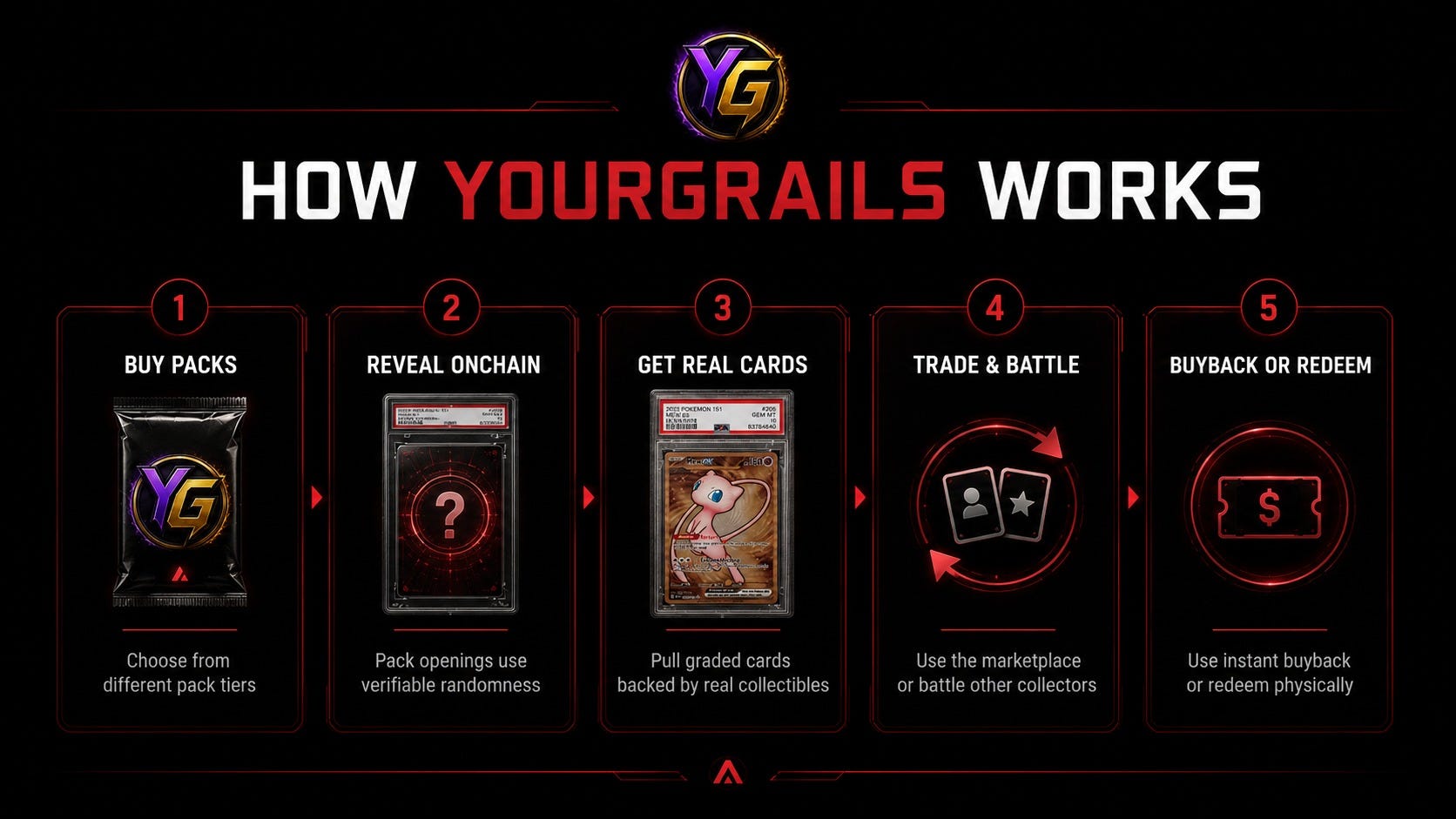
This is the strongest part of the product design. YourGrails does not ask collectors to abandon the physical card. It keeps the physical card as the center of value and uses blockchain to improve how that card can be owned, moved, valued, sold, financed, and redeemed. That is a much cleaner thesis than forcing a speculative token into a collectibles product. The card remains the asset. The chain becomes the rail.
Why Avalanche is the Right Rail for YourGrails
YourGrails choosing Avalanche makes sense because the product needs fast, low cost, onchain settlement for actions that should feel smooth to collectors:
pack purchases
reveals
marketplace trades
buybacks
burns
redemption flows
A pack opening experience cannot feel slow or expensive. Avalanche gives the product the speed and cost profile needed to make onchain ownership feel closer to a normal consumer app.
The second reason is infrastructure fit. YourGrails is built around real graded cards, Card Token ownership, USDC payments, marketplace liquidity and cross-chain accessibility. Avalanche’s EVM environment, native USDC support and Circle CCTP integration give the platform the rails to settle collectible ownership onchain while keeping the user experience simpler. The collector sees the pack, the reveal and the card. Avalanche handles the settlement layer underneath.
Custody as the Trust Layer
The custody model is central to the trust architecture. YourGrails states that underlying cards are graded by PSA, CGC or BGS, stored in a secure climate controlled facility, and insured during storage and shipment subject to custodian terms. That is important because the credibility of the product depends on the link between the Card Token and the physical card. If the token represents ownership, the user needs confidence that the physical card exists, is identifiable, is held properly, and can be transferred or redeemed according to the rules of the platform.
In this type of model, custody is not a back office detail. Custody is part of the product. Without strong custody and clear ownership language, tokenized collectibles become only another layer of speculation. With it, they can become usable asset wrappers. This is where YourGrails becomes more interesting than a simple pack opening app. The platform is not only selling a reveal experience. It is building an ownership system around physical collectibles.
Pack Opening as the Consumer Entry Point
The pack opening mechanic is where YourGrails connects product design with collector behavior. Users purchase packs, open them, and receive one randomly selected card from the available inventory for that tier, with rarity odds published and updated on the relevant pack pages.
That matters because users are not buying an unclear chance at a collectible. They are entering an inventory based system where randomness, valuation, rarity, and available card pools shape the experience. YourGrails starts with something collectors already understand, the sealed pack, the chase, and the reveal, while blockchain improves what happens after the pull.
Verifiable Randomness and Fair Reveals
Randomness is critical for any pack opening product, especially when real graded cards and market value are involved. YourGrails reduces the need to trust private server logic by using a verifiable randomness process, making card distribution more transparent and auditable.
This does not remove every trust assumption, since custody, valuation, inventory, and operations still matter. But it strengthens one of the most sensitive parts of the experience: proving that the reveal is not just a black box.
The Buyback Mechanism
The buyback mechanism is the second major design choice. YourGrails states that users may exercise a buyback option to receive 90 percent of the assessed value of a card, paid in the medium designated by the platform. The assessed value is determined by YourGrails using market data sources disclosed on the service. The buyback reserve is replenished through pack sale revenue, and larger buybacks may be subject to manual review and processing delays. This makes the buyback feature powerful, but it should be framed correctly. It is not a guaranteed profit engine and it is not a risk free exit. It is a contractual liquidity feature with conditions, reserve management, valuation methodology, manual controls, and possible temporary suspension during extreme market disruption or technical maintenance.
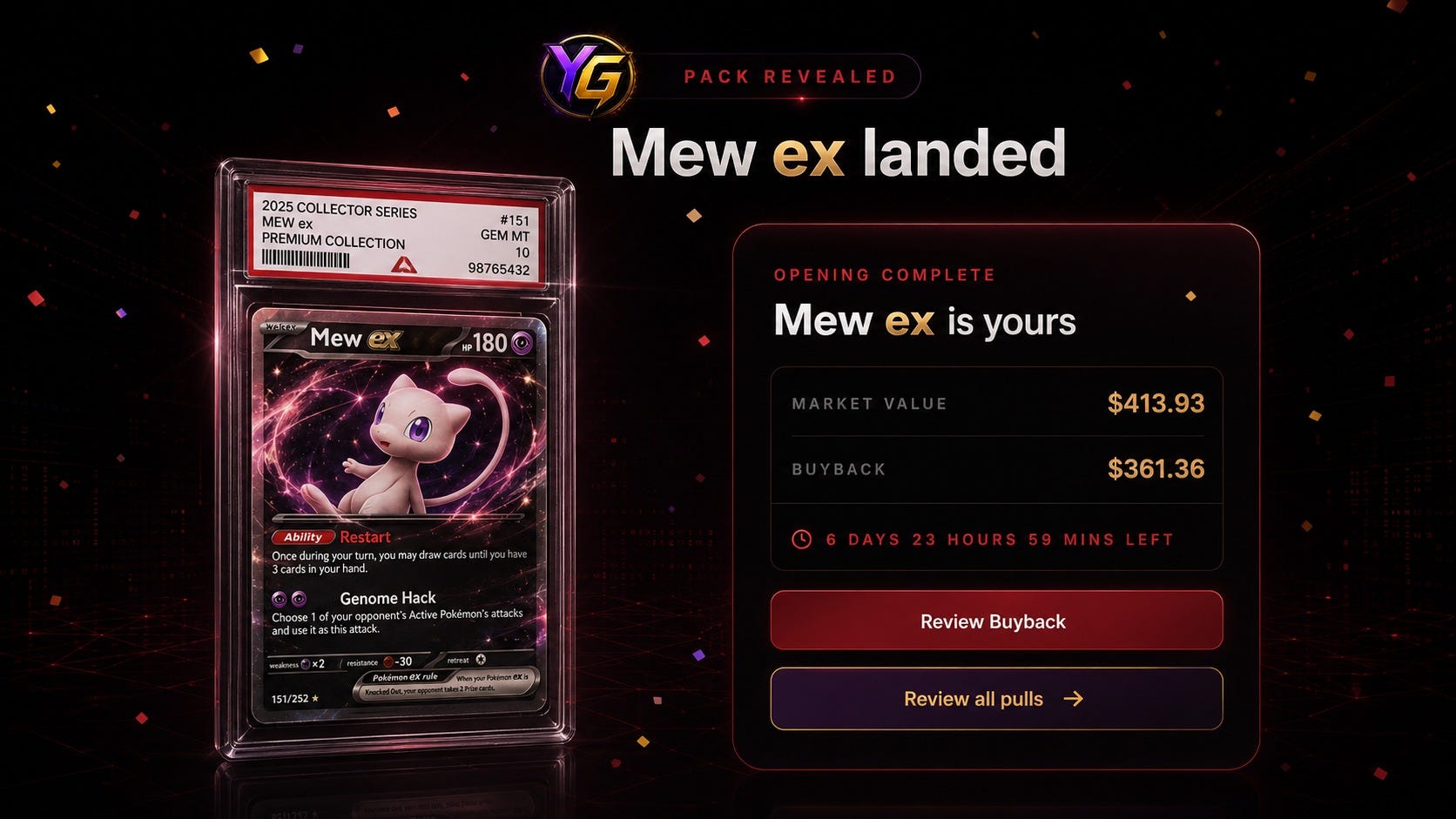
That nuance is important because the strongest version of YourGrails is not “open packs and make money.” That framing would be weak and probably wrong. The stronger framing is that YourGrails introduces a cleaner liquidity layer for physical collectibles. A collector can reveal a card and then decide whether to hold, list, sell back, use in platform mechanics, or redeem physically. That decision tree is much richer than the traditional experience of opening a physical pack, storing the card, and later trying to sell it through fragmented marketplaces.
Marketplace Liquidity
The marketplace turns YourGrails from a pack opening product into a secondary ownership layer. Users can list and buy Card Tokens, with transactions settling on Avalanche and ownership transferring onchain once payment is completed.
This makes vaulted collectibles easier to trade because the physical card does not need to move every time ownership changes. The Card Token can move instantly, while the card remains in custody until someone chooses redemption. That creates faster trading, cleaner ownership transfer, and better price discovery, as long as marketplace activity remains protected from wash trading, self dealing, and misleading listings.
Redemption Back to the Physical World
Redemption is what connects the onchain ownership layer back to the physical card. Users can request shipment of the underlying card they own by holding the Card Token, completing any required verification, providing shipping details, and covering the relevant fees.
Once redemption is confirmed, the Card Token is burned on Avalanche and the physical card is retrieved, inspected, packaged, and shipped. This burn to redeem model is important because it prevents the same collectible from existing as both a live digital ownership claim and a redeemed physical asset at the same time.
Pack Battles and Engagement Mechanics
Pack Battles add a more competitive layer to the YourGrails experience. Two users open packs of equal value, and the user with the higher total card value wins a bonus pack, while both users keep their original pulls.
The feature adds social energy and intensity to pack opening, but it also needs clear boundaries. YourGrails frames Pack Battles with age restrictions, jurisdiction responsibility, random outcomes, and no guarantee of profit, which is important for keeping the product both engaging and properly defined.
No Platform Token
One of YourGrails’ strongest design choices is that it does not rely on a platform token. Card Tokens represent beneficial ownership of real physical trading cards, not equity, profit share, or a claim against the company.
That makes the model cleaner. The value is centered on the card itself, while the utility comes from the product experience:
inventory
custody
fair reveals
marketplace liquidity
settlement
redemption
trust
YourGrails does not need a speculative token narrative to make the thesis work.
A Different Kind of Real World Asset
The broader thesis is that tokenization becomes more interesting when it attaches to assets people already understand. Real world assets are usually discussed through the institutional lens. Treasuries, private credit, money market funds, invoices, real estate, or structured products. Those categories matter, but they are not the only form of real world asset. A graded Pokémon card is also a real world asset. It has provenance, price history, authenticity requirements, custody needs, liquidity constraints, and emotional demand.
YourGrails applies onchain infrastructure to a category where the user does not need a long explanation of why the object matters. The card already matters. The question is whether the rails around the card can become better. That is where the product becomes strategically interesting. It connects consumer culture, physical collectibles, stablecoin settlement, NFT ownership, marketplace liquidity, and Avalanche infrastructure into one experience.
The Final Read
YourGrails is still early, but the early signal is already difficult to ignore.
More than $500,000 in pack volume during closed beta
Over 30,000 transactions
More than 700 battles
7,000 plus packs opened show that this is not only a concept living inside a deck or a landing page.
It is an actual collector loop being tested by real users, with real money, real graded cards, and real onchain activity.
After all the mechanics, the real test is simple, how does it feel when the theory becomes a pack opening?
The video below shows how the experience comes together, from opening a pack and revealing a card, to owning it onchain.
That matters because consumer crypto usually fails when the product asks users to care about infrastructure before they care about the experience. YourGrails does the opposite. It starts with something people already understand, the sealed pack, the reveal, the chase, the card, the collection. Then it adds the rails that physical collecting has always lacked: Avalanche settlement, verifiable randomness, Card Token ownership, custodial backing, marketplace liquidity, instant buyback, pack battles, and physical redemption.
The bigger story is not that every pack is a financial opportunity. That would be the wrong framing. The bigger story is that every pack becomes a more programmable version of a real collectible. A card can now move between emotion, ownership, liquidity, and infrastructure without losing the reason people cared about it in the first place.
If YourGrails can continue building trust, deepen inventory, improve valuation transparency, scale the marketplace, and make redemption feel seamless, it can become more than a digital pack opening platform. It can become a serious case study for how real world collectibles move onchain.
The next grail is not just something you pull. It is something you can own onchain, trade instantly, redeem physically and use inside a deeper collector economy.

Looking to join the global community live? Registration is now open for Avalanche Summit NYC. Secure your pass today for 2 days of exclusive keynotes and networking.