




Hyundai Card, the payments arm of Hyundai Motor Group, has completed its first stablecoin transfer pilot, which it announced in July. It moved $20,000 from Hyundai Motor America to Hyundai Motor Mexico using USDT on Avalanche. According to Hyundai Card, the whole process, from conversion into USDT to conversion back into dollars, took roughly seven minutes.
Heejung Nam, who leads the payments business at Hyundai Card, later clarified that the pilot was actually two transactions, one inside banking hours and one outside, and that seven minutes was the average. The announcement also noted that traditional interbank transfers would take around three to four hours. The two figures are not directly comparable, but the pilot shows that a cross-border transfer between two corporate entities can be completed in minutes.
What stands out is that this was not a test on a testnet. The funds were tied to a real payment need between two group subsidiaries, and Hyundai Card stressed that this was not a theoretical blockchain experiment. $20,000 is a small number for an automaker, but the pilot asks a very specific question: can stablecoins move corporate money across borders in a real business environment?
The Path of the Money
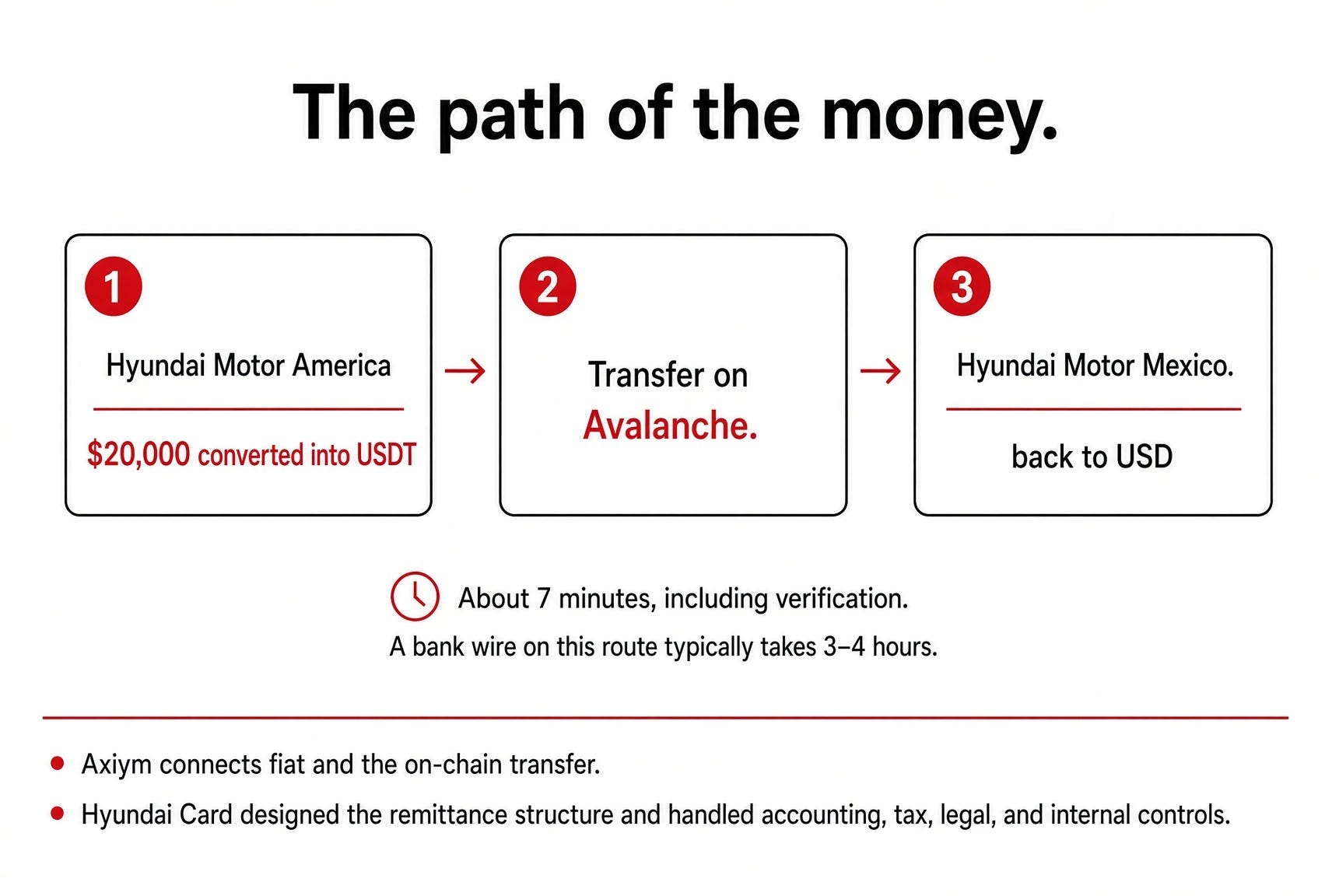
The money followed three steps. Hyundai Motor America converted $20,000 into USDT. The tokens were sent over Avalanche to Hyundai Motor Mexico. The receiving entity converted them back into US dollars. Hyundai Card measured the whole process, from transfer to verification, and it averaged about seven minutes. Hyundai Card ran one transaction during banking hours and another outside banking hours, so the pilot tested both situations. Each partner had a distinct role: Tether supplied the USDT, Avalanche served as the transfer rail, and Axiym provided the settlement platform that connects fiat money to onchain transactions.
But the hard part is everything that has to be done before anyone hits send. Hyundai Card designed the entire transfer framework and, together with Hyundai Motor, worked through the accounting, tax, legal and internal control requirements of the overseas entities in advance. A transfer inside a corporate group needs an accountable owner, a ledger entry, and a way to explain it to tax authorities and auditors. If a transaction is fast onchain but the books don’t match the next day, treasury will not use it a second time. That is why Hyundai Card took this work on itself rather than handing it entirely to an outside provider.
The Wait Is What Gets Cut
Intercompany transfers like this happen all the time. Their cost is not only the intermediary bank fees. It also lies in cut-off times, in the wait for funds to arrive, and in the need for both sides to reconcile which payments have actually been booked. Finishing a transfer in minutes does not make a corporation richer in a single day, but it suggests the waiting step can be cut.
Banking hours are a real constraint. Transfers stop at cut-off times, across time zones, and on the receiving country’s holidays, while two subsidiaries of the same group do not follow that calendar. A payment that needs to go out on a Friday evening can sit until Monday morning. A stablecoin transfer is not tied to that calendar, so it removes the window when banks are closed. In this setup, Avalanche handles the token transfer. Hyundai Card and Axiym still decide who can send, how the payment is booked, and who settles the fiat side. The transfer only works for treasury if an accountant can follow it.
What’s Next
Hyundai Card’s direction already goes beyond a single transfer. By September, it was talking about running the model as a treasury process, including transactions both inside and outside banking hours. When the U.S.-Mexico pilot was announced, the next step would be a test between Hyundai Motor entities in Europe, with Circle and Visa expected to take part. This time the test would not be limited to dollars: Hyundai wants to see transfers in other local currencies and measure the foreign exchange costs and compliance work that come with them.
It is important to be clear about what has not happened yet. As of October, the results of the European test have not been published, so it remains a stated direction, not a closed pilot. Hyundai has no rollout schedule for the whole group. Hyundai Card’s Heejung Nam was upfront about the pilot’s limits: the company has to prove that the whole operating model works at a larger scale, and $20,000 is only the first test.
The next test is whether Hyundai can run the same process at a larger scale, across different currencies and under different compliance requirements. The planned European pilot should help show what needs to change before the model can be used more widely.

Dive into the Avalanche ecosystem today! Download the Core Wallet and unlock a world of seamless DeFi, NFTs, and more.