



When Progmat completed its migration to Avalanche in July 2026, the headline number was ¥452 billion in digital securities, equivalent to roughly $2.7 billion at the time.
Progmat didn’t transfer $2.7B in cash; ¥452B is the total value of securities issued on its platform. That makes the migration less about capital moving between networks and more about changing the core technology underneath an operating financial market.
Progmat’s previous architecture was built on R3’s Corda 5, an enterprise distributed-ledger technology. It has since moved to a dedicated Avalanche L1, migrating its existing smart-contract functionality into an EVM-compatible environment while preserving the behaviour and specifications of existing issuances.
The transition was designed so participating institutions could continue using the platform without having to rebuild the financial products already running on it.
The ¥452 billion did not “move” in the crypto sense
When Datachain announced the original migration plan in February, it described more than ¥439.6 billion in digital securities on Progmat ST. By the time the migration was completed, the figure reported by Avalanche had risen above ¥452 billion in total asset value.
For a crypto user, “moving assets to another chain” normally implies a transaction: burn here, mint there, bridge there, or transfer tokens from one wallet to another.
A tokenized bond remains connected to the underlying financial instrument and the legal rights associated with it. Changing the distributed ledger used to record and administer that instrument does not, by itself, change the bond.
The closer analogy is a financial institution modernizing its core technology while keeping its customer-facing services running. Commonwealth Bank of Australia, for example, has undertaken large-scale modernization of core banking infrastructure by moving critical systems to cloud infrastructure. Customers don’t need to understand the technology behind their accounts; the bank’s job is to upgrade it without disrupting reliable services.
That is the paradox of critical financial infrastructure: the more successful the migration, the less visible it can be.
Rebuilding the infrastructure underneath the securities
One of the more important pieces of the architecture is the mediation layer between Progmat’s applications and the underlying blockchain infrastructure.
Its purpose is to separate the financial services and business logic from the specific ledger supporting them. Rather than designing every application around one blockchain, Progmat can introduce an abstraction between its applications and the networks underneath them.
For the current migration, that means the digital-securities platform can run on Avalanche while maintaining the same expected behaviour for existing issuances.
For future development, it creates another possibility: Progmat can interact with more than one blockchain without treating every network change as a complete redevelopment of the platform.
The diagram below shows how that separation looks in practice.
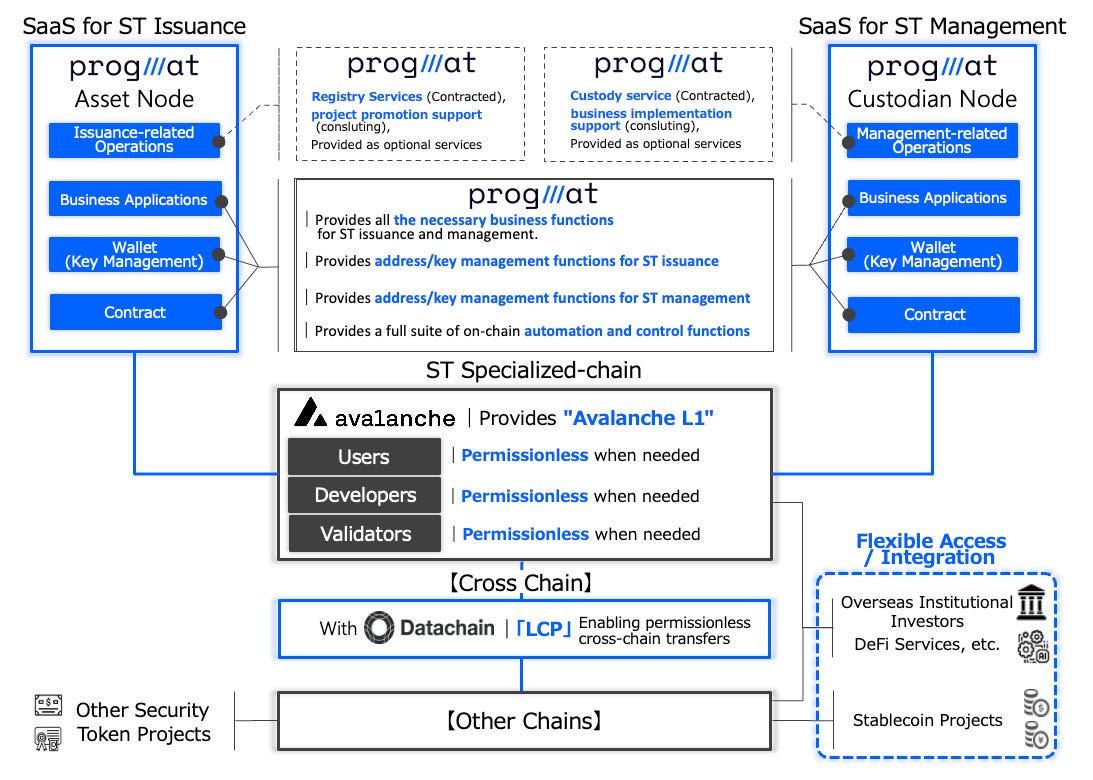
At the top sit Progmat’s two SaaS layers: an Asset Node for issuance and a Custodian Node for management, each with its own business applications, wallet and key management, and contracts. Beneath them, the securities run on a dedicated Avalanche L1, which the diagram labels as permissionless when needed for users, developers and validators. To the side, Datachain’s LCP is designed to connect that L1 to other chains, giving Progmat a route to other security token projects, stablecoin projects and overseas institutional investors without rebuilding the platform.
That raises the question of what this means for the settlement side of securities transactions.
Japan’s Financial Services Agency, the country’s financial regulator, is already supporting an industry experiment to test blockchain-based settlement across Japanese government bonds, corporate bonds, investment trusts and equities, with stablecoins used to connect the securities transfer with payment.
The objective is delivery-versus-payment, or DvP: the security and the corresponding payment are exchanged together. For example, rather than a buyer’s payment being processed separately from the transfer of a tokenized bond, the two could occur as part of the same coordinated transaction. This can reduce settlement risk and operational complexity and potentially allow securities transactions to operate beyond traditional market hours.
That puts Progmat’s migration in a broader context: the value of moving securities to programmable infrastructure may go beyond tracking ownership to connecting it with other parts of the transaction.
Progmat and Datachain have identified cross-chain DvP between security tokens and stablecoins as part of their broader strategy. But that should not be confused with what the July migration itself delivered. The migration established the new underlying infrastructure; broader cross-chain settlement capabilities remain a future development.
Settlement also depends on the payment side, and Japan’s stablecoin market is where the constraint sits. The map below shows where things stand.
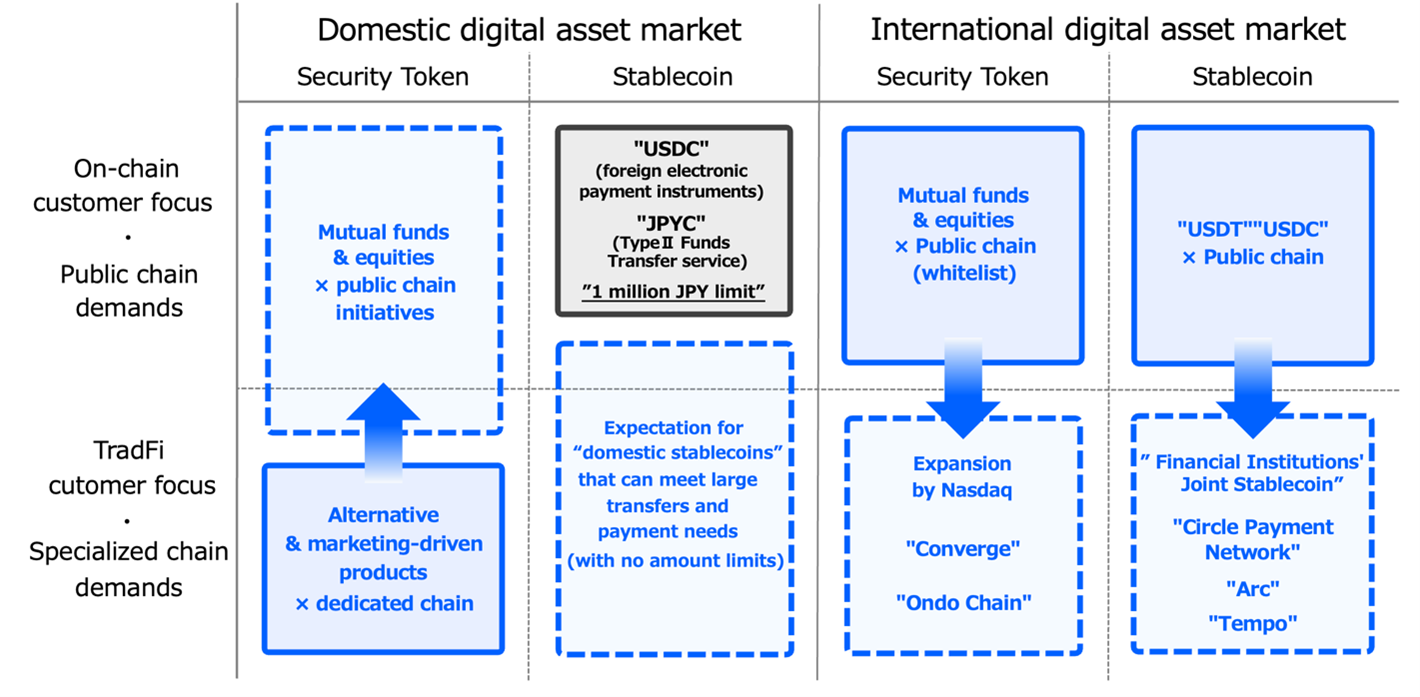
The market map shows the gap: international markets are already building dedicated chains for security tokens and stablecoins, while in Japan current stablecoin options like JPYC are capped at 1 million JPY. Until domestic stablecoins can handle large transfers, cross-chain DvP remains a goal rather than a live capability.
So what did Progmat gain?
The company says rights-transfer processing is now approximately three to five times faster than before, with transaction finality under two seconds. It has also said that new participating institutions no longer need to operate dedicated Corda nodes.
Those performance figures are company-reported, and there is not yet an independent public benchmark demonstrating how the new system performs across the entire settlement process, including the off-chain processes that financial institutions still need to complete.
The removal of dedicated Corda-node requirements could nevertheless have an important operational effect. Institutions joining the network no longer have to take on the infrastructure, security, maintenance and technical-support requirements associated with running those specialized nodes.
That could make participation easier as the number of institutions using the platform grows.
AvaCloud’s role is relevant here because financial institutions generally need more than raw blockchain performance from a technology provider. Avalanche has highlighted SOC 1 and SOC 2 Type II attestations associated with the infrastructure supporting Progmat, addressing the kind of controls and assurance that enterprise customers tend to demand.
The platform is also beginning to be tested beyond the securities included in the July migration. On September 3, Progmat and three MUFG companies announced a proof of concept for a domestically registered tokenized investment trust, with the experiment taking place in a live operating environment.
The project is designed to test the practical operation of the fund, including asset management, custody, rights administration and the systems supporting tokenization.
That moves the proposition beyond simply putting an existing security onchain. It begins testing whether programmable infrastructure can support more of a financial product’s lifecycle.
It is still only a proof of concept, so it is too early to treat it as evidence of mass adoption. But it shows that Progmat can begin testing with an architecture that is no longer as tightly tied to its previous ledger environment.
What the migration actually accomplished
There is a tendency to measure blockchain adoption through the amount of money placed on a network but this shows why that metric can be misleading in institutional markets.
The more meaningful measure is what happened to the financial infrastructure supporting that value.
Progmat is not simply building another securities platform tied to a single blockchain. Instead, it separates the platform from the underlying network, creating a different performance profile, lowering the infrastructure requirements for new participants and giving applications greater flexibility over which networks they can run on.
That may ultimately be the more important lesson from the migration.
The migration itself shows what financial institutions may ultimately want from blockchain technology: not a new market every time the technology changes, but infrastructure that can evolve without forcing the market to change with it.
Dive into the Avalanche ecosystem today! Download the Core Wallet and unlock a world of seamless DeFi, NFTs, and more.