



Pangolin is one of Avalanche’s earliest decentralized exchanges, having launched during the explosive AMM boom of 2021. While many DEXs faded after incentive programs dried up, Pangolin survived multiple market cycles and continued generating real, consistent on-chain activity.
Pangolin is no longer just a legacy AMM. With the release of Pangolin V3 and the launch of Perpetual Futures (Perps), the protocol has entered its most transformative era yet.
This report explores:
Core AMM mechanics
Liquidity depth and market performance
PNG token economics
The new V3 liquidity engine
Perpetual Futures and their economic importance
Pangolin’s strengths, challenges, and long-term outlook

Core Protocol Architecture: How Pangolin Works
AMM Foundation
Pangolin operates as an Automated Market Maker (AMM), where users trade against liquidity pools instead of order books. This model enables:
Permissionless swaps
Continuous liquidity
Predictable mathematical pricing
Avalanche-Native Advantages
Avalanche provides Pangolin with key structural benefits:
Fast finality
Low gas fees
High throughput capacity
Smooth UX through Core Wallet and other integrations
These properties position Pangolin as a cost-efficient, high-speed DEX suitable for both retail and professional flows.
PNG Token Utility
The PNG token functions as:
A governance and voting token
An incentive mechanism for LPs
A long-term alignment tool for the protocol and its community
This remained largely unchanged until Pangolin’s two major upgrades: V3 and Perps.
If you are considering staking PNG, the latest update may be relevant.
Pangolin has adjusted its reward and fee distribution mechanics, resulting in improved earnings for users who stake PNG.
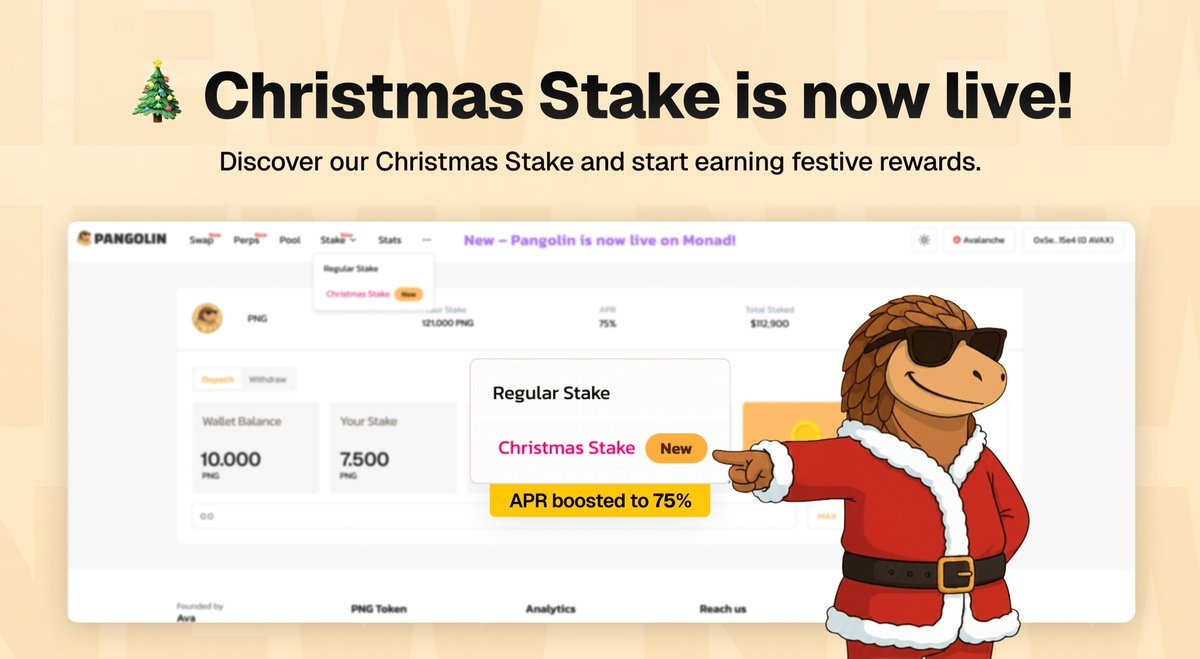
You can review the updated details here → http://app.pangolin.exchange
Liquidity Profile: Understanding Pangolin’s Market Depth
Pangolin’s most active liquidity pools include:
AVAX / USDC
PNG / AVAX
USDC.e / USDT
WETH / USDC
These pools anchor the protocol’s routing and volume.
Liquidity is deep enough for mid-sized trades, though not equivalent to the largest AMMs on Avalanche. This context makes V3’s efficiency upgrades especially important, allowing Pangolin to amplify liquidity depth even without substantial TVL increases.
Pangolin V3: A Structural Upgrade, Not a Cosmetic One
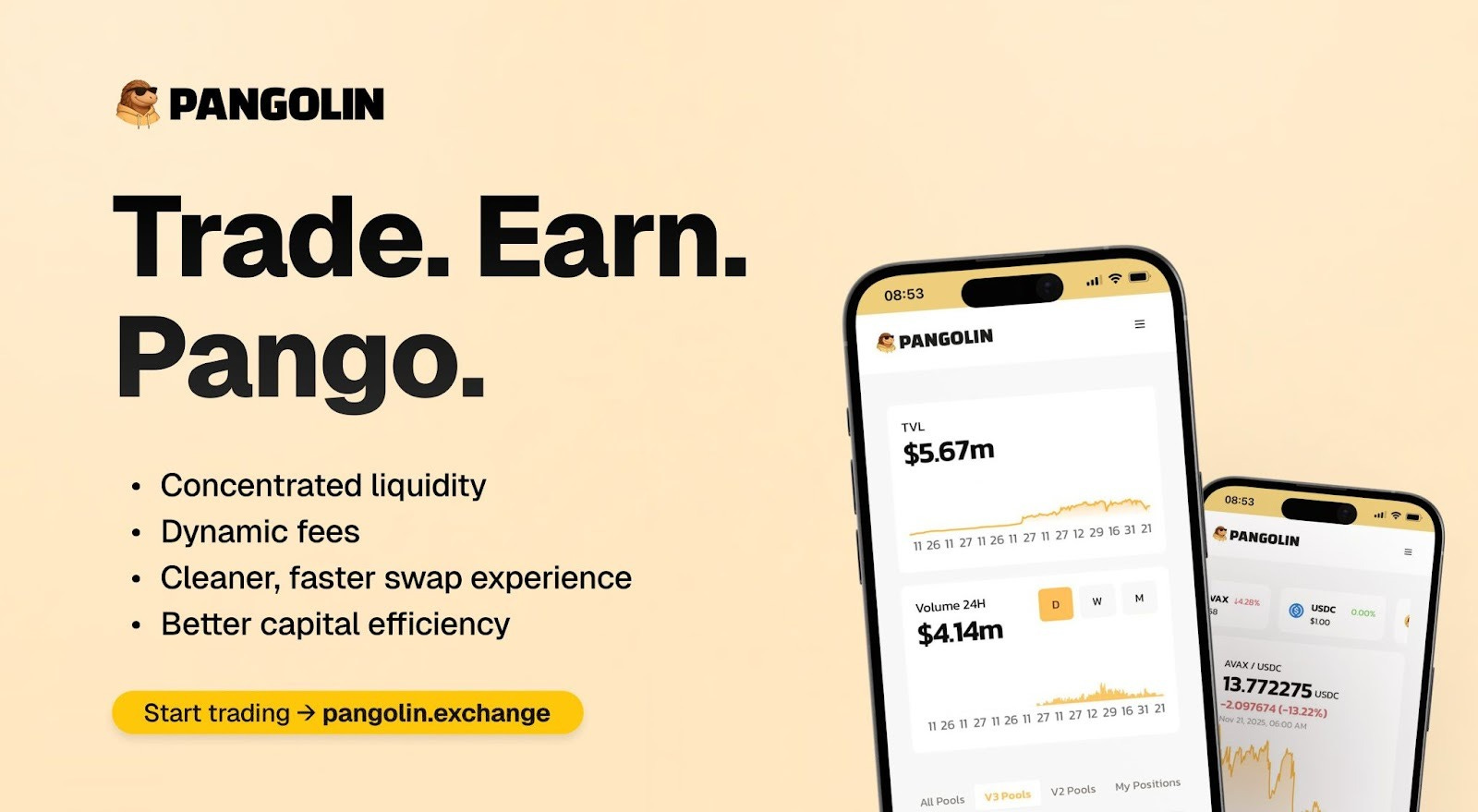
Pangolin V3 represents a complete redesign of the protocol’s liquidity engine. It introduces advanced AMM features seen in industry-leading DEXs and transforms Pangolin into a capital-efficient, customizable liquidity platform.

Concentrated Liquidity: The Core of V3
Liquidity providers (LPs) can now deploy capital within specific price ranges.
This results in:
Greater capital efficiency
More depth per unit of TVL
Higher potential fee earnings
Improved execution for traders
For a protocol with modest TVL, concentrated liquidity is a powerful equalizer.
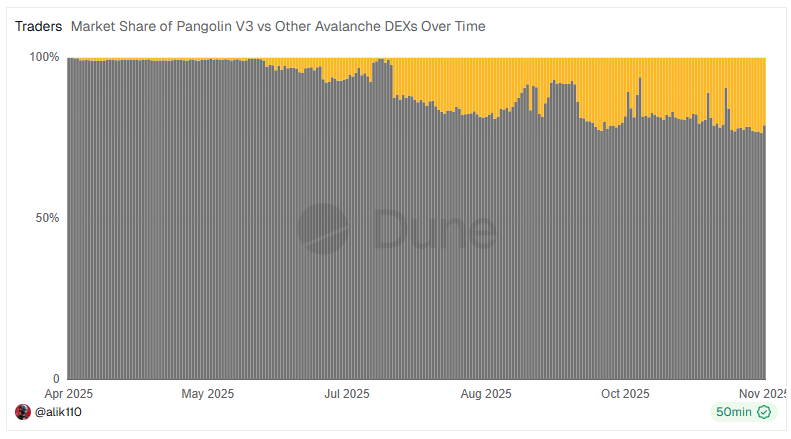
Pangolin’s market share on Avalanche DEXs has increased from 10% at V3 launch in July 2025.
Dynamic Fees
Pangolin V3 introduces variable swap fees that adjust automatically according to:
Market volatility
Liquidity conditions
Trading behavior
LPs earn more during high-risk conditions, while traders enjoy lower fees during stable market periods.
Multiple Fee Tiers
To accommodate different asset profiles, V3 introduces multiple fee tiers:
Ultra-low fees for stable pairs
Moderate tiers for blue-chip assets
Higher fees for volatile tokens
This allows Pangolin to optimize liquidity across a wide spectrum of markets.
In-Range Farming & Superpools
To complement concentrated liquidity, V3 adds:
In-range farming (rewards only when LP capital is active)
Superpools offering dual-token or boosted incentives
A deeper, strategically deployed liquidity model
This shifts Pangolin from passive AMM liquidity to intelligent, curated liquidity.
Risks Introduced by V3
While V3 offers major improvements, it also introduces:
Higher operational complexity for LPs
Potential liquidity fragmentation
The need for active range management
Variable fees that may impact predictability for traders
Despite these challenges, V3 positions Pangolin on par with modern AMMs and ready for its next evolutionary step.
Perpetual Futures: Pangolin’s Most Ambitious Expansion
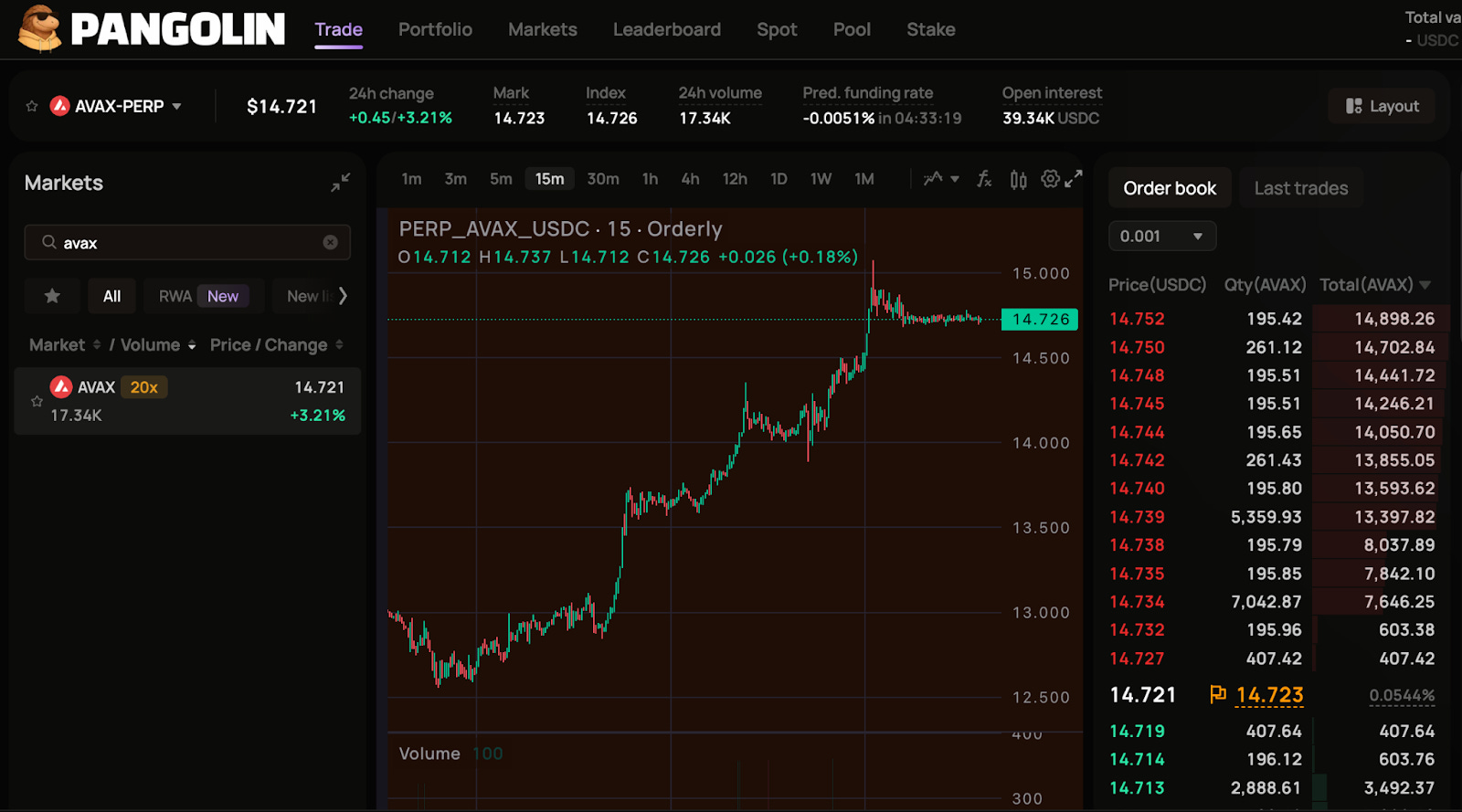
The launch of Perpetual Futures (Perps) marks Pangolin’s entry into the derivatives market, the most revenue-rich sector in on-chain trading.
Perps enable:
Long and short positions
Leveraged exposure
No expiry
High-frequency trading
These features fundamentally redesign Pangolin’s market identity.
Why Perps Matter
Perpetual DEXs like GMX, dYdX, Hyperliquid, and Vertex have demonstrated that:
Perp traders are more active
Derivatives generate higher sustained revenue
Protocols become less dependent on TVL
Growth accelerates through professional trader acquisition
Introducing Perps allows Pangolin to tap into a significantly larger opportunity segment.
Perps Engine: How It Works
Pangolin’s Perps system uses:
Oracle-based pricing
Leverage options (typically 10–50x)
Funding rates balancing long/short demand
Multi-layered fee generation
Risk management tools for market exposure
This model aligns Pangolin with modern derivatives platforms rather than classic AMMs.
Economic Impact of Perps
Perps bring powerful economic advantages:
Multiple fee streams → higher protocol revenue
Higher trading volume → deeper liquidity network effects
Professional traders → stronger market identity
Reflexive growth loop: more traders → more liquidity → better execution → more traders
With Perps, Pangolin moves from a single-product DEX to a multi-product trading platform.
Strengths, Risks, and Strategic Outlook
Strengths
Modern architecture combining V3 + Perps
Real, persistent organic usage
Avalanche-native execution speed
High upside due to small market cap
Broader appeal for LPs, traders, and advanced DeFi users
Risks
Higher complexity for LPs using V3
Competition from other AMMs and Perp DEXs
Liquidity fragmentation in narrow ranges
Oracle and liquidation risks introduced by Perps
Conclusion
Pangolin is undergoing the most transformative evolution in its history. What started as a simple AMM has evolved into:
A capital-efficient V3 DEX,
A full-featured derivatives venue,
A multi-product exchange capable of competing with modern DeFi leaders.
Despite its relatively small size, Pangolin now operates with a sophisticated architecture and a broader market footprint. Adoption across 2025–2026 will determine how far this transformation carries the protocol, but the groundwork for real growth has already been laid.
Dive into the Avalanche ecosystem today! Download the Core Wallet and unlock a world of seamless DeFi, NFTs, and more.
go pango go