




Nansen recorded 48.4 million transactions, down 33% from the previous 30 days. At the same time, DEX volume climbed to $2.7 billion, up 145%, while active users increased 8.1% to 1.6 million.
So Avalanche was not simply quieter. There were fewer transactions in Nansen’s dataset, but much more trading volume. Users still grew, capital continued moving through the ecosystem, and activity across individual Avalanche L1s adds another part of the picture.
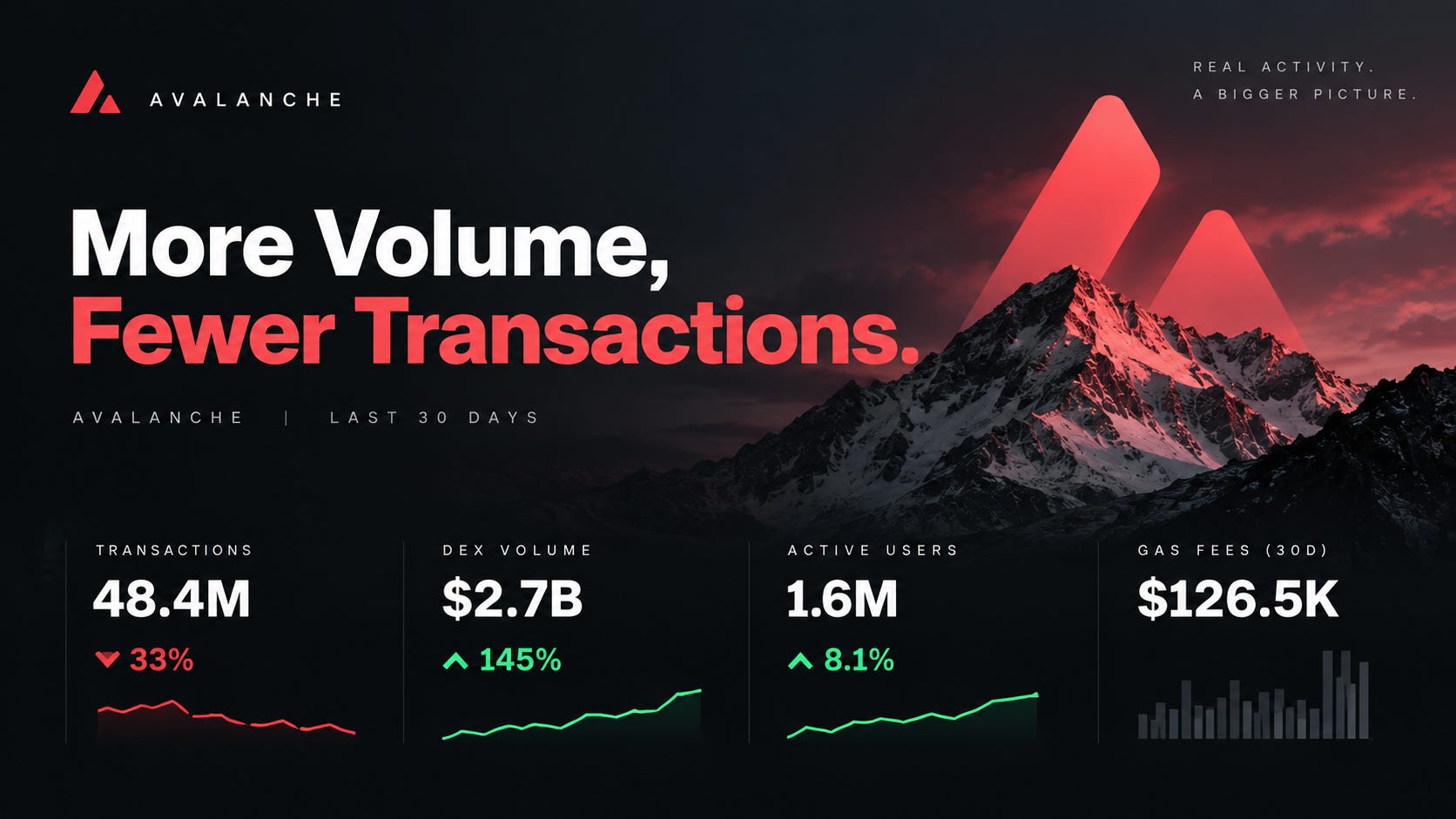
Trading picked up fast
The biggest change is DEX volume. WAVAX alone accounted for around $2.5 billion, with roughly $1.3 billion in buys and $1.3 billion in sells.
Active users also moved higher, reaching around 1.6 million, up 8.1% from the previous period. If that user growth continues while transactions stabilize, this month may end up looking more like a change in how Avalanche is being used than a simple drop in activity.
AVAX and WAVAX are moving differently
Around $4.6 million of native AVAX left exchange wallets over the latest seven days. WAVAX went the other way. Around $12.3 million moved into exchanges, while Top PnL wallets reduced their WAVAX positions by roughly $2.2 million.
Native AVAX is moving away from exchanges while WAVAX is moving toward them. At the same time, WAVAX remains extremely active on DEXs. For now, it looks more like capital moving around the ecosystem than everyone taking the same position.
Fresh wallets are still bringing money in
Fresh wallets added approximately $20.8 million in AVAX over seven days. Another $16.3 million went into WAVAX. Those are meaningful inflows, but both were below their normal levels. AVAX was running at around 0.6x its average flow, while WAVAX was around 0.4x.
New wallets are participating, just not at an unusually high rate. There is fresh capital coming in, but this does not look like another sudden wave of adoption.
BTC.b is still doing real volume
BTC.b continues to be one of the more active parts of Avalanche DeFi. It recorded around $238.8 million in DEX volume over 30 days, with approximately $1.3 million in net flow.
Over the latest seven days, BTC.b generated another $60.9 million in volume, with $31.5 million in buys and $29.4 million in sells.
There is no major imbalance between buyers and sellers. It is simply an active market.
Bitcoin liquidity gives Avalanche another source of capital beyond AVAX and stablecoins, and BTC.b is still moving through the ecosystem rather than simply sitting in wallets.
sAVAX looks steady
sAVAX has around 16,609 holders, approximately $169.8 million in market cap, and roughly $2.2 million in liquidity. Seven-day volume was around $743,000, with approximately $424,000 in buys compared with $319,000 in sells.
There is no obvious new staking surge here. But sAVAX does not need explosive trading volume to remain useful. Its role is still the same: letting AVAX holders earn staking yield while keeping their capital available elsewhere.
This month, it looks steady.
BUIDL is becoming part of a bigger institutional story
Around $564 million of BlackRock’s BUIDL is currently on Avalanche. DefiLlama independently shows almost the same figure, and its chain breakdown places Avalanche among BUIDL’s largest deployments.
That balance is lower than the $900M+ Avalanche briefly held during the summer, but the institutional story has become broader than BUIDL alone.
In July, Securitize launched tokenized SECZ shares on Avalanche and Solana when the company went public. Then in August, Securitize and Neuberger launched the HINC fixed-income fund across Avalanche, Ethereum, Solana and Sui.
More recently, IXS launched a high-yield corporate bond vault on Avalanche backed by BlackRock’s SHYG ETF. So the institutional story on Avalanche is starting to look broader than one tokenized Treasury fund.
There are now examples of tokenized Treasuries, public equities and fixed income using Avalanche infrastructure.
BUIDL was one of the first big proofs that institutional-scale assets could live on Avalanche.
Avalanche activity goes well beyond C-Chain
Avascan’s rolling 30-day figures currently show GUNZ at roughly 12 million transactions, Dexalot at around 6.9 million and Henesys at around 4.6 million. Because these are rolling figures, they change every day.
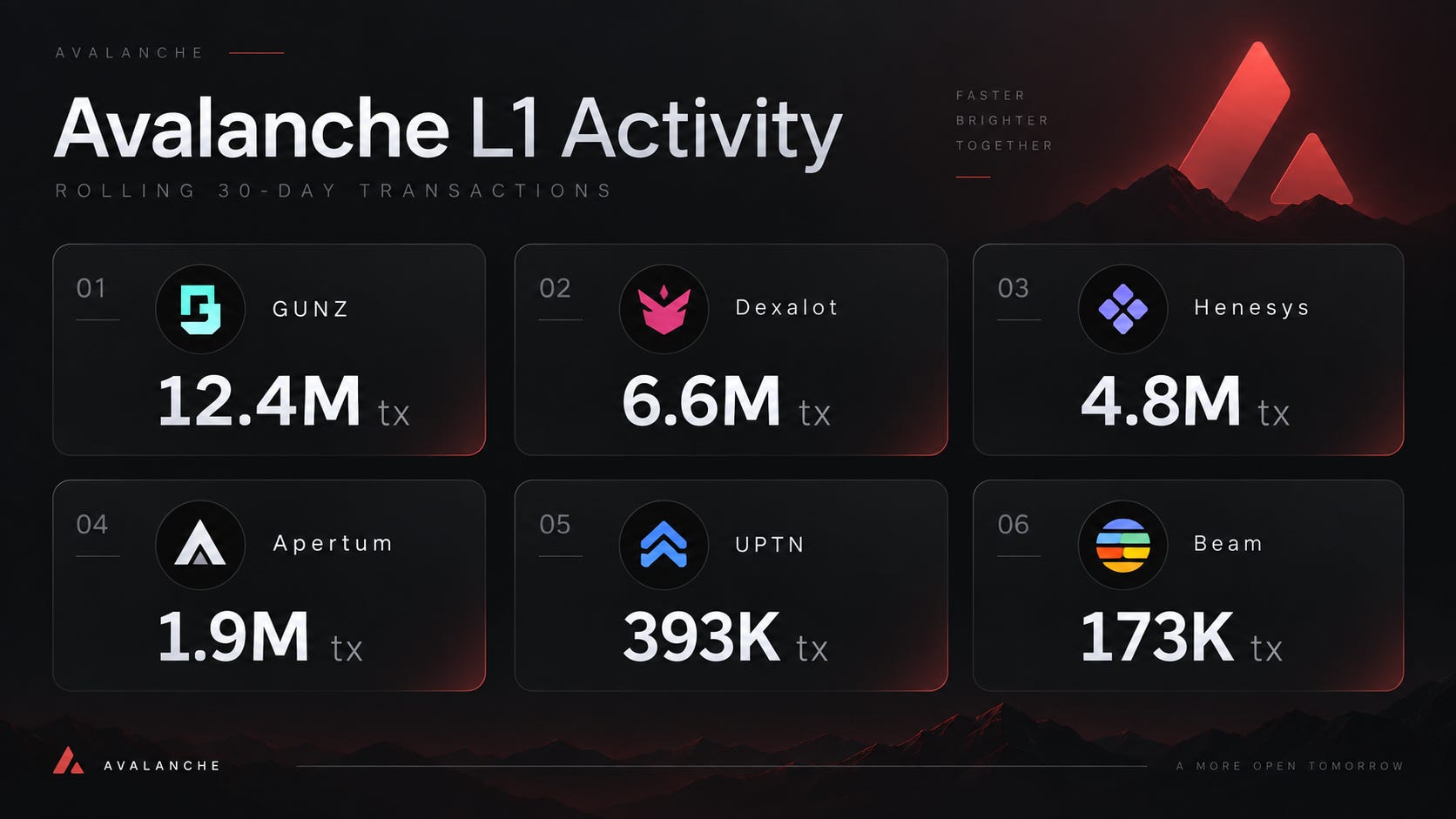
And those networks are doing very different things. GUNZ is built around gaming. Dexalot runs an onchain order book on its own Avalanche L1. Henesys powers the MapleStory Universe ecosystem.
That is what makes the L1 numbers interesting.
C-Chain is still central to Avalanche, but it is no longer the whole story.
Purpose-built Avalanche L1s are already processing millions of transactions a month across gaming, trading and other applications. The L1 strategy is no longer just something to talk about in terms of architecture. There is real activity behind some of these networks.
Where Avalanche stands now
This month looks less like a slowdown and more like a shift in where the activity is happening.
DEX volume is up
active users are higher
BTC.b remains active
institutional assets are expanding beyond BUIDL
Avalanche L1s are already processing millions of transactions of their own
The network is becoming broader, more specialized and more useful across different types of applications.
Avalanche is not just growing on one front anymore. It is building several at once.
Dive into the Avalanche ecosystem today! Download the Core Wallet and unlock a world of seamless DeFi, NFTs, and more.