




More than 15 million academic records are now live on Avalanche’s C-Chain. The Kenya National Examinations Council projects the total will reach roughly 35 million as that rollout continues. KNEC and Avalanche announced the deployment on Monday, and it’s already one of the largest government-backed deployments on the network to date.
The headline numbers:
15 million-plus records already integrated onto the C-Chain, the figure KNEC and Avalanche confirm as currently live
35 million records projected as the rollout continues
Records dating back to 1989, covering KCPE, KCSE, diploma, and teaching certification data
Close to 1 million KCSE 2025 certificates already distributed exclusively through the new e-certification system

The problem this solves
Kenya has struggled with certificate fraud for years. Thousands of forged academic documents surface annually, ranging from fabricated diplomas to altered exam results, and the damage runs deep. Employers hire unqualified staff, universities admit students on fake transcripts, and legitimate graduates end up competing against paper that was never real. Verifying a certificate the old way meant a slow, manual back-and-forth with KNEC, often taking weeks. None of that scaled to a system managing exam records for a country of more than 50 million people.
What KNEC built
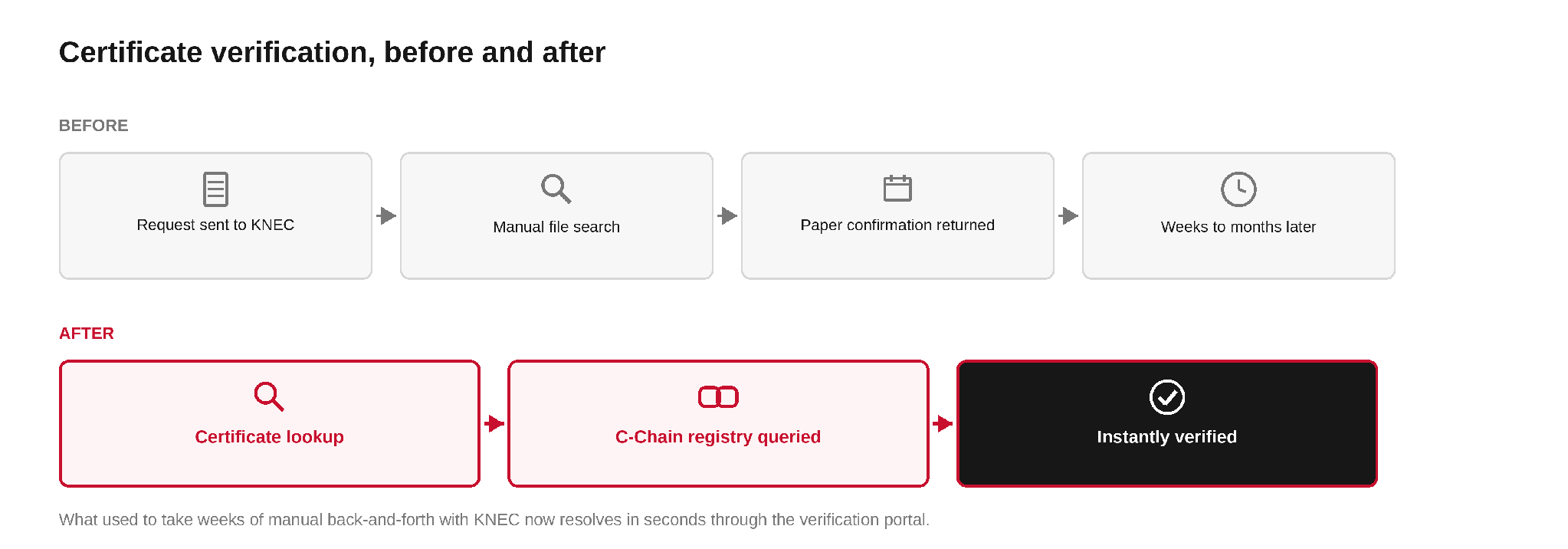
The system converts each historical and current examination record into a blockchain-secured asset on Avalanche’s C-Chain, built in partnership with local technology provider LegitDoc. That creates a registry institutions can query instantly, replacing manual confirmation from examination authorities. Every certificate becomes independently verifiable, so an employer or university can confirm it against the onchain record directly, without needing to trust whoever is holding the physical copy.
What this unlocks:
Employers, universities, and government agencies can verify a certificate’s authenticity directly through the verification portal, without contacting KNEC
No paperwork trail for fraudsters to exploit, since the source record lives onchain, not in a filing cabinet
Every newly issued certificate now follows the same onchain path, starting with the 2025 KCSE cohort
Verification that used to take weeks now happens in seconds through the verification portal
The rollout also fits into a wider push by the Kenyan government toward digital identity infrastructure. KNEC has been involved in earlier pilots covering digital credential wallets and verifiable credentials for public services, and this deployment builds directly on that groundwork.
Why C-Chain, and not a dedicated Avalanche L1
KNEC anchors verification proofs, not full certificate data or personal records, to Avalanche’s C-Chain using a Merkle-tree structure. That distinction matters for the infrastructure decision. A dedicated Avalanche L1 makes sense when an application needs custom execution rules, a private validator set, or throughput a shared chain can’t offer. KNEC’s workload doesn’t hit those limits. Verification proofs are small and don’t demand the transaction volume that would justify standing up dedicated validators.
The C-Chain gave KNEC three practical advantages instead. It’s public and permissionless, so any employer, university, or agency can query the registry without needing special access or KNEC’s cooperation. It’s already built out with explorers, indexers, and wallet support that a new L1 would need to recreate from scratch. And the Etna upgrade cut C-Chain base fees by roughly 25 times, making it cheap to anchor tens of millions of records without the ongoing validator costs a dedicated chain would carry. For a government registry meant to be checked openly by the public, those trade-offs favor the shared chain.
Why this matters for Avalanche
Putting records onchain changes what tampering requires. Altering a paper certificate or a siloed database entry can come down to bribing a clerk or forging a signature. Once a record is anchored to the C-Chain, an attacker has to break the cryptography instead, which is a far harder problem to solve.
For Avalanche, this is a live demonstration that its infrastructure can handle national-scale public records alongside its DeFi activity. It’s a use case built for permanence and verification, and it shows the C-Chain holding up under a workload most blockchains never get tested against: tens of millions of records tied to a country’s entire education system, with millions more added every year as new students graduate.
Why Kenya keeps choosing Avalanche
KNEC’s rollout doesn’t stand alone. It’s part of a broader pattern of governments turning to Avalanche for records that need to be fast, auditable, and resistant to tampering.
Other government deployments on Avalanche:
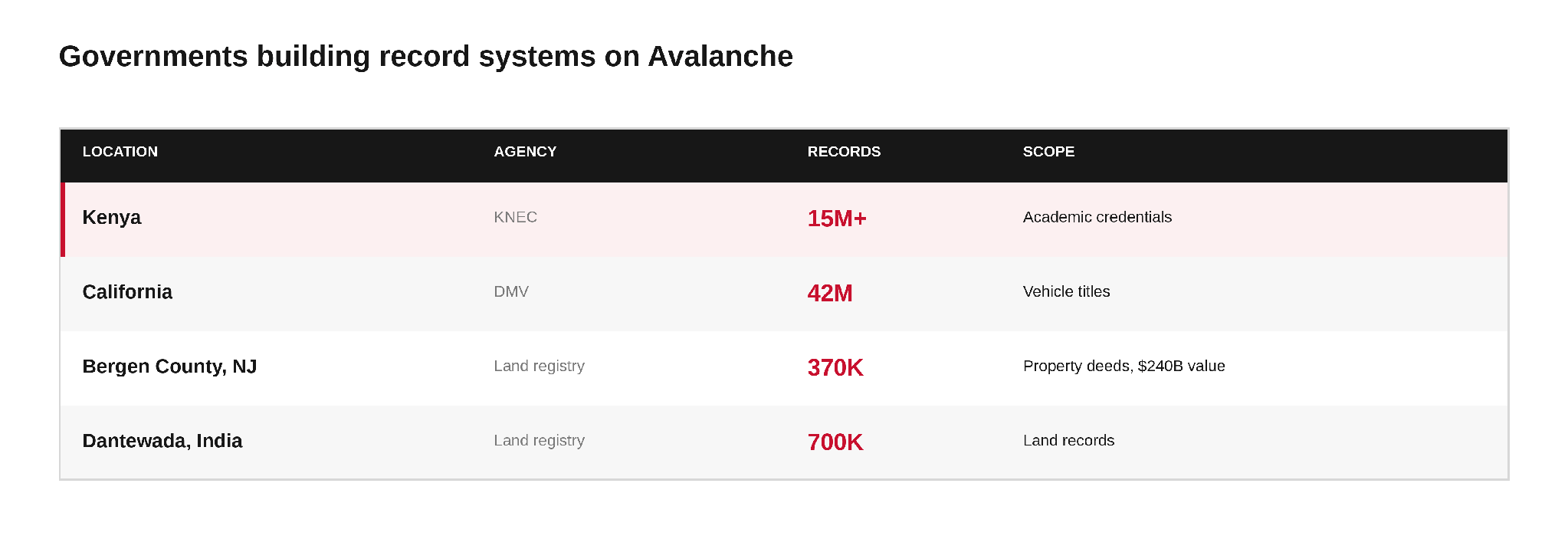
California DMV: 42 million vehicle titles digitized to fight lien fraud
Bergen County, New Jersey: 370,000 property deeds tokenized, representing $240 billion in real estate value, the largest blockchain-based land registry project in U.S. history
Dantewada, India: 700,000 land records digitized, cutting verification times from weeks to under a day
Kenya: 15 million-plus academic credentials, now added to that same trend line
Academic credentials are the latest sector where Avalanche is becoming the default choice for record integrity. The common thread across these deployments is the underlying need: institutions with millions of records that have to stay accurate, auditable, and resistant to tampering for decades.
What this means for builders
A national credential system running on the C-Chain gives Avalanche builders a concrete reference point for government-grade verification infrastructure.
Why it matters for anyone building in this space:
Proof that public-sector deployments at this scale are workable on Avalanche today, not a future roadmap item
A real deployment to study for anyone building identity, credentialing, or verification tools
A live system already processing certificates for millions of students and institutions, with a clear growth path built in from day one
KNEC and Avalanche haven’t disclosed adoption figures yet, meaning how widely employers and universities are actually using the verification portal, but the infrastructure itself is live and running today. That’s the part builders can study right now.

Looking to join the global community live? Registration is now open for Avalanche Summit NYC. Secure your pass today for 2 days of exclusive keynotes and networking.
Nice Read!