



Helicon went live on Avalanche mainnet on September 22, activating six Avalanche Community Proposals: ACP-194, ACP-236, ACP-267, ACP-273, ACP-283 and ACP-285.
The upgrade reshapes two key areas of the network in particular. The C-Chain gets a new execution model and a new way of managing its minimum gas floor, while validators get shorter staking periods, automatic renewal and changes to the reward curve.
Continuous Execution Changes the C-Chain
One of the biggest changes in Helicon is how the C-Chain processes transactions. Instead of making the network wait for execution to finish at every step, Continuous Execution separates consensus from execution. New blocks can continue moving through the network while earlier blocks are still being executed.
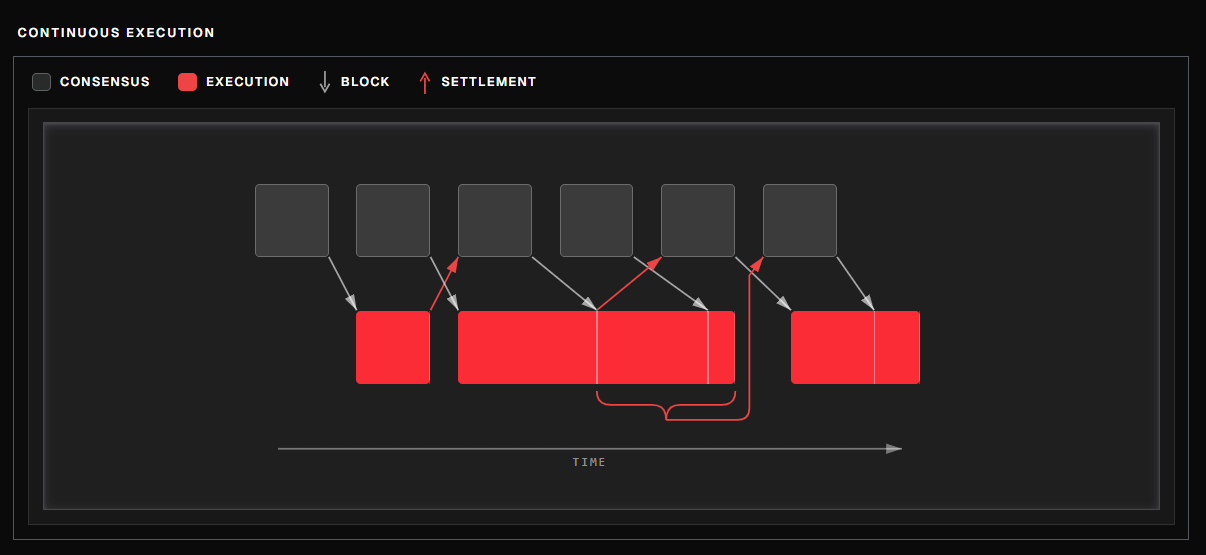
The goal is to remove a bottleneck and give the C-Chain more room to handle periods of high activity. For everyday users, most of this happens behind the scenes.
Developers and infrastructure providers do need to account for a change in timing, though. A transaction can be included in a block before its state changes have finished executing, creating a short gap between block inclusion and the state becoming available. RPC providers, indexers and applications that depend on immediate state updates need to handle that distinction.
The C-Chain Gets a Dynamic Gas Floor
ACP-283 changes another long-standing C-Chain assumption.
The network previously had a fixed 1 wei minimum gas price. Helicon replaces that fixed floor with a validator-governed minimum based on stake-weighted validator preferences.
The floor starts at 1 wei and can change over time. Validators can influence the minimum gas price, allowing the floor to respond to changing network conditions rather than staying permanently fixed.
For most users, this should happen without any change to how they use their wallets. Developers and RPC providers, however, should no longer assume that 1 wei will always be the minimum.
Validator Staking Drops to 48 Hours
Helicon makes its most significant changes on the validator side by pairing shorter commitments directly with automation. ACP-273 cuts the minimum validator staking period from two weeks to 48 hours, while ACP-236 introduces auto-renewed staking so operators can set custom cycle lengths and automatically compound rewards.
The two proposals belong together. Without auto-renewal, a 48-hour minimum would force continuous node operators to manually submit new staking transactions every two days, trading capital flexibility for constant operational overhead. Auto-renewal eliminates that friction, giving operators more flexibility over locked capital without requiring them to repeatedly manage new staking periods. Delegators, however, do not get the same treatment: their minimum duration remains two weeks, and delegations cannot auto-renew. Delegators also remain subject to the lower reward rates introduced by ACP-285.
At the same time, this increased capital flexibility comes with tighter performance demands. ACP-267 raises the minimum uptime threshold for new staking periods from 80% to 90%. Because missing the threshold results in forfeiting the entire cycle’s yield rather than receiving a partial payout, maintaining high-availability infrastructure becomes critical, especially for operators running shorter staking windows.
Staking Rewards Now Favour Longer Commitments
ACP-285 changes the other side of that equation by making shorter staking periods less rewarding.
The mean consumption rate moves from 10% toward 7.5% over a 90-day ramp. The rate in effect when a new staking period begins is locked for that period.
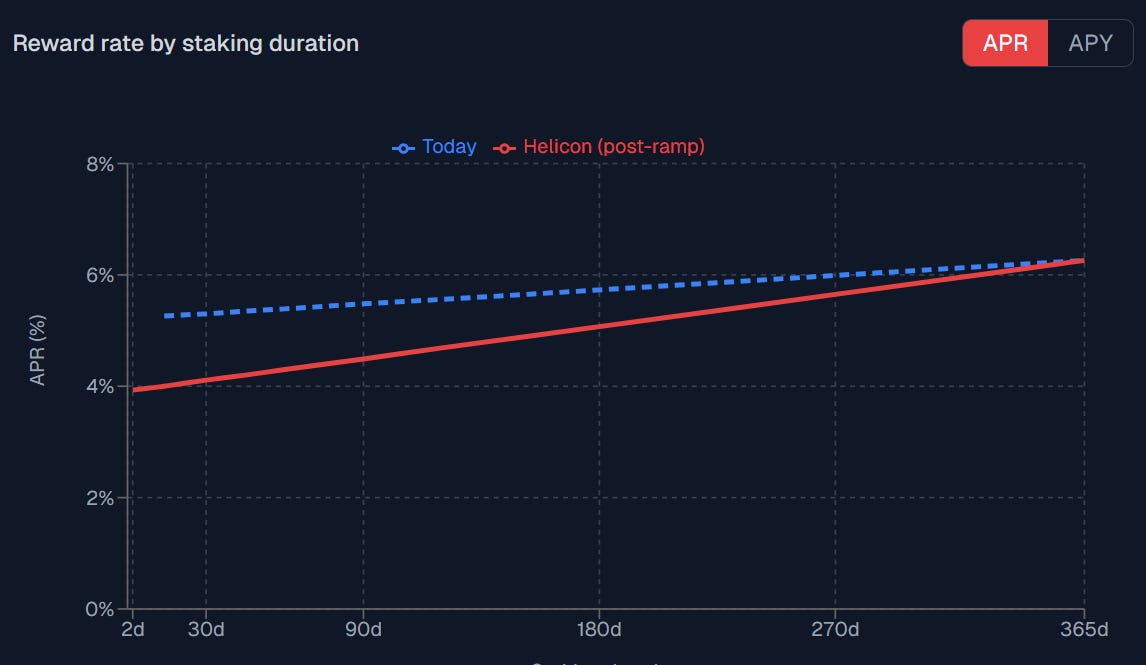
In practical terms, the shortest staking periods see the biggest reduction while the one-year maximum remains unchanged. Avalanche’s modelling in ACP-285 puts the 14-day annualized reward rate at roughly 5.4% initially, moving toward about 4.1%, while the one-year rate remains around 6.4%.
The model also estimates that the changes could increase the stake-weighted average staking duration by around two months and reduce annual inflation by roughly 0.5 to 1 percentage point. Those are projections rather than guaranteed outcomes, since the eventual effect depends on how validators and stakers respond to the new incentives.
Institutions and Validator Participation
These changes also matter for institutions considering direct participation in Avalanche’s validator set.
On September 16, six days before Helicon went live, Janus Henderson announced that it had become an Avalanche validator. The global asset manager oversees roughly $500 billion in assets.
Janus Henderson became an Avalanche validator before Helicon reached mainnet. It does, however, provide a timely example of the type of regulated institution that can participate directly in securing the network.
The upgrade changes some of the practical conditions around that participation. A 48-hour minimum gives institutions more flexibility over locked capital, while auto-renewal reduces the operational work involved in maintaining a continuous validator position.
What Changes for AVAX Holders?
Helicon does not change Avalanche’s 720 million AVAX supply cap. What it changes is the mechanism around staking rewards and, consequently, the potential pace of new AVAX issuance.
Shorter staking periods now earn less, while the highest reward rate remains available to longer commitments. For someone simply holding AVAX, there is nothing they need to change. The effects are mainly felt by validators, delegators and applications interacting directly with the C-Chain.
Helicon is now running on Avalanche’s mainnet. Its changes are relatively simple to describe individually, but together they alter the trade-off between capital flexibility, validator reliability and long-term staking incentives, while giving the C-Chain more capacity to handle periods of high activity.
Learn more: Read the Helicon upgrade documentation for the full technical details and implementation changes.
Dive into the Avalanche ecosystem today! Download the Core Wallet and unlock a world of seamless DeFi, NFTs, and more.