



Helicon activated on the Fuji Testnet on July 28, 2026, at 11:00 AM ET, bundling six Avalanche Community Proposals into the most significant single upgrade to Avalanche’s staking economics since Genesis. Building on Octane and Granite, it also brought Continuous Execution, formerly known as Streaming Asynchronous Execution, to the C-Chain.
What’s happening
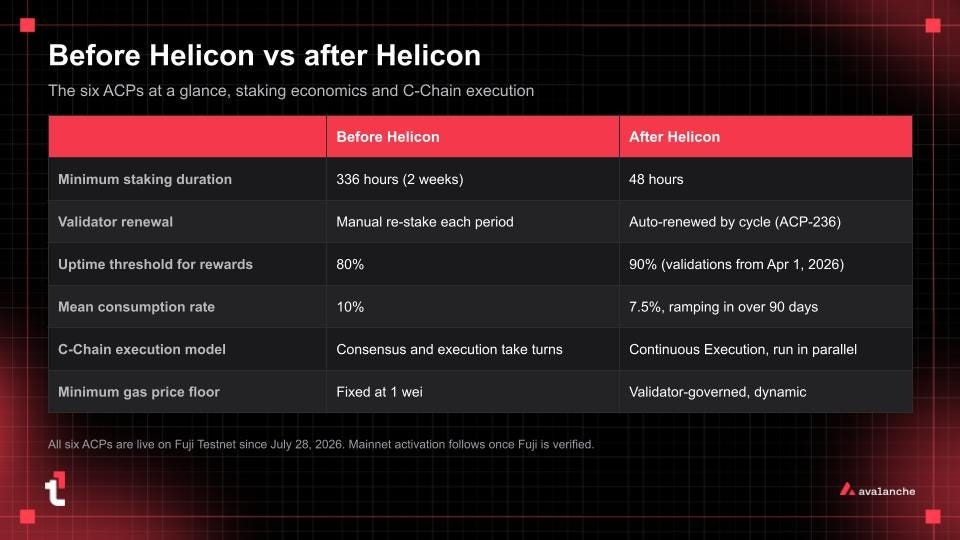
Helicon shipped six ACPs at once, split across two goals. Four of them, ACP-236, ACP-267, ACP-273, and ACP-285, rework how validators commit capital and get paid. The other two, ACP-194 and ACP-283, rework what the C-Chain can actually do with that validator set.
Staking economics
ACP-236 introduces auto-renewed validator staking. Instead of committing to a fixed end date and manually re-staking every period, validators set a cycle duration and an auto-compound ratio, and the network handles renewal automatically as long as uptime holds.
ACP-273 drops the minimum staking duration from 336 hours (two weeks) down to 48 hours, opening validation to allocators who cannot lock capital for extended periods.
ACP-267 raises the uptime requirement for rewards from 80% to 90%, applying only to validations whose staking period starts on or after Helicon activation. Validations already running when Helicon activates continue to be evaluated against the 80% threshold.
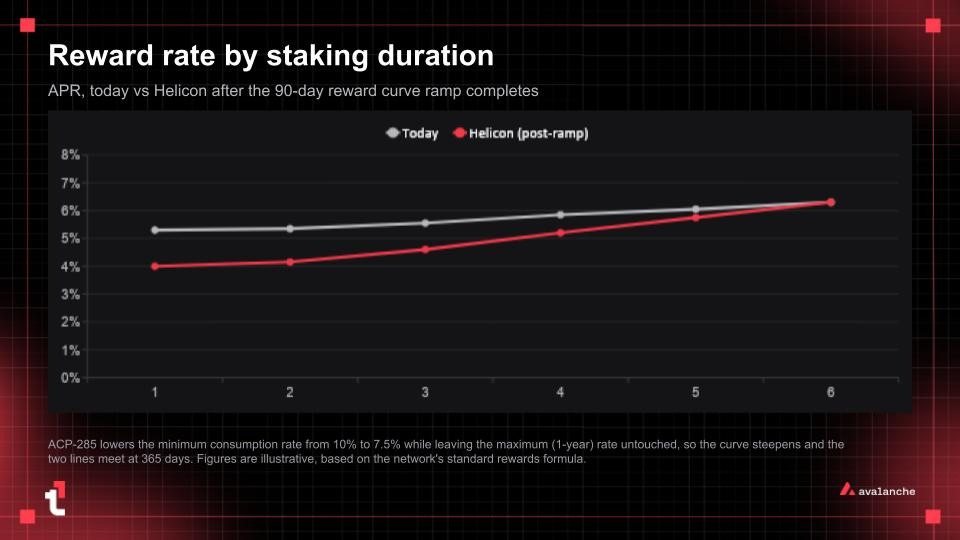
ACP-285 recalibrates the reward curve, lowering the minimum consumption rate from 10% to 7.5% over a 90 day rollout that is now underway, restoring the premium for longer-duration staking that had been flattening over time.
C-Chain execution
ACP-194 decouples consensus from execution on the C-Chain. Blocks are continuously accepted into a queue while a separate executor processes them in parallel, removing the bottleneck created when the two processes had to take turns.
ACP-283 replaces the C-Chain’s fixed 1 wei minimum gas price with a validator-governed floor that adjusts based on real network conditions, closing a spam vector that fixed pricing left open.
Three new P-Chain transaction types make auto-renewed staking work:
AddAutoRenewedValidatorTx registers a validator with a cycle duration and auto-compound ratio instead of a fixed end date.
RewardAutoRenewedValidatorTx is issued automatically by the network at the end of each cycle, requiring no operator signature.
SetAutoRenewedValidatorConfigTx lets an operator update the cycle duration or auto-compound ratio, taking effect only at the next cycle boundary.
Delegations, notably, do not auto-renew and must fit inside a single cycle.
All six ACPs are now live on Fuji. Mainnet activation has not happened yet; that will follow once Fuji has run clean for long enough to verify.
Why it matters
The staking changes solve two real problems at once. Validators running multiple nodes have long dealt with the operational overhead of manual re-staking at every period boundary, plus the reward gaps that come from missing a renewal window. Auto-renewal removes that entirely. At the same time, institutional allocators whose redemption cycles move faster than a two-week lockup have effectively been priced out of validating. The shorter minimum duration, combined with auto-renewal, now lets them stay continuously staked in short, recurring cycles instead of choosing between liquidity and participation.
The reward curve recalibration matters because making short-term staking easier could have flattened the incentive to stake longer even further. A two-week stake had been earning roughly 84 to 85 percent of the one-year rate, and the spread between the shortest and longest durations had fallen from about 1.9 percentage points at Genesis to around 1 point. ACP-285 protects the incentive to stake longer by steepening the curve, widening that spread from about 1 percentage point back toward 2.3, while pulling the minimum-duration annualized reward rate from about 5.4% down to 4%. The maximum rate for a full 365-day commitment is untouched, at roughly 6.4%.
On the C-Chain side, Continuous Execution addresses a real throughput ceiling that existed before this upgrade. Consensus and execution no longer wait on each other, so the chain can process more in the same amount of time. The tradeoff worth knowing: a transaction’s effects finalize a moment after block acceptance rather than instantly, which matters for infrastructure like block explorers and bridges that read receipts immediately after acceptance.
The dynamic gas price floor closes a gap that had made spam protocols like XEN profitable on Avalanche, at a cost the network had been absorbing at several AVAX a day under the previous stopgap.
How to get involved
The Fuji Testnet activation is live now. Builders and validator operators can pull the release build from the AvalancheGo GitHub releases page and start testing against Fuji today. The Helicon Devnet Resources repository is built specifically for spinning up a node and testing the new auto-renewed staking transaction types firsthand.
Anyone running C-Chain infrastructure with receipt-dependent logic should test against the new acceptance-to-settlement gap now, ahead of mainnet activation. Anyone estimating gas costs in an application should move away from any hardcoded minimum gas price assumption, since that floor is now governed dynamically by validators rather than fixed.
Discussion on all six ACPs is open on the Avalanche Foundation’s GitHub.
The full technical breakdown
This overview covers the headline changes, but Helicon touches on a lot of technical detail: the new P-Chain transaction types behind auto-renewed staking, exactly how the reward curve math works, what changed for tooling under Continuous Execution, and how the dynamic gas price mechanism is governed. I wrote up the full technical deep dive, including code examples and implementation notes for builders, on my Substack.
Resources

Looking to join the global community live? Registration is now open for Avalanche Summit NYC. Secure your pass today for 2 days of exclusive keynotes and networking.
