



Gaming titles built on Avalanche generated over 100 million transactions in 2025 alone. MapleStory Universe drove the network to process 1 million daily transactions in its first week. Off The Grid became the first AAA blockchain game to ship on PlayStation, Xbox, and PC. The activity is real, and it is accelerating. What sits behind all of it is an architecture that most developers misunderstand before they start building.
What “Blockchain Gaming” Actually Means
The most common misconception is that a blockchain game runs on the blockchain. The game engine, physics, rendering, matchmaking, AI, and real-time session state all run on traditional infrastructure, the same way they always have. The blockchain serves as a settlement and ownership layer sitting underneath the game. It is a separate system that sits beneath your game server and handles what game servers were never designed to handle: permanent, verifiable ownership.
The clearest mental model: blockchain is your game’s permanent ledger of ownership and economy. The game engine is the experience. They are connected through event-driven architecture, and the engineering challenge is building that bridge well.
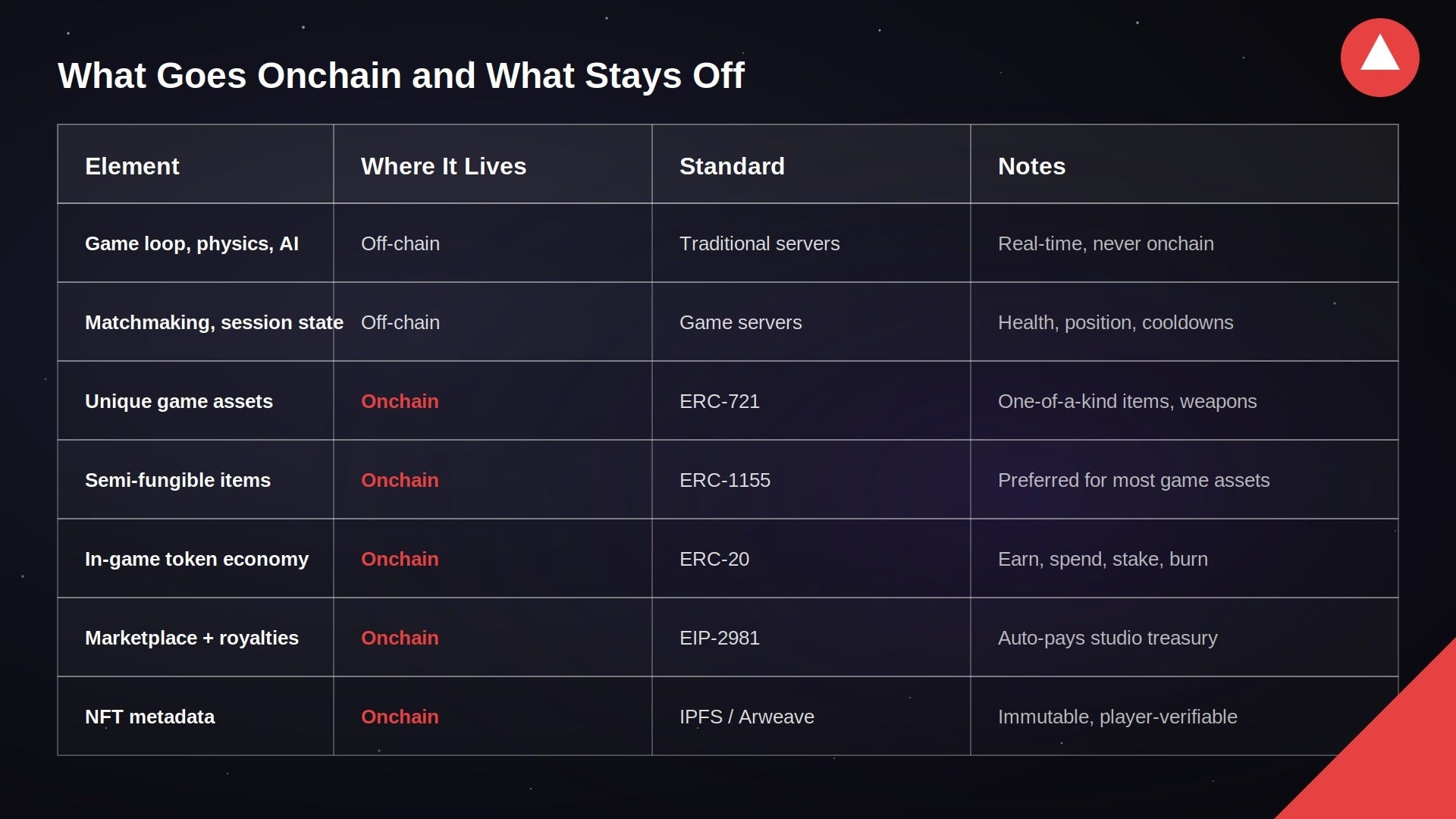
The game layer covers everything you already know: Unity or Unreal, your physics engine, rendering pipeline, matchmaking servers, AI systems, and player session state. None of that changes when you go Web3. The blockchain layer is where Avalanche lives: asset ownership recorded as NFTs, token balances, marketplace logic, smart contract-enforced crafting rules, verifiable randomness for loot drops, and tournament prize pools.
Why Avalanche for Games
Most transactions on Avalanche confirm in 1 to 2 seconds. Ethereum takes 12 to 15 seconds. That difference matters for games because players notice. A player who earns an item and sees it appear immediately has a fundamentally different experience from one staring at a loading state wondering if something broke.
The C-Chain is fully EVM-compatible. Solidity contracts deploy with zero changes. Hardhat, Foundry, MetaMask, OpenZeppelin, and WalletConnect all work without modification. The C-Chain processes over 4,500 transactions per second and the Octane upgrade in mid-2025 cut fees by over 95%, which changed what is economically viable for studios running game economies with millions of microtransactions.
The deeper differentiator is the L1 architecture. The ability to launch a sovereign blockchain with custom validators, a custom gas token, isolated workloads, and configurable EVM parameters is what has attracted the studios shipping serious games. Read more on the Avalanche9000 upgrade at https://www.avax.network/about/blog/building-on-avalanche9000.
C-Chain or Your Own L1: How to Choose
The economics of launching an L1 changed significantly with Avalanche9000 and ACP-77, which shipped to mainnet in December 2024. Previously, each L1 validator was required to stake 2,000 AVAX on the primary network. A 5-validator minimum meant an upfront capital commitment approaching $240,000 at 2024 prices. ACP-77 removed that requirement entirely, replacing it with a pay-as-you-go fee of roughly 1 to 10 AVAX per validator per month. The 99% reduction in deployment cost is real, and it makes dedicated game chains accessible to studios that could not justify the old model. Full technical breakdown at https://github.com/avalanche-foundation/ACPs/discussions/78.
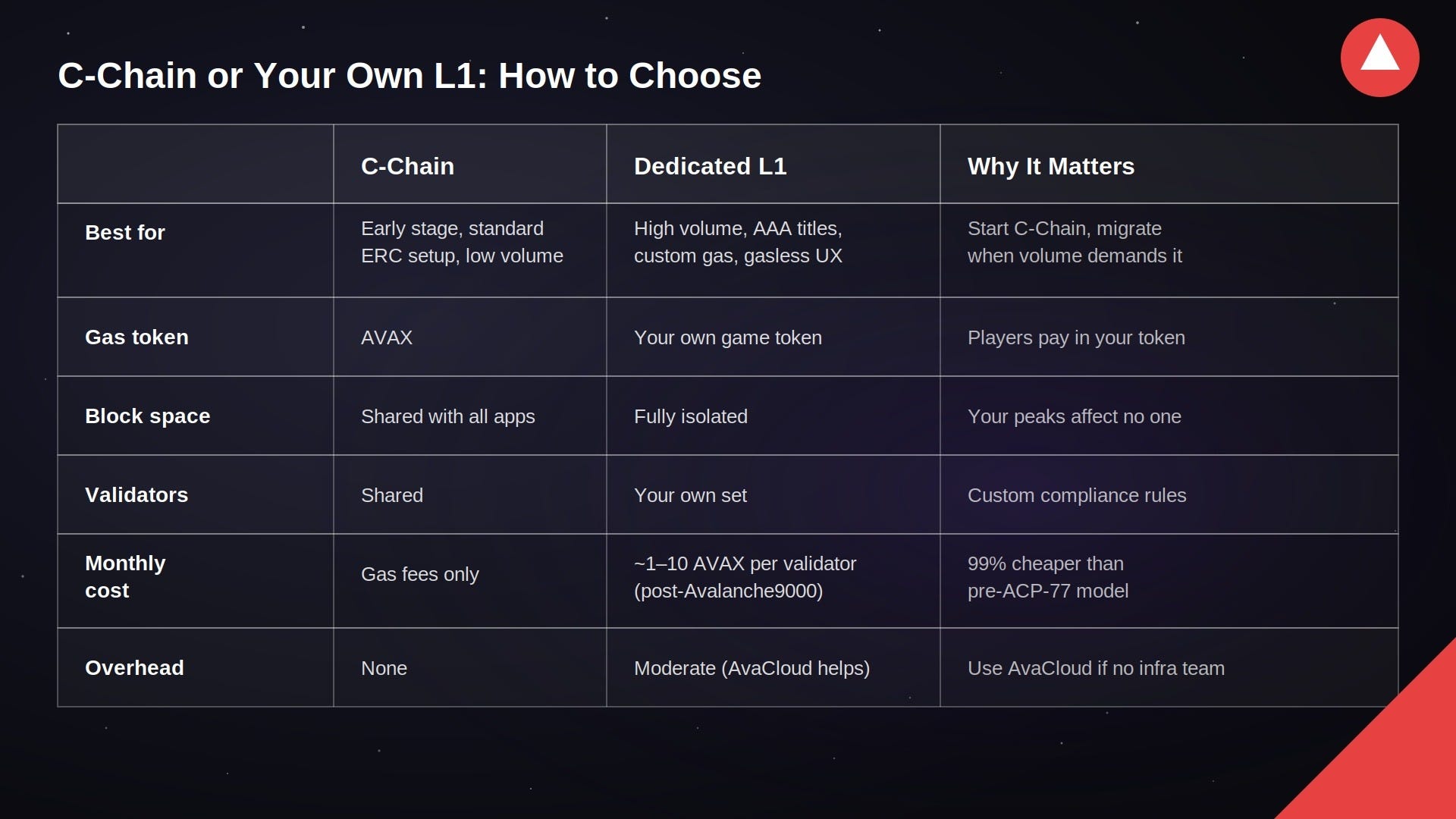
The practical path: build on the C-Chain, get real players generating real transactions, and move to your own L1 when volume and economics justify it. Avalanche’s Interchain Messaging (ICM) infrastructure handles asset bridging between chains so the transition is invisible to players.
Studios that made the move to dedicated L1s:
GUNZ (Off The Grid) by Gunzilla Games. A AAA battle royale on PlayStation, Xbox, and PC. The game client runs traditionally. GUNZ L1 handles weapons as NFTs, the GUN token economy, marketplace, and staking.
MapleStory Universe L1 by Nexon. Player-owned guilds, tradeable progression items, transparent enhancement logs built onchain. Drove 1 million daily transactions in week one.
FCHAIN by Faraway Games. Powers nine titles simultaneously. Assets and economy move across games in the same ecosystem.
What Goes Onchain and What Stays Off
Blockchain is built for settlement and permanent state changes. Real-time execution belongs on your traditional game servers.
The bridge between your game server and your contracts is event-driven. A game server event triggers a backend listener that calls the relevant contract function. With sub-second finality on Avalanche, that transaction resolves in 1 to 2 seconds rather than 12 to 15. Players see their items appear almost immediately.
Smart Contract Patterns That Matter Most
Vault and escrow: For any session where assets are at risk, dungeon runs, PvP wagers, high-stakes crafting. The player approves the vault contract, the game server triggers a deposit at session start, and the contract releases assets based on the verified outcome from a signed server message.
Merkle tree reward distribution: For large-scale reward events. The studio publishes one Merkle root to the contract instead of minting individually to thousands of players. Each player claims their reward by submitting a Merkle proof. One transaction sets the root; players cover their own claim gas.
ERC-2771 meta-transactions: The most important pattern for Web2 onboarding. Players sign transactions without paying gas. A studio-run relayer submits and covers the cost. On a dedicated L1 with a custom gas token, this becomes even simpler at the protocol level: players spend your game token and the relayer complexity goes away entirely.
The Tooling Stack
For smart contract development, Hardhat and Foundry both work without modification on the C-Chain. OpenZeppelin provides audited implementations of every standard you will need. The Hardhat config for Avalanche is identical to an Ethereum config with the RPC URL changed to https://api.avax.network/ext/bc/C/rpc and chainId set to 43114. Fuji testnet (chainId 43113) is the staging environment, with free test AVAX at faucet.avax.network.
For Avalanche-specific infrastructure, the Avalanche CLI handles local network setup, L1 deployment, and genesis configuration. AvaCloud provides a no-code alternative for studios that want a production L1 without a dedicated infrastructure engineer. The Core Wallet SDK covers Avalanche-native capabilities including P-Chain interactions and cross-chain asset visibility. Glacier API gives fast onchain data access without running a custom indexer, and The Graph handles custom subgraphs for leaderboards, trade history, and activity feeds.
For game engine integration, the Moralis Unity SDK connects Unity projects to Avalanche onchain data. ChainSafe’s web3.unity is a strong alternative for tighter engine integration. ethers.js handles EVM interaction in Node.js backends and web frontends.
For wallet UX, Privy and Dynamic both provide embedded wallet SDKs that generate wallets from email or social login. Players never see a seed phrase unless they choose to. This is the single biggest lever for Web2 player retention in any blockchain game.
Migrating from Web2 to Web3 on Avalanche
Migration happens in three phases and studios that try to do all three at once typically ship nothing.
Phase 1: Asset tokenization (4 to 8 weeks). Identify which items become onchain assets. Begin with cosmetics rather than gameplay-critical items so that a failed blockchain integration does not break core gameplay. Deploy an ERC-1155 contract, map internal item IDs to token IDs, add wallet connection alongside the existing login system, and build the minting pipeline from game server to contract.
Phase 2: Economy layer. Deploy an ERC-20 game token that replaces or supplements the existing currency system. Design the token economy, supply, emission rate, and sinks, before writing a single contract. A badly designed token economy will collapse regardless of contract quality. The main deliverables at this phase are the marketplace contract for player-to-player trading and a meta-transaction relayer so players do not need AVAX to transact.
Phase 3: Deep integration. Crafting and upgrade logic move to smart contracts with onchain outcome records. Competitive modes implement commit-reveal for verifiable match outcomes. Player-owned guilds exist as contracts with onchain treasuries. At this point the studio should also evaluate whether transaction volume justifies moving to a dedicated L1.
The four UX principles that determine whether Web2 players stay:
Abstract the wallet completely: Use embedded wallet tools like Privy or Dynamic so players log in with email or social accounts and never interact with key management directly. Call it an “inventory vault” or “digital ownership account” in your UI. Keep the word wallet out of it.
Sponsor gas for new players: Requiring AVAX ownership from a player who has never touched crypto is an immediate exit. Set up a meta-transaction relayer and cover their early transactions.
Use progressive disclosure: Show players they own their items. Let them discover trading when they are ready. The player who figures out they can sell a rare drop and receive real money will evangelize your game. The player hit with “connect your MetaMask to continue” on the loading screen closes the tab.
Fail gracefully: Queue failed transactions for retry and show neutral “syncing your inventory” states rather than raw blockchain errors. Most retries succeed and the player never knew anything happened.
Token Economics: Building an Economy That Survives
The 2021 to 2022 play-to-earn era established a useful negative example. When new player capital is the primary source of token value for existing players, token collapse follows slowing user growth, and the game collapses with it.
The dual token model:
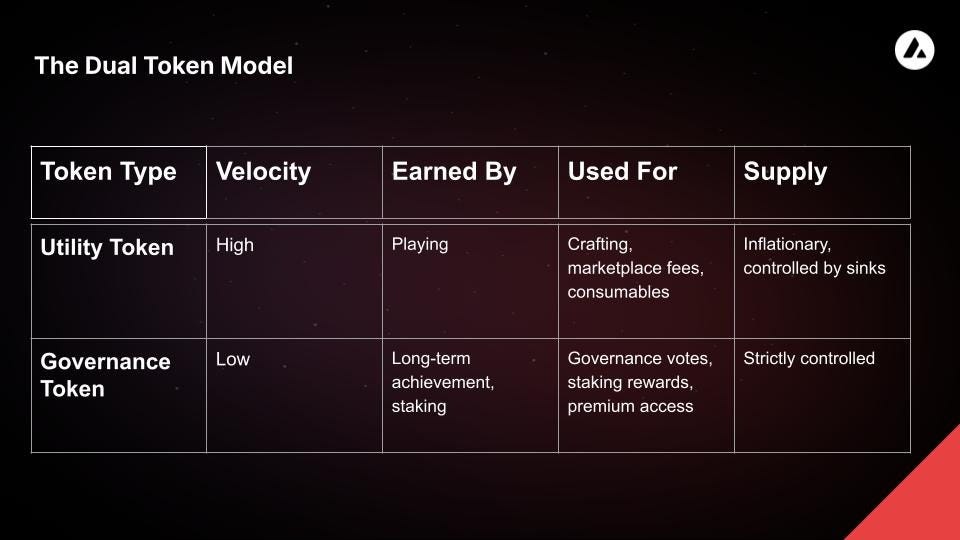
The dual structure lets the in-game economy run independently of governance token price movements on secondary markets.
Token sinks to design in from day one:
Crafting costs, burned on creation or upgrade
Enhancement fees, burned regardless of success or failure
Marketplace fees, a percentage burned or sent to treasury
Season pass and premium content spending
Guild creation and maintenance costs
Tournament entry fees that partially burn
Gunzilla Games routes 30% of monthly Off The Grid revenue into GUN token buybacks from the open market, which are then burned. That creates a direct link between game revenue and token value.
The sequencing principle that separates sustainable games from failures: design the game to be worth playing for free first. Layer on ownership mechanics that reward long-term players second. That order matters.
Why games keep choosing Avalanche
The technical case comes down to a specific combination of properties that Avalanche has built deliberately for this use case. Sub-second finality means asset transactions confirm before players notice a delay. EVM compatibility means studios bring their existing Solidity knowledge, auditors, and tooling without relearning anything. The post-Octane fee reduction of over 95% on the C-Chain makes microtransaction-heavy game economies economically viable at scale.
The dedicated L1 architecture is the deepest advantage. A gaming studio can run a sovereign blockchain with its own validators, its own gas token, its own EVM configuration, and complete workload isolation. Peak game activity, including major NFT drops and large competitive events, cannot affect other applications and other applications cannot affect the game. Post-Avalanche9000, launching that L1 costs roughly 1 to 10 AVAX per validator per month rather than tens of thousands of AVAX upfront.
Interchain Messaging connects L1s to each other and to the C-Chain without external bridges, so multi-game ecosystems like FCHAIN can share assets and economy across titles on the same infrastructure.
What This Means for Builders
The infrastructure for serious game development on Avalanche is in place. Studios that start today have access to sub-second finality, a tooling stack that works without modification for any EVM developer, dedicated chain economics that are genuinely accessible, and a set of ecosystem programs designed to fund and support the build.
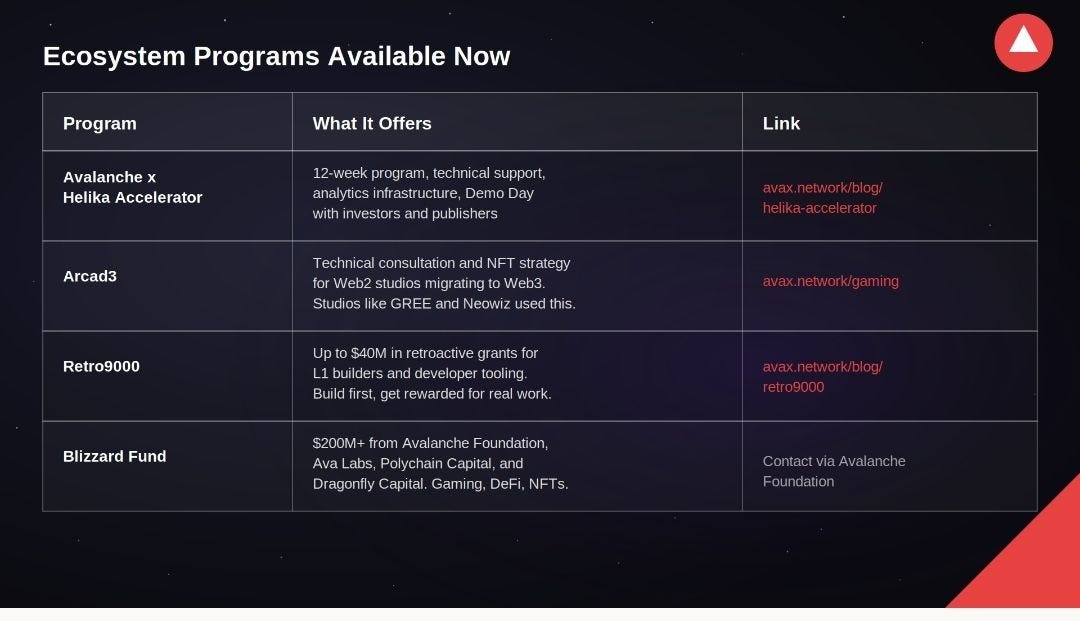
The developer opportunity is around studios that treat blockchain as infrastructure rather than product feature. The games winning in 2025 are marketed as games first. The blockchain is invisible to most of their players. Building that kind of invisible-infrastructure experience on Avalanche is where the real work is, and the tools to do it are here.
Read The Full Article
For the complete technical deep dive including Solidity code examples for ERC-1155 item registries, marketplace contracts with royalty enforcement, vault and escrow patterns, Merkle reward distribution, ERC-2771 meta-transaction relayers, and the full Hardhat configuration for Avalanche, read the full two-part article on my Substack:
Part 1: The Architecture, the Reality, and What Actually Runs Onchain, available at Scotch’s Substack
Part 2: Tooling, Migration, Tokenomics, and Where to Start, available at Scotch’s Substack
Start Building
Developers ready to build can start with AvaCloud at https://avacloud.io and the full Avalanche developer documentation at https://build.avax.network.
The Fuji testnet faucet provides free test AVAX at https://faucet.avax.network. The Avalanche Builder Hub at https://build.avax.network covers everything from contract deployment to L1 configuration. The Avalanche Discord at https://discord.gg/avalanche has dedicated builder channels for getting unblocked quickly.
Dive into the Avalanche ecosystem today! Download the Core Wallet and unlock a world of seamless DeFi, NFTs, and more.