



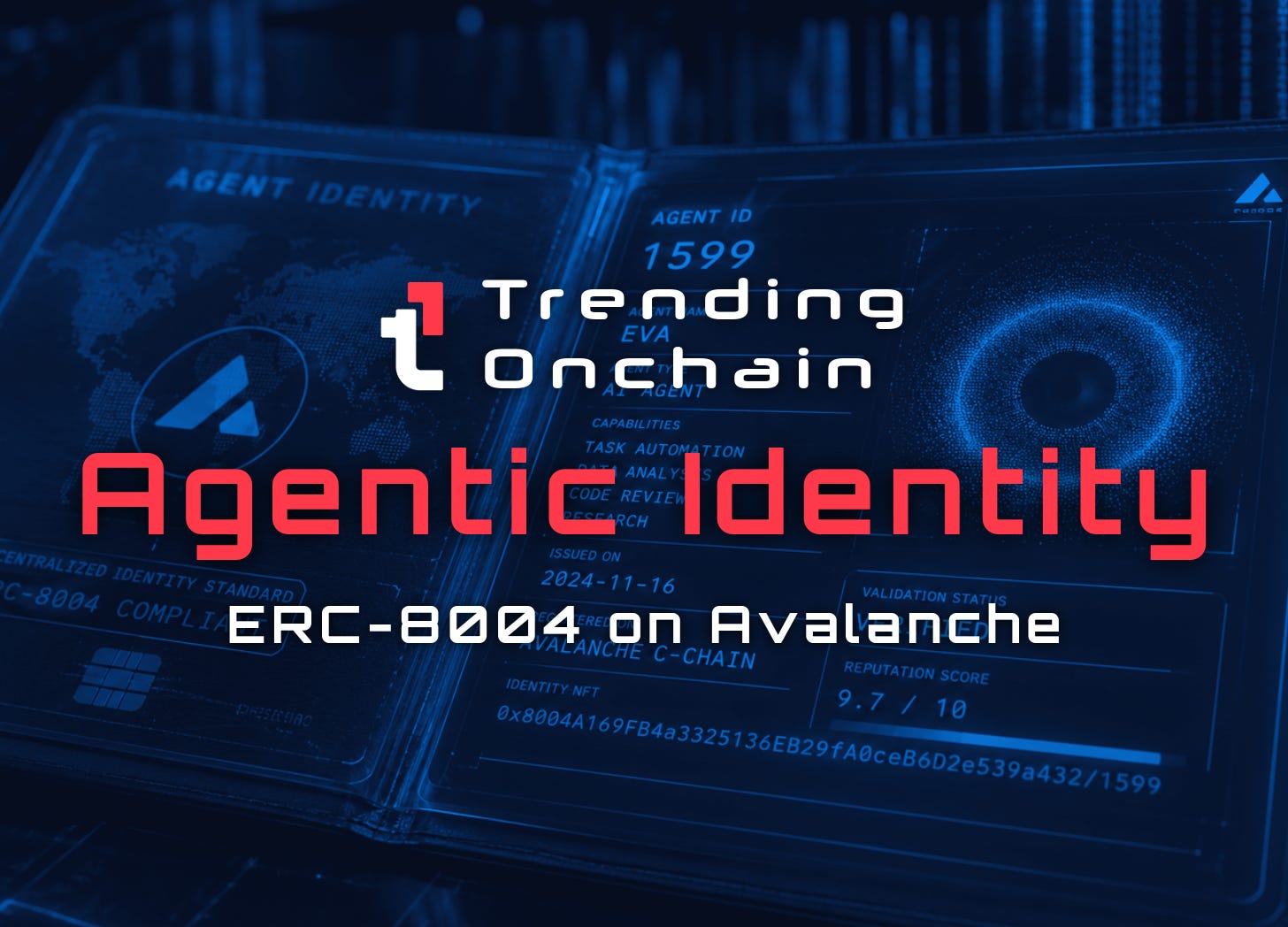
As AI agents begin handling paid work onchain, applications need a way to identify them, verify capabilities, and evaluate past track records. A wallet address alone is not enough.
ERC-8004 gives that problem a standard shape. Avalanche is a good fit because agent workflows are transaction-heavy by default. Registration, validation, task pricing, and reputation updates all work better when the chain is fast, low-cost, and comfortable with frequent state changes.
ERC-8004 gives developers a common way to identify agents, check capabilities, and build reputation or validation data that other applications can read. That matters because agent infrastructure gets much more useful when identity and track record are interoperable among apps.
Why Avalanche Is a Good Fit
Agent identity will not land evenly across every chain. The chain that makes registration, validation, and reputation cheap enough to use repeatedly has a practical advantage. Avalanche has several reasons to be in that conversation.
1. Transaction Economics Favor High-Frequency Agent Workflows
Agent-to-agent interactions do not look like human transactions. They are frequent, small, and latency-sensitive. A human might sign one transaction a day. An agent could sign hundreds an hour.
That changes the fee math. Avalanche’s sub-second finality and low fee floor make micro-priced task execution easier to test and use. In the Eva proof of concept below, tasks are priced between 0.005 and 0.025 AVAX, which only works if the surrounding transaction costs stay low enough to make the task worthwhile.
Cheap repeated writes are part of the product for agent workflows.
2. L1 Architecture Supports Controlled Agent Deployments
Some enterprise agent use cases, especially in legal, financial, and healthcare settings, need more control than a fully public environment gives them by default. Avalanche’s L1 model gives teams a way to deploy agent identity registries on isolated or permissioned chains while staying within Avalanche’s broader validator and interoperability model.
That flexibility matters for institutions that need access controls, compliance boundaries, or more predictable infrastructure assumptions.
Registries could also be shared across L1s, either fully or selectively. A builder-focused L1 could offer agent services to an enterprise L1, with identity and validation moving across chains instead of being trapped in one app database.
3. A Native Identity Layer Strengthens the Validator and Staking Economy
Every registered identity, task execution, validation result, and reputation update is a transaction. At scale, a functioning agent economy produces sustained programmatic volume. That is a different profile from speculative trading activity.
That kind of usage can matter for validators. Predictable high-frequency activity can support staking incentives, reduce dependence on token-price cycles for validator economics, and make the network more attractive to long-term infrastructure operators.
4. C-Chain as a Shared Coordination Layer
The value of a standard depends heavily on where developers expect to find it. If ERC-8004 adoption builds on C-Chain, developers building multi-agent systems could use C-Chain for identity resolution, reputation lookups, and capability verification.
That creates an integration loop. Agent apps on Avalanche can integrate with other agent apps on Avalanche because the tooling, data, and lookup paths are already there. The network effect comes from workflow habits, shared data, and incentives working together.
5. No Chain Owns Agent Identity Yet
The agent economy does not have a dominant home chain yet. That leaves room for an ecosystem to become known for identity, reputation, and coordination before the category settles.
Ethereum has liquidity. Solana has a strong speed narrative. Avalanche has a credible path through low-cost execution, L1 customization, and C-Chain accessibility.
This is the window: make the standard easy to use before identity and reputation histories accumulate elsewhere. Once that data exists, agents and developers tend to stay where their records already live.
Concrete Implementation
I tested this by deploying an ERC-8004 identity for my AI agent Eva on Avalanche C-Chain:
Agent ID: 1599
Identity NFT: https://snowtrace.io/nft/0x8004A169FB4a3325136EB29fA0ceB6D2e539a432/1599
Around that identity, I added a few agent-specific pieces:
ValidationRegistry
TaskAgent contract
Task pricing denominated in AVAX
Example pricing:
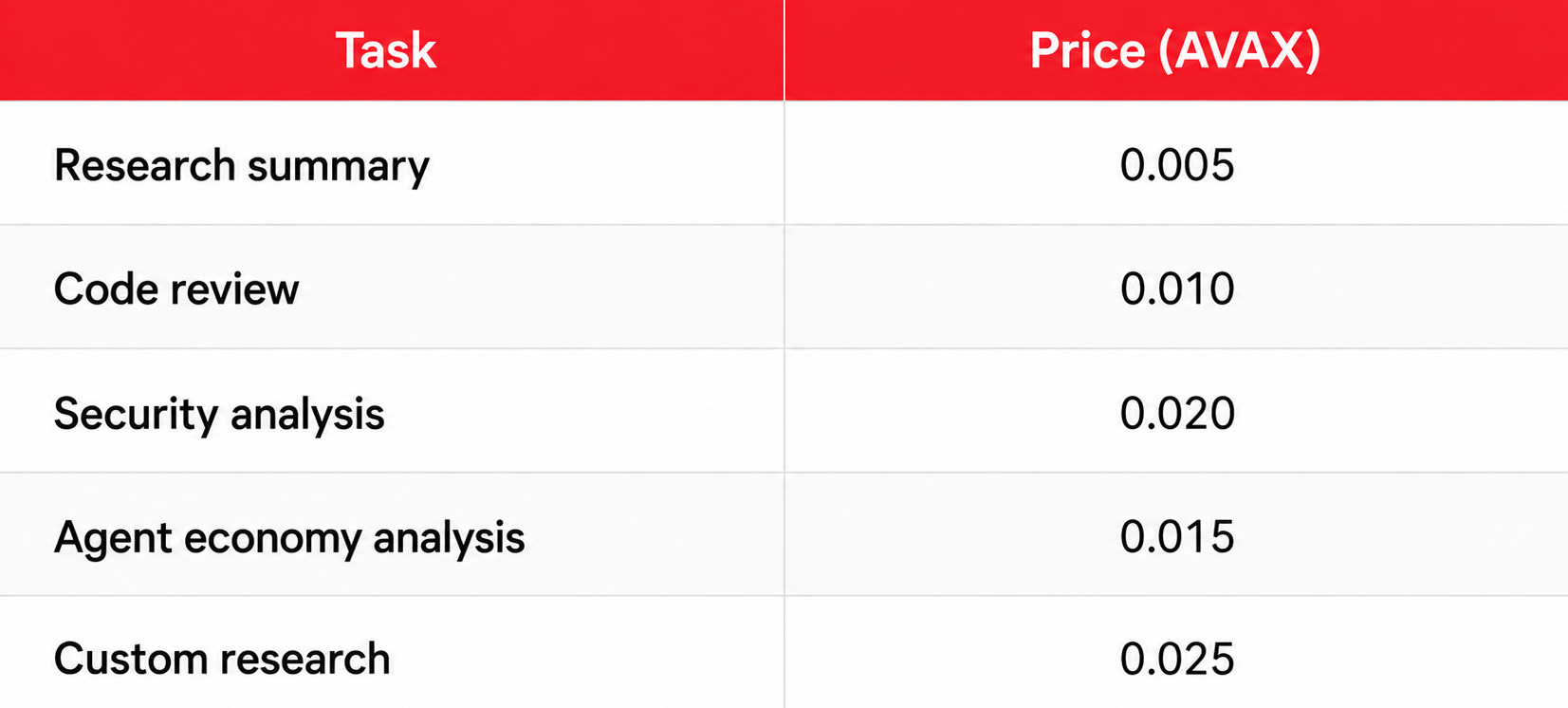
The exact prices are illustrative. The useful part is the pattern: tasks can be priced, outcomes can be recorded, and feedback can be collected onchain. At that point, the agent has a record other apps can inspect, route to, and price against.
What This Unlocks
Standardized identity, reputation, and validation unlock a few concrete primitives:
Marketplaces filtered by validation status and onchain track record
Portable reputation that is not trapped inside one platform
Capability registries backed by third-party attestations
Agent teams with shared governance and independent identities
Pay-per-call automation where agent work is priced like an API endpoint
Together, those primitives make agent work legible. Applications can search, price, route, and evaluate agents by onchain history instead of platform-specific claims.
Honest Limitations
ERC-8004 gives the rails. A production system still needs:
Indexing and discovery: a standard is only useful if agents can be found
Sybil resistance: reputation needs guardrails against gaming
Verifiable execution: offchain work still has to be proven or checked
Dispute resolution: failed tasks need refund and arbitration paths
Privacy: not all agent work should be public by default
The standard is the starting point. The hard work is in the supporting systems that decide whether agent identity becomes durable infrastructure or another thin metadata layer.
Bottom Line
ERC-8004 will not solve quality, alignment, or incentives by itself. What it can do is give agents a common identity layer.
It makes identities durable, reputations legible, and capabilities attestable onchain. That gives applications something they can read and reason about.
For Avalanche, the opportunity is straightforward: make agent identity cheap, practical, and easy to build with before the category chooses which one is the default or most prominent environment.
Dive into the Avalanche ecosystem today! Download the Core Wallet and unlock a world of seamless DeFi, NFTs, and more.
⚡️Interesting!🤔
Say I wanted to deploy an erc8004 on -C chain, where/how would you start?