



Public ledgers still show too much
On a public blockchain, anyone can open a block explorer and follow your transfers. That visibility is a big part of why people trust the system. It also means payroll, treasury moves and trading size sit in the open.
For an institution that handles sensitive flows, or a DAO that doesn’t want to publish salaries and grant amounts to the whole network, that exposure is a problem. You can stay on a public chain, keep amounts private, and still give a regulator or an internal auditor a way to decrypt them when they have to.
AvaCloud built eERC (Encrypted ERC) to handle that tradeoff. It’s an encrypted token standard that keeps balances and transfer amounts private, while authorized auditors can still review activity. You deploy it as smart contracts on existing EVM chains, including Avalanche L1s and the C-Chain. It also runs on other EVM networks, permissioned or permissionless, with no changes to the underlying protocol (AvaCloud launch post). Under the hood it combines zero-knowledge proofs (zk-SNARKs) with partially homomorphic encryption (EncryptedERC repo).
What eERC hides, and what it doesn’t
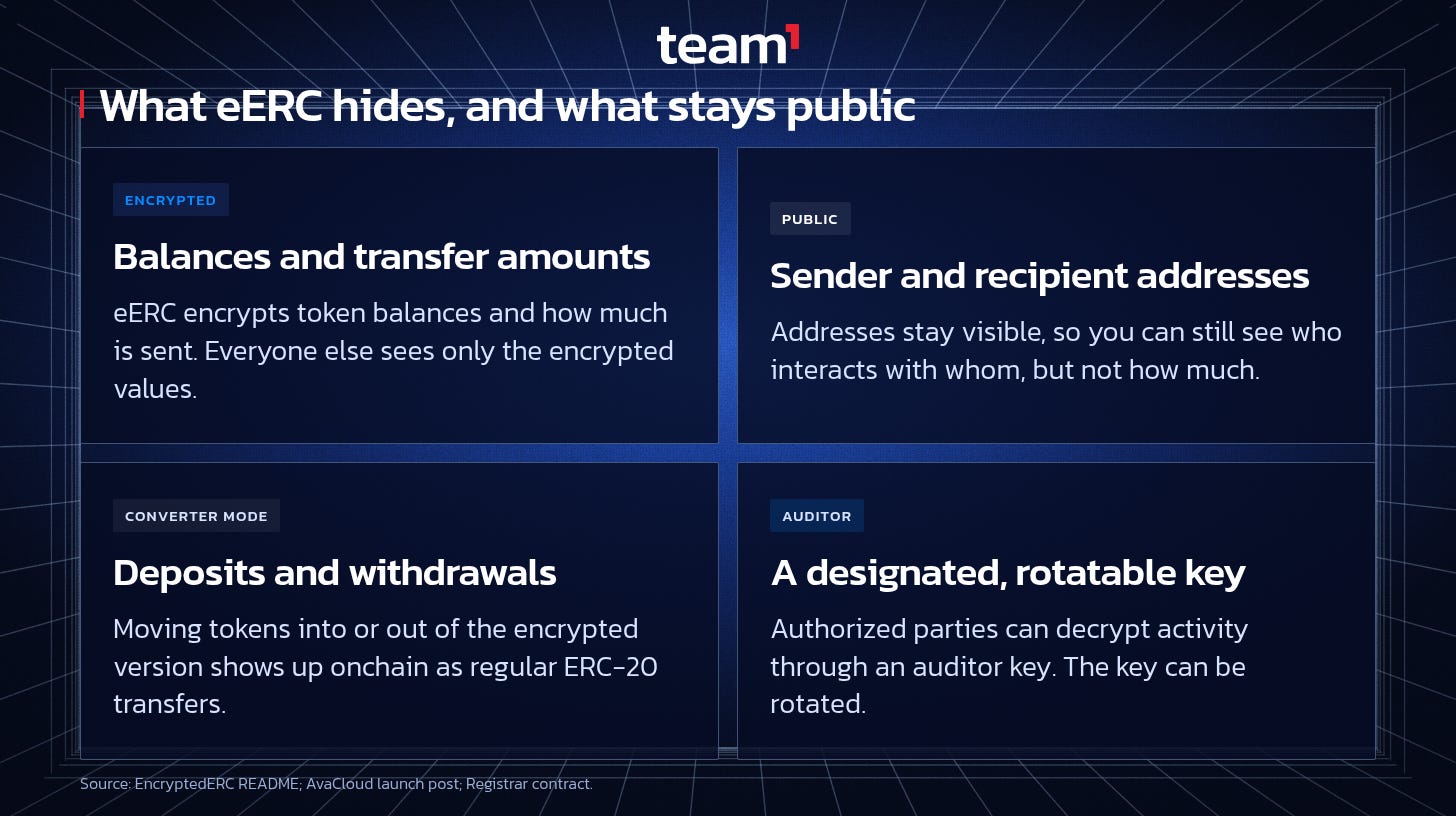
eERC encrypts token balances and transfer amounts. Sender and recipient addresses stay public, so you can still see who interacts with whom, but not how much. In converter mode, deposits into and withdrawals out of the encrypted token show up onchain as regular ERC-20 transfers.
Authorized parties, such as regulators or compliance teams, can decrypt activity through an auditor with a designated, rotatable key. Everyone else sees only the encrypted values.
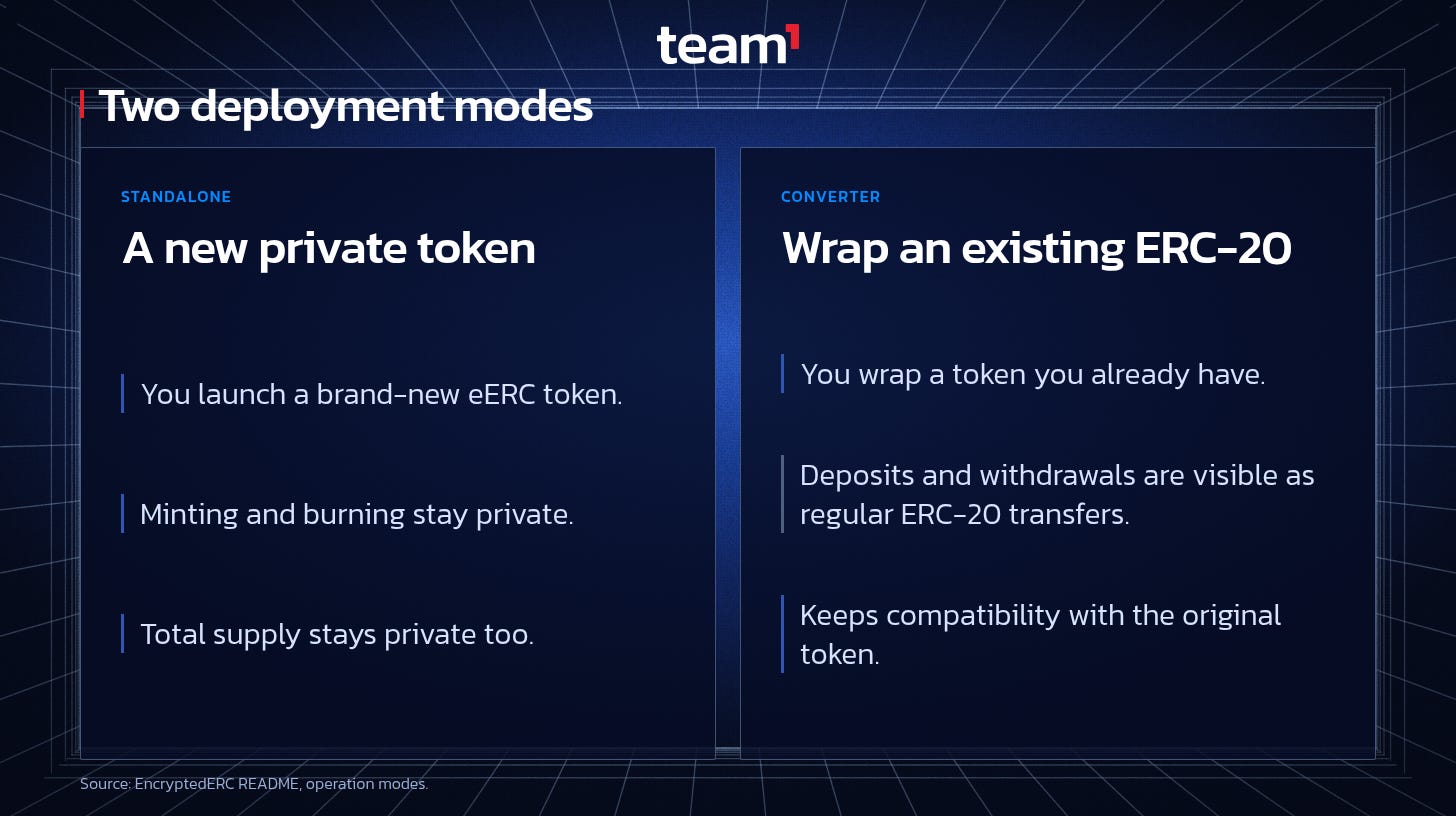
Two deployment modes cover different starting points. In standalone mode you launch a new private token; minting, burning and total supply stay private. In converter mode you wrap an existing ERC-20 into an encrypted version, which keeps compatibility with the original token and makes those deposit and withdrawal amounts visible.
Recipients have to register before they can receive an encrypted transfer, because the contract needs their public key to encrypt the amount for them. Registration is open to anyone: each user registers their own wallet with a proof, and no allowlist sits in front of it (Registrar contract).
The current contracts handle token amounts up to 251 bits (2^251). The protocol also lets you attach arbitrary-length encrypted metadata to a transaction (README).
Gas, the SDK, and the audits
eERC runs on any EVM-compatible chain, and you don’t need custom devices or specialized compute. Users encrypt, decrypt and generate proofs on their own device. The official TypeScript SDK, @avalabs/eerc-sdk, is wallet agnostic, so a wallet and a browser are enough (AvaCloud SDK docs).
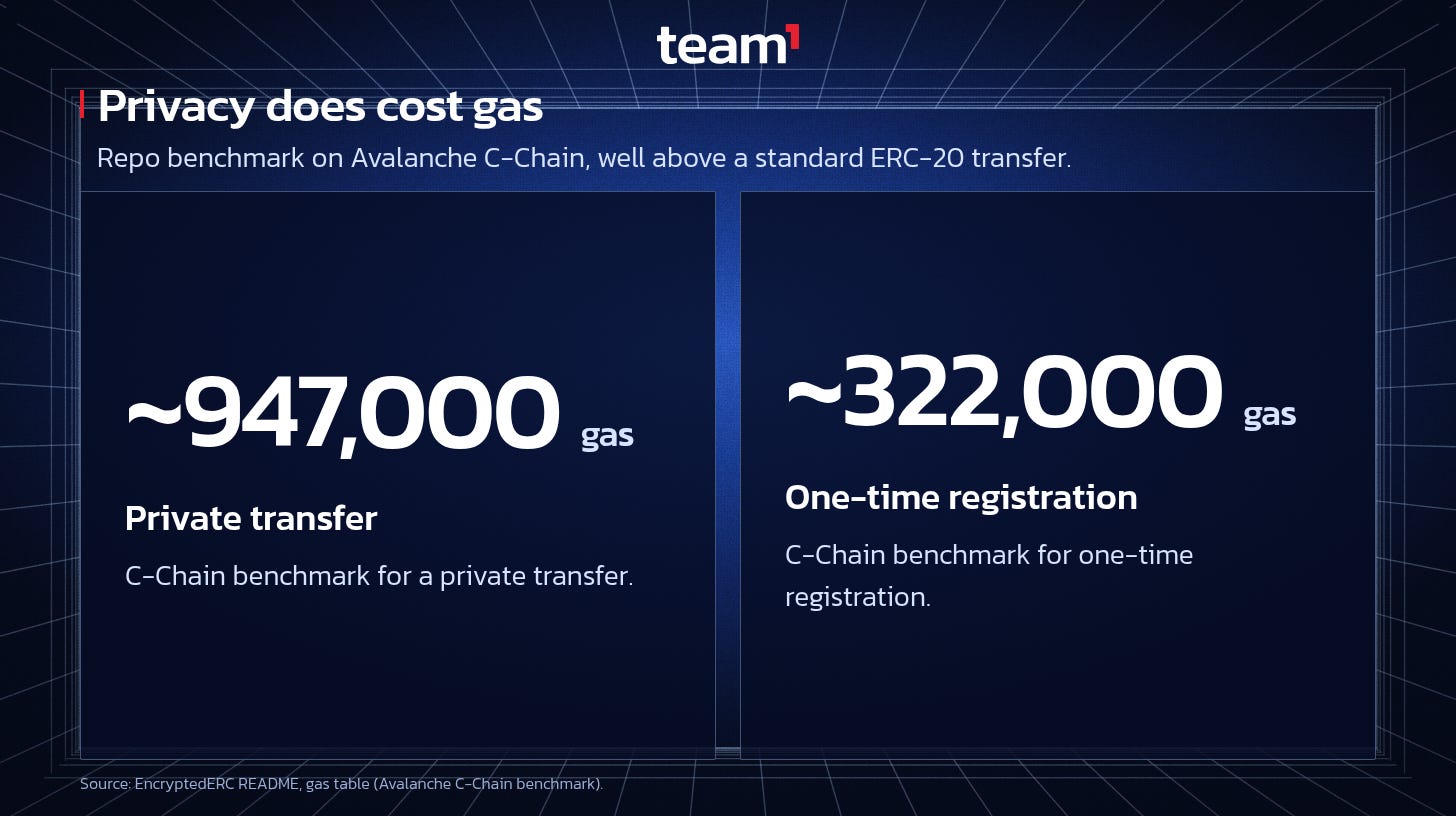
Privacy does cost gas. The repo’s benchmark on Avalanche C-Chain shows about 947,000 gas for a private transfer and about 322,000 for a one-time registration, well above a standard ERC-20 transfer (EncryptedERC README, gas table). Factor that in when you pick a chain and design your app.
The circuits and core protocol were audited in March 2025; the reports are in the repo’s audit folder. A Hexens review of the Circom circuits in April 2025 reported one medium finding and two informational ones, which the report says were fixed.
Why this matters on Avalanche
Being able to hide amounts on a public chain, and still show them to a designated auditor, is useful for more than one kind of team. Institutions can keep treasury flows and settlement sizes off the public explorer. DAOs and startups can pay contributors without publishing the figures to the whole network.
As Nicholas Mussallem, CEO of AvaCloud, put it at launch:
“eERC represents a major step forward in blockchain privacy. We are committed to providing solutions that empower users and enterprises to leverage the benefits of blockchain technology while maintaining the highest levels of data confidentiality.”
Who’s using it
Public eERC deployments are still early, but a few teams have already put the standard onchain.
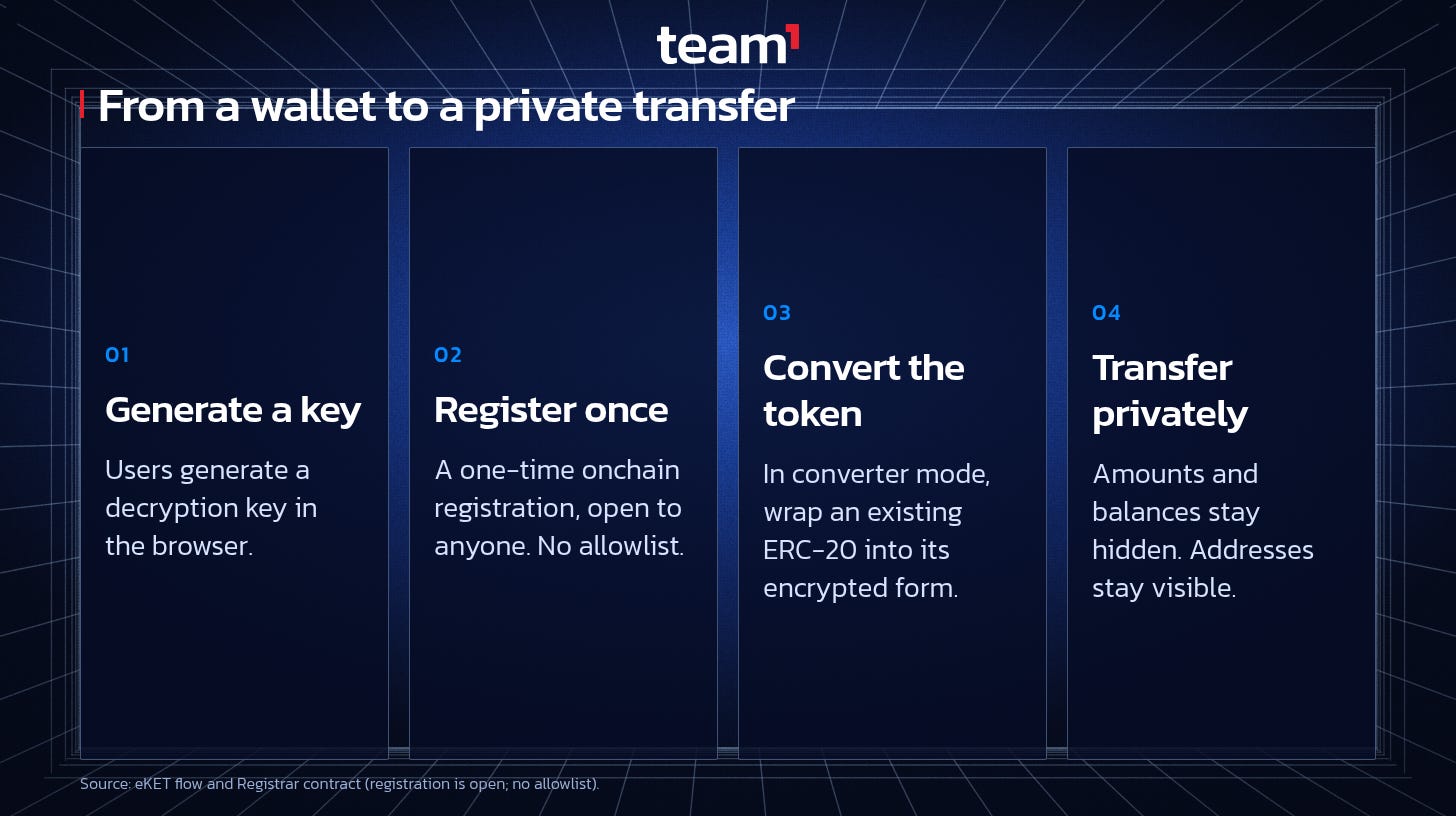
In mid-2025, YellowCatDao, creator of the KET memecoin, ran eKET as an early public test of AvaCloud’s eERC. Users registered once onchain, then converted regular $KET into encrypted $eKET and back again. Transfers hid amounts and balances; addresses stayed visible, and the conversions showed up as normal token transfers. Their sample web app repo is still public.
Benzo, from Miny-Labs, is a private payments system built on the same standard. Its eERC converter is deployed on Avalanche C-Chain and wraps Circle USDC and EURC into encrypted balances. The same stack also runs on Fuji and on BenzoNet, a permissioned demo L1. The team described the July 2026 C-Chain release as a fresh mainnet deployment, not yet production-hardened: the contracts are source-verified, but the admin key has not been moved to a multisig, and they describe the release as unaudited on their side.
VeilPay is a confidential payroll prototype built for Team1 India’s July 2026 Speedrun on privacy. It uses eERC converter mode to wrap a stablecoin, send salary transfers with encrypted amounts, attach an encrypted payslip in the transaction metadata, and let a designated auditor decrypt the history for compliance. The app is live on Fuji, not on mainnet.
Other uses, still mostly possibilities
eKET was an early public test; Benzo and VeilPay are later examples of things AvaCloud and the Avalanche docs already describe. Unless a project above already ships it, treat the rest as possibilities, not named production deployments (AvaCloud; Avalanche docs).
Confidential payroll and grants are the obvious ones: the payment can settle onchain without publishing what each person was paid. Internal treasury and B2B payments follow the same pattern, including shielded transfers of an existing stablecoin through converter mode. Official docs also point to tokenized funds, deposit or settlement tokens, and real-world assets where holders and transaction sizes should stay confidential, and to supply-chain assets where you want traceability without letting distributors see one another’s volumes.
Gaming is in the same list: a game could hide quest rewards or in-game balances so inventories stay off the public explorer. We did not find a named live game that has shipped eERC in production, so that remains a design target rather than a case study.
How to start building
If you need confidential balances with auditability on Avalanche, there are two ways to start:
AvaCloud. eERC is available for AvaCloud L1 deployments through the AvaCloud portal. The product docs are at docs.avacloud.io/encrypted-erc. For C-Chain deployments, AvaCloud’s launch post asked teams to contact sales@avacloud.io.
Open source. The contracts, circuits and docs live on GitHub at ava-labs/EncryptedERC under the Ecosystem License, so you can read the code and run it yourself. The TypeScript SDK is @avalabs/eerc-sdk, and there is an overview in the Avalanche docs.
AvaCloud also has a video walkthrough: How to Create Encrypted Tokens on AvaCloud.
Dive into the Avalanche ecosystem today! Download the Core Wallet and unlock a world of seamless DeFi, NFTs, and more.