



Avalanche’s smart contracts can execute flawlessly and still fail their users if the data feeding them is wrong or manipulable. Lending markets need honest prices to avoid bad debt. Betting platforms need randomness nobody can rig. Cross-chain transfers need a way to move value without a centralized bridge operator holding the keys. Chainlink is the infrastructure Avalanche protocols lean on to solve all three problems. That dependency is the real reason Chainlink matters to Avalanche: pull it out, and a meaningful share of what makes Avalanche’s DeFi and gaming ecosystems trustworthy goes with it.
The numbers at a glance:
182 Chainlink integrations live on Avalanche, second only to Ethereum
$33.124 billion secured by Chainlink’s oracle network across 505 protocols network-wide
Roughly 59 percent of the tracked oracle market by total value secured
CCIP transfer volume grew 319 percent year over year in Q1 2026, processing over $18 billion for the quarter
CCIP now connects more than 60 blockchain networks, up from four at launch

What is Chainlink?
Chainlink is a decentralized oracle network, co-founded by Sergey Nazarov, that lets smart contracts securely access off-chain data, APIs, and payment systems. It solves a problem specific to blockchains: contracts execute exactly as written, but they have no native way to know a token’s market price, confirm a real-world event happened, or talk to a contract on a different chain.
Chainlink’s nodes fetch, verify, and deliver that data onchain. Data Feeds alone power 908 integrations across more than 27 blockchains, with Ethereum hosting 1,403 individual integration points, the largest share of any network.
How it works
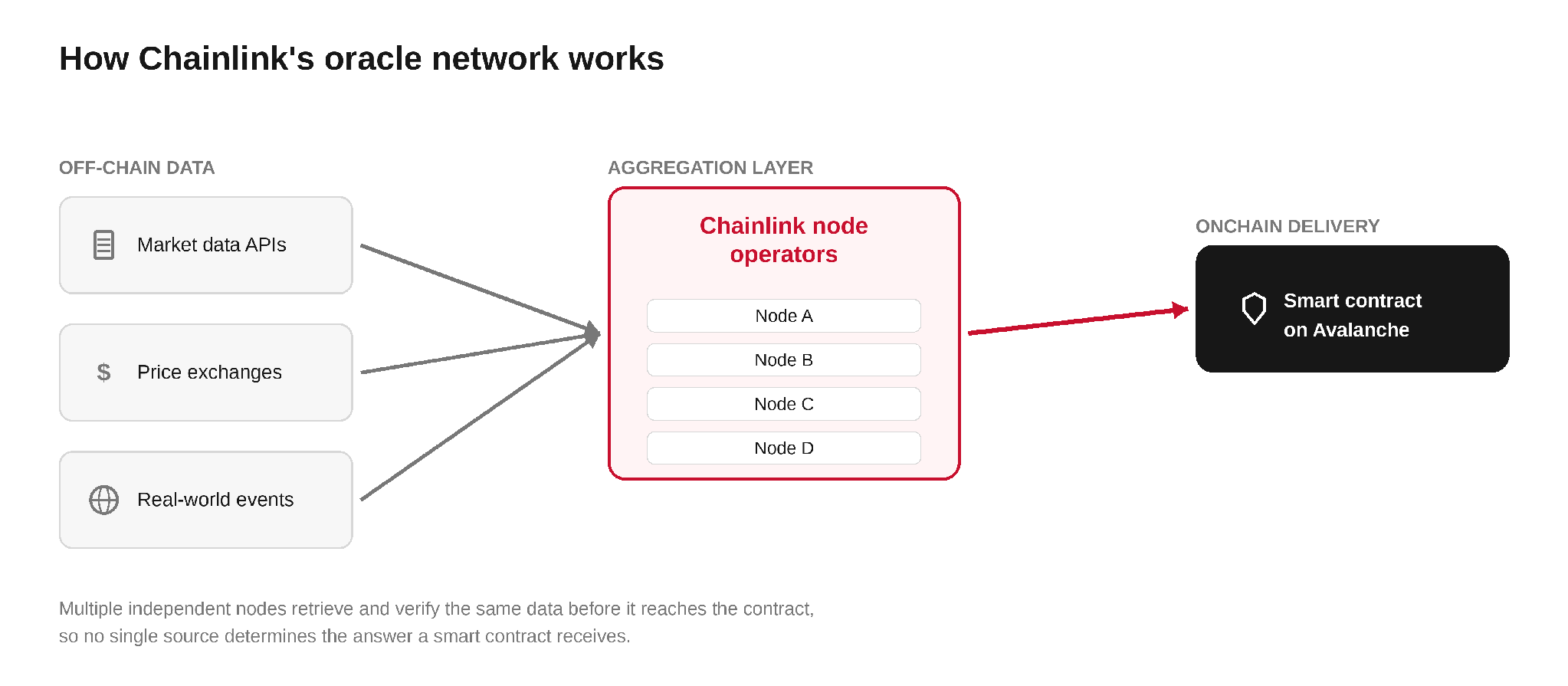
Chainlink runs as a network of independent node operators, so no single data source determines what a contract receives. Multiple nodes retrieve the same piece of information, and the network aggregates their responses before delivering a single verified answer onchain. No single node, API, or operator can quietly feed a smart contract bad information.
The core services built on that network:
Price Feeds. Continuously updated, aggregated price data that DeFi protocols use to determine collateral values, liquidation thresholds, and asset pricing.
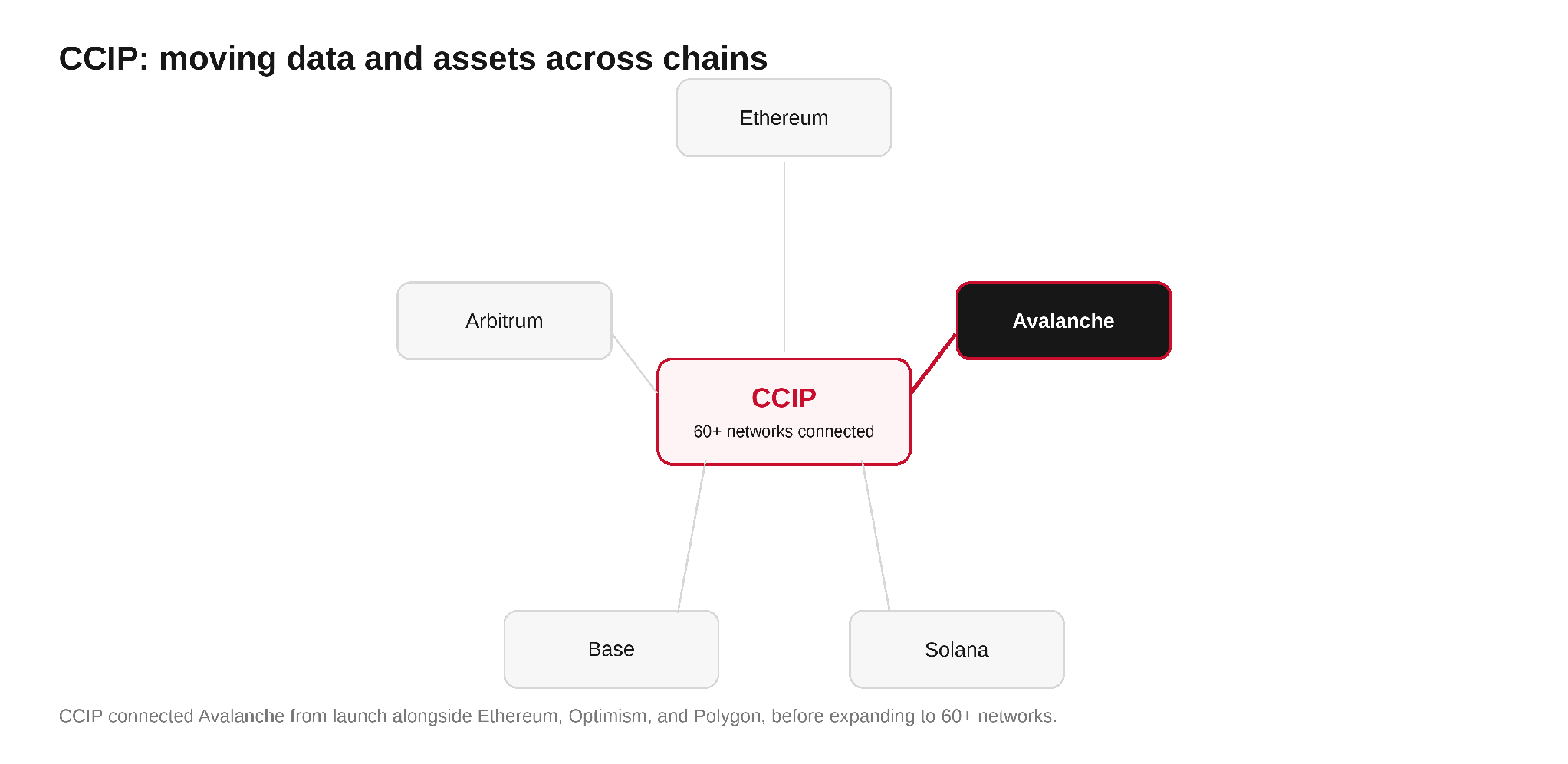
CCIP (Cross-Chain Interoperability Protocol). A messaging and token transfer layer that lets smart contracts on one chain communicate with and move assets to another, now spanning over 60 public and private networks.
VRF (Verifiable Random Function). Generates tamper-proof, cryptographically verifiable randomness for gaming, NFT minting, and any use case that needs an outcome nobody can rig, the exact mechanism FerdyBet uses to prove its betting results aren’t manipulated by the house.
Data Streams and Automation. Low-latency data delivery and automated contract execution for time-sensitive applications.
Functions. Lets smart contracts call external APIs directly, extending what a contract can react to beyond onchain events.
Staking. Chainlink Staking v0.2 secures oracle and CCIP services through a 45 million LINK pool, with a 4.5 percent annual base reward rate and a 4.32 percent effective rate for community stakers.
Chainlink’s footprint on Avalanche
Chainlink is one of the most deeply integrated pieces of infrastructure on Avalanche, but the integration count only matters because of what it enables in practice. Two examples show what that looks like day to day.
BENQI, Avalanche’s largest lending protocol, has run on Chainlink Price Feeds since 2021, using them to price collateral and trigger liquidations across markets for AVAX, ETH, BTC, and stablecoins. Without a reliable price feed, an undercollateralized loan can sit unliquidated long enough to leave the protocol holding bad debt, which is exactly the failure Chainlink’s aggregated pricing is built to prevent.
On the gaming and gambling side, FerdyBet uses Chainlink VRF to generate the random outcomes behind its betting games. Every roll or draw comes with a cryptographic proof that the result wasn’t manipulated by the house, the developers, or anyone else, which is the difference between an onchain betting platform players can verify and one they simply have to trust.
Beyond these two, the broader pattern holds across categories:
DeFi accounts for the largest share of integrations network-wide, at 1,120 projects
NFT projects account for 608 integrations
Gaming accounts for 346 integrations
Aave V3 alone accounts for 43.11 percent of Chainlink’s total secured value, at $14.28 billion
Avalanche’s own Builder Hub lists Chainlink as a core integration, pointing developers to CCIP for secure cross-chain data transfer and smart contract execution. CCIP connected Avalanche from launch, alongside Ethereum, Optimism, and Polygon, before expanding to the 60-plus networks it supports today.
Why it matters for Avalanche
Avalanche’s DeFi ecosystem depends on price data it cannot generate internally. Lending markets need accurate collateral pricing to avoid bad debt. Derivatives platforms need real-time feeds to settle positions correctly. Chainlink’s Price Feeds have become the default way Avalanche protocols get that data, which is a large part of why the integration count sits at 182, behind only Ethereum.
CCIP extends that role beyond price data. As more assets, gaming economies, and enterprise deployments move across multiple chains, Avalanche needs a reliable way to move data and tokens in and out. CCIP is one of the main paths doing that today, connecting Avalanche to the broader multi-chain landscape.
The enterprise side is worth watching closely. Chainlink has become a default layer for institutional players moving real-world assets onchain:
Partnerships with major banks including ANZ and BNY Mellon for tokenized asset settlement
A collaboration with SWIFT, the global banking messaging network, connecting traditional interbank infrastructure to blockchain-based assets
Amundi’s Spiko tokenized fund, powered by Chainlink, reached more than $400 million in assets under management within three weeks of launch
The World Economic Forum estimates $867 trillion in global financial assets could eventually be tokenized, with RWA tokenization already surpassing $27 billion in distributed asset value in 2026
As institutional activity increasingly touches Avalanche, Chainlink’s existing rails give it a head start most competing oracle networks don’t have.
The competitive picture
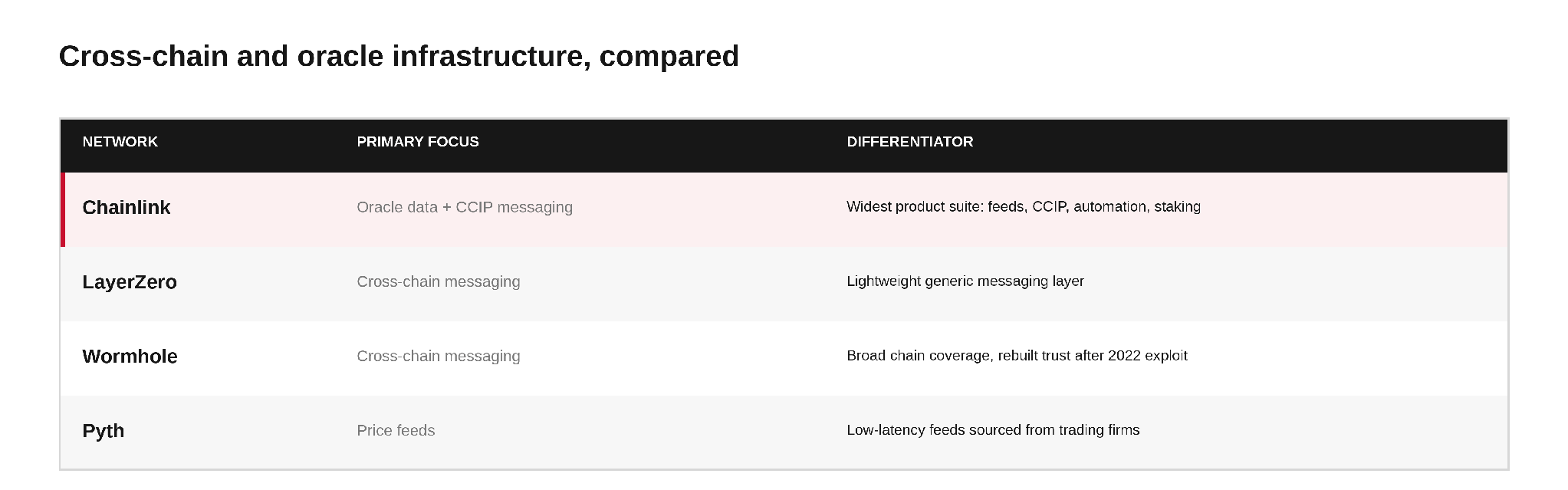
Chainlink isn’t unchallenged. LayerZero has built substantial adoption for cross-chain messaging, Wormhole continues operating as cross-chain infrastructure despite past security incidents, and Pyth competes directly in price feeds. Chainlink’s response has been to widen its product suite, spanning Price Feeds, CCIP, Data Streams, Functions, Automation, and Staking, and to deepen institutional integrations that are harder for smaller competitors to match.
What’s next
Chainlink’s roadmap keeps leaning into cross-chain infrastructure and institutional integrations, and Avalanche is well positioned to benefit from both. As CCIP’s network of supported chains keeps growing, Avalanche protocols gain more reach without a heavy lift. As institutional players keep building tokenized asset products on Chainlink’s rails, Avalanche’s existing Price Feeds and CCIP connections put it in a strong position to receive that activity.
The signal worth watching is adoption depth, not headline announcements: whether more of Avalanche’s lending, gaming, and RWA protocols start building on CCIP the way BENQI built on Price Feeds, and whether the next wave of institutional tokenization projects choosing Avalanche do so because Chainlink’s infrastructure is already sitting there ready to use.
Dive into the Avalanche ecosystem today! Download the Core Wallet and unlock a world of seamless DeFi, NFTs, and more.