



Getting exposure to AVAX used to mean managing wallets, figuring out private keys, and navigating staking mechanics on your own. For most institutional investors and everyday brokerage users, that friction was enough to keep them on the sidelines.
Bitwise Asset Management launched the Bitwise Avalanche ETF (NYSE: BAVA), giving investors direct exposure to AVAX through a standard brokerage account. No wallet setup. No staking complexity. Also, BAVA actively stakes the fund’s AVAX holdings, aiming to pass those staking rewards back to shareholders.
What Is BAVA
BAVA is a spot Avalanche ETF, meaning the fund holds actual AVAX tokens rather than derivatives or futures. Bitwise, which manages $11 billion in client assets, runs the product through its in-house staking division, Bitwise Onchain Solutions.
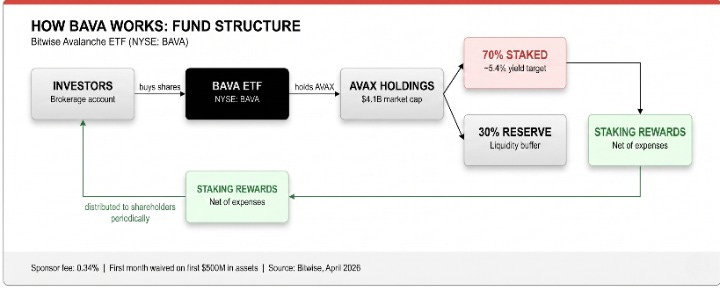
Here is how the staking structure works: roughly 70% of the fund’s AVAX is staked at any given time, targeting Avalanche’s current average staking reward rate of 5.4%. The remaining 30% stays in a liquidity reserve to handle redemptions. Net rewards flow back to shareholders on a regular schedule.
The fund trades on the NYSE under the ticker BAVA. The sponsor fee is 0.34%, waived entirely for the first month on the fund’s first $500 million in assets. Early trading showed $400,000 in volume within the first 90 minutes, which Bloomberg ETF analyst James Seyffart described as quite good for a launch.
Why Avalanche, Why Now
The timing of BAVA reflects something that has been building quietly in the Avalanche ecosystem, a growing list of real-world assets deployments that go well beyond crypto-native use cases. Currently, Avalanche is emerging as one of the leading platforms for businesses, governments, and real-world use cases by powering institutional projects like:
FIFA‘s proprietary blockchain for digital collectibles, including ticket options for the 2026 World Cup
Wyoming’s Frontier (FRNT) Stable Token, the first state-issued stablecoin in the U.S.
Bergen County, New Jersey’s digitization of 370,000 property deeds representing $240 billion in real estate value, via Balcony’s platform built on Avalanche
Toyota’s enterprise blockchain initiatives for mobility and supply chain
Institutional tokenization projects from KKR, Apollo, SkyBridge, and BlackRock
Japan’s first regulated stablecoin (JPYC) and Korea’s first KRW-denominated stablecoin (KRW1)
Avalanche’s L1architecture allows institutions to build sovereign, customizable blockchains that operate within their own compliance and governance rules, while still connecting to the broader network. It’s that combination of flexibility and performance, near-instant settlement with low fees, that keeps drawing serious enterprise interest by making things faster, cheaper, and more transparent for users.
The Staking Angle Is the Real Story
Most crypto ETFs are passive vehicles. You buy the fund, you hold the asset, you ride the price up or down. BAVA is structured differently.
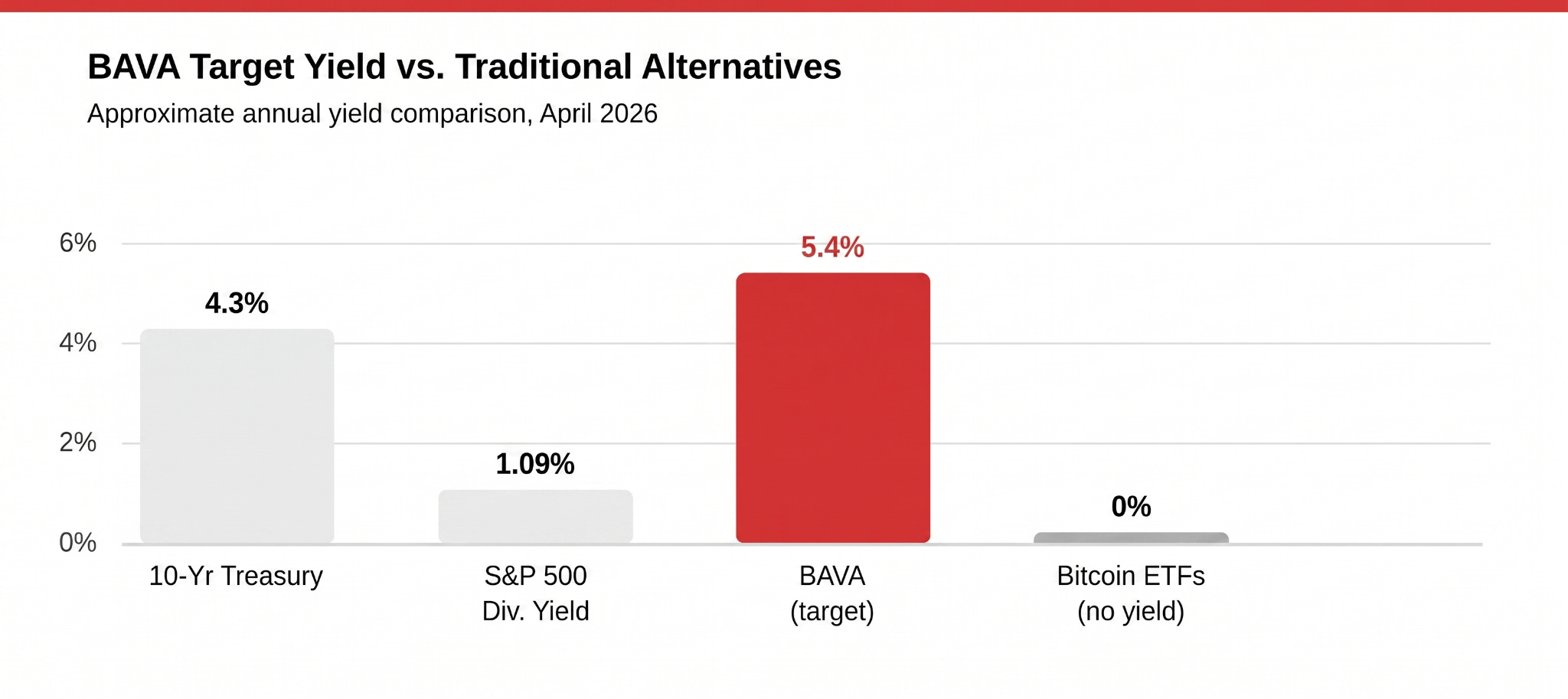
By staking the majority of its AVAX holdings in-house, Bitwise targets a 5.4% staking yield that gets passed back to shareholders. This matters for a few reasons. First, it makes BAVA a yield-bearing crypto product at a time when most alternatives offer none. Second, in-house staking through Bitwise Onchain Solutions means the fund retains direct oversight rather than outsourcing to a third party. Third, it connects BAVA shareholders directly to Avalanche’s consensus mechanism, meaning the fund actively participates in securing the network.
For Avalanche, this has a compounding effect. More institutional capital staking AVAX strengthens network security and signals conviction from sophisticated investors who have done the due diligence to back it in a regulated product.
What to Know Before You Invest
BAVA makes AVAX more accessible, but accessible does not mean risk-free. A few things worth understanding before investing:
AVAX is a volatile asset. The fund’s value moves with the price of AVAX, which has historically seen significant swings in both directions. A 5.4% staking yield means little if the underlying asset drops 10% or 20% in the same period.
Staking rewards are variable. The 5.4% target is based on current network conditions. Avalanche’s staking rate adjusts over time based on the total amount of AVAX staked across the network. As more institutional capital enters through products like BAVA, that rate could compress.
The fund structure adds a layer of fees. Bitwise retains 12% of staking rewards as an operational cut, on top of the 0.34% sponsor fee. Investors are not receiving the raw staking yield a direct validator would earn.
None of this makes BAVA a bad product. It makes it a product worth reading the prospectus for before putting capital in.
What This Means for the Ecosystem
BAVA is not the end of something. It is the infrastructure for what comes next.
When a major asset manager with $11 billion under management launches a regulated product built around Avalanche, it opens access to an entirely new category of investor. Financial advisors who previously could not include AVAX in client portfolios now have a compliant on-ramp. Institutional allocators who need a custodied, auditable product can now participate.
That capital flows back into the ecosystem. It supports validators, increases network security, and adds a layer of long-term credibility that speculative trading volume alone cannot provide.
Get Involved
BAVA is live on the NYSE today. Here is where to go next:
Review the official BAVA prospectus at bavaetf.com/prospectus
Learn more about building on Avalanche at avax.network
Join the conversation in the Avalanche community Discord and follow @avax on X for the latest ecosystem updates
Dive into the Avalanche ecosystem today! Download the Core Wallet and unlock a world of seamless DeFi, NFTs, and more.