




Avalanche has plenty happening beyond the usual transaction counts and trading volumes. Aave V4 is attracting deposits, Bitcoin liquidity remains active, and BlackRock’s BUIDL continues to represent a substantial institutional presence on the network.
Meanwhile, dedicated Avalanche L1s are processing millions of transactions across gaming, trading and other applications. Not every part of the ecosystem is growing at the same pace, but the range of activity is becoming more interesting as different applications build around their own needs.
Aave V4 is gaining traction on Avalanche
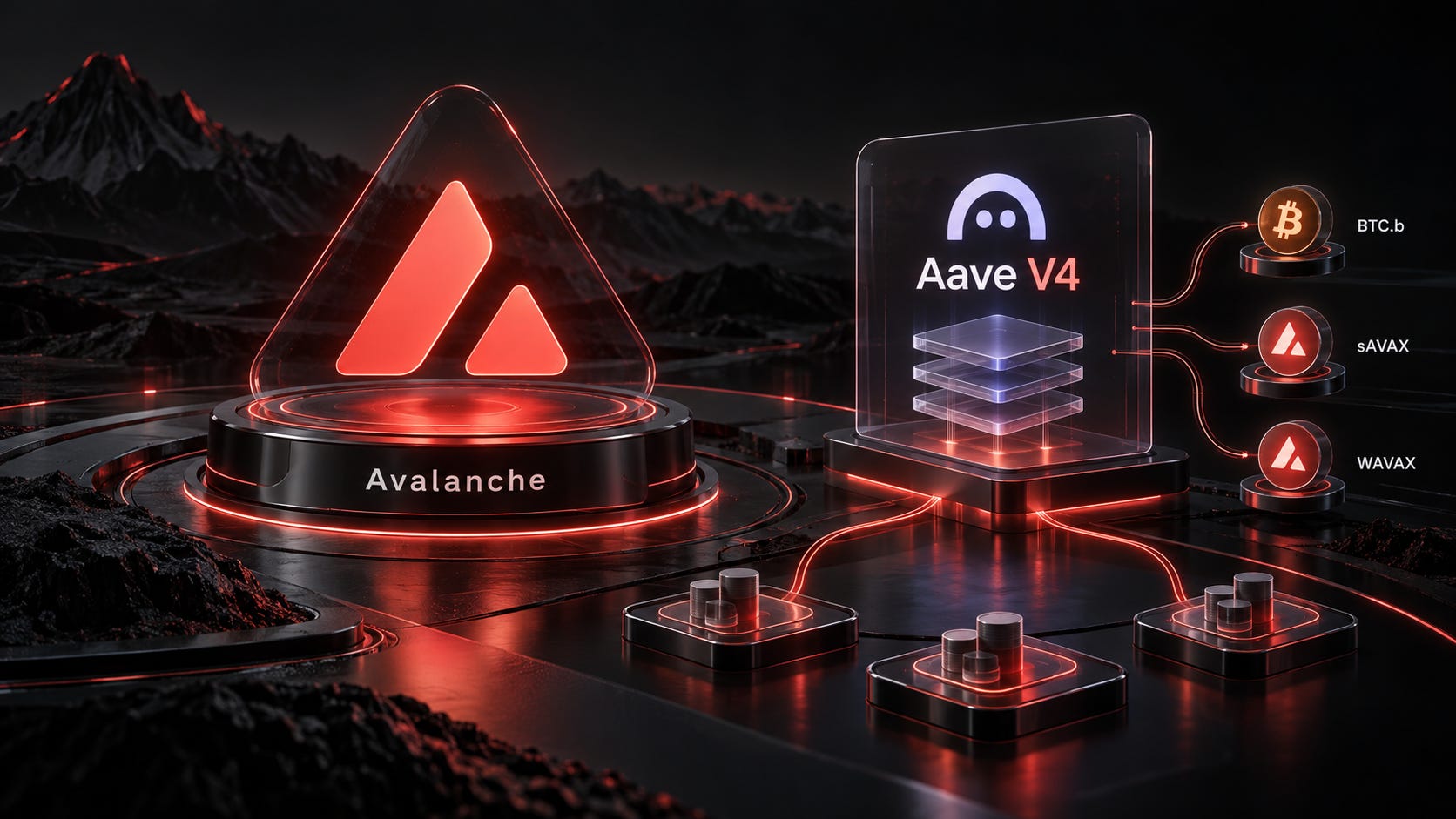
One of the more interesting developments in Avalanche DeFi this year has been the arrival of Aave V4. Launched on Avalanche in July, it marked V4’s first expansion beyond Ethereum and introduced a different approach to how lending markets share liquidity.
According to Aavescan’s latest available data, Aave V4 on Avalanche holds approximately $50 million in deposits and $13 million in active loans, with deposits increasing by around $14 million over the past 30 days. Aave V3 remains considerably larger, with approximately $448 million in deposits and $152 million in active loans, although its deposits have declined during the same period.
It is difficult to tell how much capital, if any, is moving directly between the two versions. What we can see is that V4 is beginning to establish a lending market of its own.
The architecture is worth looking at. Instead of relying on separate pools that manage liquidity independently, V4 introduces a shared Liquidity Hub connected to specialized markets. On Avalanche, these include a general lending market, an AVAX Correlated market for liquid staking strategies, and a Forex market focused on stablecoin borrowing and exchange-rate exposure.
This allows assets such as BTC.b, sAVAX, WAVAX, USDC and EURC to be used across markets designed for different borrowing needs.
There is also an institutional angle. Aave’s original Avalanche proposal included plans for a dedicated RWA Hub, which could eventually connect tokenized financial assets with onchain lending. That remains a proposed development rather than one of the live markets covered here, but it is an area worth following given Avalanche’s existing presence in institutional tokenization.
Bitcoin liquidity remains active
BTC.b continues to be one of the more active assets in Avalanche DeFi. Over the latest seven days, it recorded approximately $69.2 million in DEX volume, including $34.9 million in buys and $34.3 million in sells.
The token has around 33,442 holders, while its latest one-day trading volume reached approximately $4.9 million. Buying and selling remain closely balanced, with no obvious rush in either direction.
Bitcoin-backed liquidity also has a role beyond trading. BTC.b is supported in Aave V4’s main lending market, where it can be used in collateral and borrowing strategies. That gives Bitcoin holders another way to use their assets within Avalanche DeFi without having to sell their BTC exposure.
With almost $70 million in weekly DEX volume and additional lending use cases developing around it, BTC.b remains an important part of Avalanche’s liquidity landscape.
AVAX flows remain active
The latest wallet data shows continued movement in AVAX, although the different groups of holders are not all moving in the same direction.
Around $6.3 million of native AVAX left exchange wallets over seven days, while fresh wallets recorded approximately $6.6 million in net inflows. Top PnL wallets also saw around $10.1 million in net AVAX inflows during the week.
WAVAX showed a different pattern. Approximately $9.5 million moved into exchange wallets, while Top PnL wallets recorded around $1.8 million in net outflows.
These movements make it difficult to describe the current market as straightforward accumulation. Exchange withdrawals can reflect several different activities, and inflows into profitable wallets do not necessarily mean those holders are building long-term positions.
Still, the amount of capital moving through these wallets is notable, particularly the activity among profitable AVAX holders. The next few weeks should give us a better indication of whether those positions are maintained or continue to rotate.
sAVAX and BENQI remain important to Avalanche DeFi
Liquid staking has been quieter in the latest trading data. sAVAX currently has approximately 18,237 holders, with around $371,700 in seven-day DEX volume. Buy volume reached $205,500, compared with $166,200 in sells.
Those figures are relatively modest, but secondary-market trading is only one part of how liquid staking is used. sAVAX allows holders to maintain staking exposure while keeping their capital available for lending and other DeFi strategies.
Aave V4’s AVAX Correlated market adds another use case by allowing users to supply sAVAX as collateral and borrow WAVAX. This creates opportunities for staking-related borrowing strategies within a dedicated risk environment.
BENQI also remains an established part of Avalanche’s lending and staking ecosystem. According to DefiLlama, BENQI Lending holds approximately $107 million in TVL, alongside roughly $36 million in active loans.
Lending deposits have not increased across every protocol during the latest month, but substantial capital remains deployed across these markets. With Aave V4 now operating alongside established platforms such as BENQI, Avalanche users have more choices in how they stake, borrow and use their assets.
BUIDL remains a major institutional asset
BlackRock’s BUIDL continues to be one of Avalanche’s most significant institutional use cases. According to RWA.xyz, approximately $481.5 million of BUIDL is deployed on Avalanche, out of roughly $2.19 billion across all networks. That puts Avalanche at around 22% of the fund’s total value.

The balance is below the levels reached during the summer, although the latest Nansen scan shows a substantial change in token burning activity. Approximately 6.35 million BUIDL tokens were burned during the latest 30 days, compared with 79.05 million in the previous period, a decline of roughly 92%.
Much of the earlier total came from one large burn, so the change should be viewed in that context. Without complete mint data, we cannot determine whether BUIDL experienced net issuance or redemptions during the latest period.
Beyond these monthly movements, the larger development is the range of institutional assets beginning to use Avalanche infrastructure. BUIDL helped establish the network as a home for tokenized Treasuries, while other issuers and platforms have introduced tokenized equities and fixed-income products.
Nearly half a billion dollars in BUIDL remains a meaningful institutional presence on Avalanche, particularly for a product designed around large, approved investors rather than widespread retail trading.
Aave V4 adds another interesting possibility. If its planned RWA infrastructure develops further, tokenized assets could eventually find more uses within onchain lending markets. There is still work to be done before that becomes a measurable part of Avalanche DeFi, but the infrastructure being developed today could support those applications in the future.
Avalanche L1s continue processing millions of transactions
Some of Avalanche’s busiest applications operate on their own dedicated L1s rather than C-Chain. According to Avascan’s recent rolling 30-day snapshot, GUNZ processed approximately 11.6 million transactions, Dexalot recorded 8.7 million and Henesys around 3.9 million.
These networks serve very different markets. GUNZ supports gaming through Off The Grid, Dexalot operates an onchain order-book exchange, and Henesys powers the MapleStory Universe ecosystem.
Each uses a dedicated execution environment built around its application’s requirements. That gives developers more control over how their networks operate without requiring every application to share the same execution environment.
The transaction numbers are substantial, although they do not tell us everything about user growth or retention. A game generating millions of transactions and a financial application processing fewer, higher-value transactions are also difficult to compare using transaction counts alone.
Still, these are established applications generating measurable activity on their own networks. Avalanche’s L1 strategy is already being put to work across different industries, with gaming and trading providing some of the clearest examples.
As more applications launch and mature, the next question is how consistently these networks attract returning users and sustain activity over time.
Where Avalanche stands now
Aave V4 is attracting deposits, Bitcoin liquidity remains active, and nearly half a billion dollars of BUIDL is deployed on Avalanche. At the same time, established lending protocols continue to hold substantial capital, while dedicated L1s are processing millions of transactions across gaming, trading and other applications.
Not every metric is moving higher, but Avalanche is developing across several markets with very different needs. Some are focused on financial infrastructure, others on consumer applications, and each is finding its own use for the network.
Avalanche is growing beyond a single chain or use case, with real activity already taking place across lending, institutional finance, gaming and onchain trading.
Data note: Nansen token and wallet figures are from the October 28, 2026 scan. Aave V3 and V4 data was cross-checked with Aavescan, BENQI with DefiLlama, BUIDL with RWA.xyz, and individual Avalanche L1 activity with Avascan. Figures are approximate snapshots from different reporting windows and methodologies. They should not be treated as directly comparable ecosystem-wide totals.
Dive into the Avalanche ecosystem today! Download the Core Wallet and unlock a world of seamless DeFi, NFTs, and more.