

Avalanche Foundation CIO Matias A. on the Shift Toward Onchain GDP
A candid discussion on economic design, institutional adoption, and long-term ecosystem resilience.


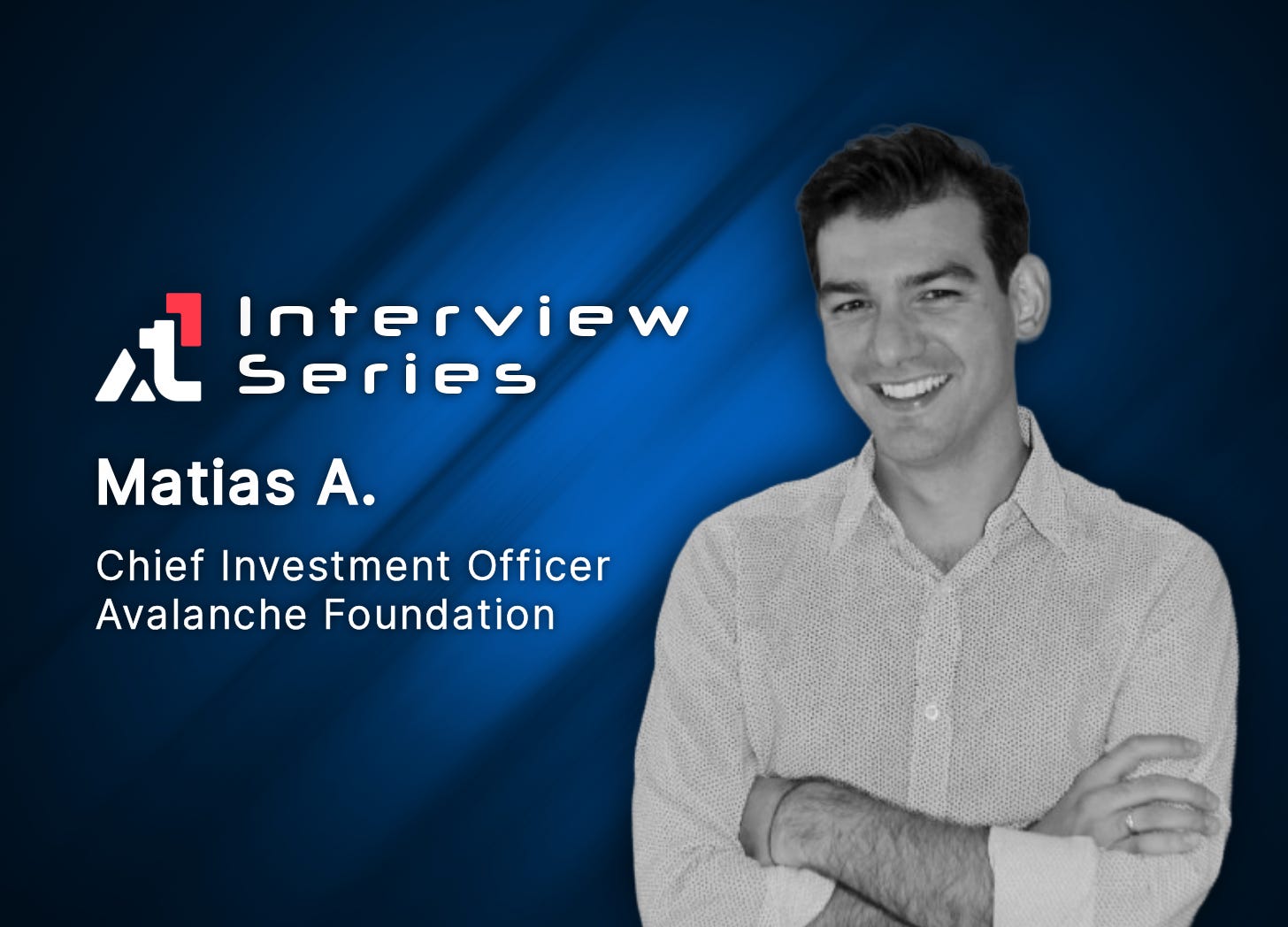
Avalanche is entering a more measurable growth phase.
The conversation is shifting toward validator sustainability, real economic output, and long-term ecosystem health. Capital and incentives still matter, but the focus is now on the kind of durable economic activity the network generates and whether that activity can persist across cycles.
For builders, validators, liquidity providers, and institutions, this shift is reshaping how success is defined.
In this conversation, we speak with Matias A., Chief Investment Officer of the Avalanche Foundation, about how he sees this next stage unfolding. With experience spanning the International Monetary Fund, the World Bank Treasury, and, most recently, leading treasury strategy within the Foundation, Matias approaches Avalanche through a macroeconomic lens grounded in measurement and risk management.
In a recent public thread outlining his priorities, he emphasized strengthening tokenomics design, expanding ecosystem GDP, improving validator economics, deepening DEX liquidity, and growing real-world asset and non-USD stablecoin activity.
That framing carries through the discussion below.
Rethinking How Growth Is Measured
How did your time at the IMF and World Bank influence the way you approach growth and market stability in the Avalanche ecosystem?
Working at the IMF and World Bank during major macroeconomic crises taught me that systemic failures generally come from measuring the wrong things or ignoring risks that don’t fit your model. I watched economies run into significant problems because policymakers focused on the political cost of missing headline GDP growth while missing currency mismatches on bank balance sheets or unsustainable fiscal trajectories. The data was there, but the incentives were to tell a growth story rather than ask hard questions about sustainability. That experience made me obsessive about building measurement frameworks that capture actual economic health, not just vanity metrics.
Later, managing $20B+ at the World Bank Treasury, I learned that sustainable growth requires understanding risk-adjusted returns, liquidity depth, and operational resilience under stress. Too much crypto operates like pre-crisis emerging markets, optimizing for whatever narrative is in vogue while ignoring fundamental vulnerabilities. TVL for a DEX means little if liquidity isn’t positioned in a range generating fees. Transaction counts tell a skewed story if they’re driven by airdrop farming.
At Avalanche Foundation, we’re building measurement frameworks that go beyond blockchain space demand. We’ll track project revenue growth, token launches above meaningful market caps, and soon, direct on-chain GDP metrics, starting with protocol revenue aggregation across native projects. We’re even exploring DSGE (Dynamic Stochastic General Equilibrium) models to understand how tokenomics changes cascade through the system. This isn’t an academic exercise; it’s about building a framework of understanding that leads to informed decisions about capital allocation and protocol design that lead to long-term ecosystem sustainability. Markets aren’t rational in the short term, but fundamentals always eventually win. As the investor base institutionalizes, the chains solving real world problems be it because they reduce operational costs of a business or open new revenue streams will ultimately survive. I think Avalanche is well positioned to be that chain.
The Move From TradFi to Crypto
What motivated your transition from traditional global finance into the on-chain world?
I saw an opportunity to combine buy-side asset management with macroeconomic understanding in a way TradFi doesn’t allow. Despite its efficiency, traditional finance runs on outdated analog infrastructure. Fixed income, where I spent years, is notoriously archaic. Most credit still trades via voice, not electronically. You have massive market fragmentation between on-the-run and off-the-run issues. Back-office settlement is a nightmare of reconciliation failures and settlement delays, especially when dealing with multiple currencies.
Blockchain aims to solve this not just by upgrading rails, but by enabling financial products that were previously too coordination-heavy to exist. Think about loan syndication, where you need multiple parties to agree on terms, fund tranches, manage servicing, and handle defaults. That coordination complexity limits what’s possible. On-chain, you can program all of that into a smart contract, and suddenly bond structures that were economically interesting but operationally impossible become viable.
The moment it clicked was when I used Trader Joe (now LFJ) and Platypus during peak Avalanche activity in 2021. I could execute high-value transactions with pricing, trade execution, and settlement all atomic in a single transaction. No counterparty coordination, no settlement risk, no phone calls. Even during chain congestion, it worked. That’s when I realized this wasn’t theoretical efficiency gains, this was fundamentally better market structure.
Why Avalanche’s Architecture Matters for Institutions
You’ve worked across both TradFi and DeFi. What makes Avalanche the place where these two worlds can genuinely meet?
Avalanche’s L1 architecture lets you build isolated, compliant environments that still connect natively to the broader ecosystem. Think about how global companies actually operate. They don’t run one entity worldwide; they create subsidiaries in each jurisdiction to comply with local regulations. Each subsidiary needs its own books and compliance framework, but they all need to move capital and information efficiently among themselves.
That’s exactly what Avalanche enables. A global financial institution like Goldman Sachs can launch a permissioned L1 for its regulated securities business in the US, another for its European operations, and maybe a public L1 for retail-facing products, all natively interconnected through Avalanche Warp Messaging. Each “business unit” gets its own execution environment with appropriate rules, but the entire cluster operates as one coherent system. This operational upgrade cannot be understated compared to forcing everything onto a single public chain or running completely disconnected private blockchains.
The alternatives don’t work for institutions. Fully public chains can’t accommodate regulatory requirements around KYC, accredited investor rules, or securities laws without finding (sometimes) difficult workarounds for example. Completely isolated private chains lose composability, interconnectivity, and liquidity aggregation benefits. Avalanche is the one of very few architectures that gives you both compliance isolation and native interoperability at the L1 level. That’s why we can seriously pursue institutional adoption while maintaining a thriving crypto-native DeFi ecosystem. They’re not competing for the same blockspace, they’re complementary parts of a heterogeneous network.
Are Fundamentals Actually Taking Hold?
What convinces you that this cycle marks a real shift toward fundamentals and institutional adoption?
Honestly? Not much yet, but the direction is clear. Crypto valuations are still almost entirely speculation and narrative-driven. But the composition of the investor base is changing. We’re seeing real allocators, sovereign wealth funds, and endowment funds asking substantive questions about protocol economics and defensibility. That didn’t happen in previous cycles.
What’s different is that the infrastructure is maturing enough that use cases are becoming economically viable, not just technically possible. Stablecoin payment rails are genuinely cheaper than correspondent banking for certain corridors. Tokenized money market funds are getting used for yield and settlement efficiency. RWA issuance is moving beyond pilots to material volumes. These have stronger persistence through cycles because they’re solving actual cost or access problems.
The financial services businesses I talk to aren’t asking about throughput anymore; they’re asking about operational resilience, regulatory clarity, and whether on-chain settlement reduces their back-office costs enough to justify migration effort. That’s fundamentally different from 2021. Will speculation still dominate prices in the short term? Absolutely. But I’d rather build for a future where protocol revenue matters than optimize for the latest narrative. The protocols that solve real world coordination problems will survive as speculation rotates away.
What Gets Prioritized Now
Which key areas will you prioritize to drive measurable progress across the Avalanche ecosystem?
The most important thing is moving validator economics away from inflation-only rewards toward fee-based sustainability while fixing tokenomics more broadly. That also means enabling network usage so that the use for AVAX is structurally embedded within the ecosystem. This is disruptive because it’s broad in reach, and its impact is difficult to isolate. We’re breaking this into phased implementations to measure effects and avoid breaking anything in production. Get validator economics wrong, and you compromise network security. Get token emissions wrong, and you either inflate away value or fail to incentivize needed growth. It’s a complex optimization problem with real constraints and no easy answers.
The second priority is improving DEX liquidity depth relative to other ecosystems. This matters because it helps reduce FX conversion costs for non-USD stablecoins and enables efficient RWA settlement. Institutions won’t launch products on a chain where they can’t execute meaningful size without slippage. DeFi protocols can’t generate revenue without trading activity. We need to make Avalanche the obvious venue for trading execution through better incentive design, improved capital efficiency, and honest assessment of what’s generating real revenue vs what depends purely on unsustainable incentive mechanisms.
Third is growing RWA and non-USD stablecoin TVL. The dollar-stablecoin market is crowded and largely solved. The opportunity is in other currencies where cross-border payments and FX settlement are still expensive and slow, and in bringing traditional financial assets on-chain, where they can be composed with DeFi primitives. Both require institutional partnerships and regulatory navigation, but both directly expand economic activity on Avalanche versus just moving existing crypto around.
What Success Looks Like in Practice
What does success look like if Avalanche becomes infrastructure for global onchain GDP?
Success is businesses using the chain for day-to-day operations because it reduces costs, creates new revenue streams, or reaches customers they couldn’t access previously. Actual production systems where the business would be materially worse off if the chain went down.
Concretely, that’s payment processors settling cross-border transactions on Avalanche because it’s faster and cheaper than correspondent banking. Asset managers are issuing and trading tokenized funds because 24/7 settlement and composability with DeFi yield is operationally superior. Global companies are running L1 infrastructure for international operations because compliance isolation plus native interoperability solves coordination problems they currently solve with dozens of entities and expensive middleware. Supply chain platforms track high-value goods because shared ledgers reduce reconciliation costs and the risk of fraud.
We’ll know we’re there when on-chain GDP, measured initially by protocol revenue from Avalanche-native projects, is growing consistently. When L1s are launching for business use cases, not just crypto-native audiences. When stablecoin and RWA TVL represent genuine economic activity, not yield farming. The metric I care about is revenue generated by projects building on Avalanche and whether that revenue grows because they’re solving problems that matter. If we get that right, everything else follows: network effects and ecosystem sustainability.
How the Foundation’s Role Is Changing
How do you see the Foundation’s long-term vision shaping the ecosystem over the next several years?
The Foundation’s role is evolving from ecosystem development in the traditional crypto sense to economic growth stewardship, focusing on creating the right macroeconomic conditions for long-term sustainable growth across a broad base. Over the next several years, I want to make Avalanche the obvious choice for businesses that want blockchain’s coordination benefits without sacrificing compliance, performance, or security.
That means getting tokenomics and validator economics right so the network is financially sustainable and secure long-term. It means building measurement frameworks to actually track on-chain economic activity beyond speculation. And critically, it means making the user experience not terrifying. Right now, interacting with smart contracts that could drain your wallet, sending irreversible transactions with no recourse if you fat-finger an address, needing to “read the chain” to verify anything, these aren’t acceptable if we expect mainstream adoption. Chain abstraction is existential. Users shouldn’t need to know which chain they’re on or manage gas tokens across ten networks.
We’re also focused on ecosystem heterogeneity. The vision isn’t one giant public chain processing everything. It’s a network of specialized L1s, some public, some permissioned, each optimized for different use cases but all natively interconnected. Global companies run compliant L1s for each jurisdiction. DeFi protocols live on the C-Chain as the liquidity center for all L1s. Gaming platforms build environments optimized for low-latency microtransactions. They all compose without bridges or wrapped tokens because they’re part of the same network fabric. That’s the architecture that supports global on-chain GDP.
As we court institutions and businesses, the existing crypto-native community isn’t being left behind; they’re the foundation we’re building on. The DeFi protocols, the developers, the validators, they’re what make this infrastructure valuable. Institutions are coming because that community already proved the primitives work. We’re expanding who can participate, not replacing those who are already here.
The Principle Behind This Shift
What core message should builders, institutions, and communities understand as Avalanche enters this next phase?
The core message is simple: blockchain’s value is in solving coordination problems and reducing costs, not in speculation or narrative. We’re building infrastructure for economic activity, where businesses depend on the chain being up because it runs their operations.
For builders, we’re supporting projects that generate revenue from users, not just token incentives and airdrops. Build something that survives without emissions, something that solves problems expensively handled today. For institutions, Avalanche gives you both compliance isolation through L1s and interconnectivity with the broader ecosystem. You don’t have to choose between regulatory requirements and blockchain’s efficiency gains.
For the community, crypto-native DeFi users, validators, and developers, you’re the reason institutions are interested in the first place. The validator set securing the network, the DEX liquidity enabling efficient swaps, the lending protocols handling collateral management, these primitives have operated through multiple market cycles and billions in volume. That operational resilience is what makes institutional adoption possible. You proved the infrastructure works. Now we’re expanding who can build on top of what you created, not replacing it.
The guiding principle is fundamentals over hype. We’re measuring success by on-chain GDP growth, by protocol revenue, and by whether businesses are using this infrastructure for operations that matter to their bottom line. That requires getting tokenomics right, making UX not terrifying, building measurement systems that track actual economic activity, and being honest about what works. Crypto speed-ran TradFi’s scandals, the ponzi schemes, the rug pulls, and the hacks. That’s not culture, that’s not necessary, and we’re not normalizing it. We’re building financial infrastructure that works, which means professional standards, real accountability, and solving problems that matter beyond short-term market narratives. If we do this right, Avalanche becomes the operating system for global on-chain economic activity, because we solve coordination problems better than anyone else.
If you are building, validating, trading, or deploying capital on Avalanche, this phase directly involves you. Sustainable on-chain GDP emerges from real usage and productive activity across the ecosystem.
What metrics do you believe matter most? Where should the Foundation focus first?
Who Is Matias?
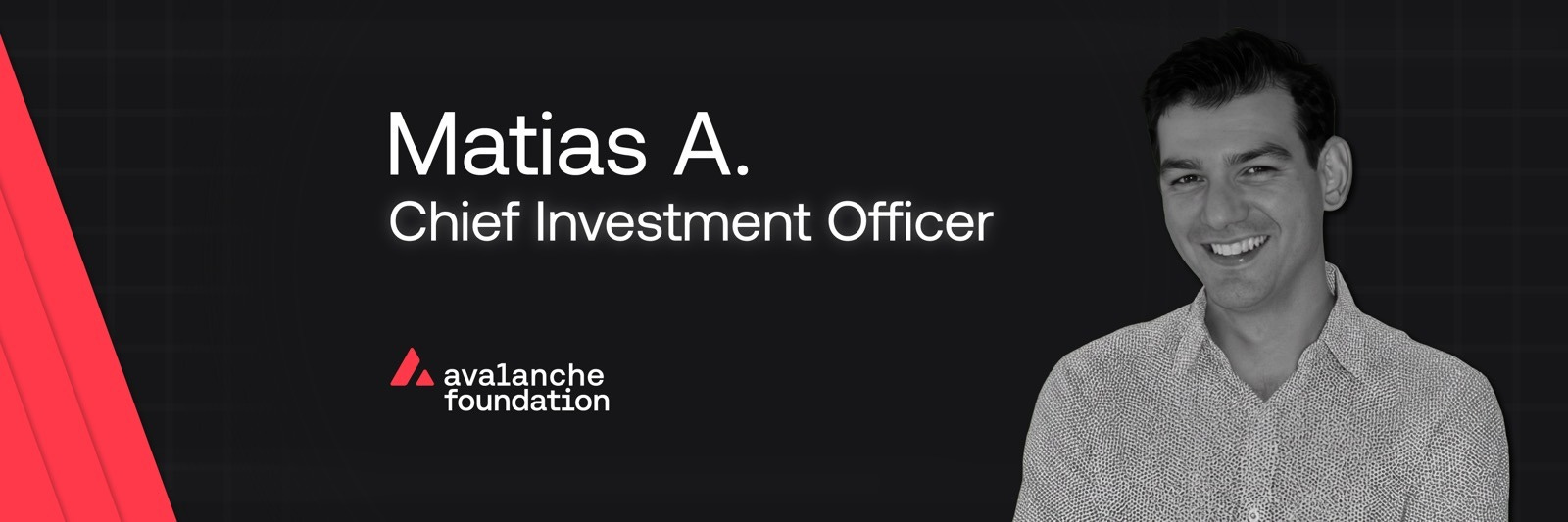
Matias A joins Avalanche Foundation as Chief Investment Officer, bringing over a decade of experience managing $20+ billion in institutional portfolios across traditional finance and digital assets. Most recently serving as Head of Treasury at the Avalanche Foundation, Matias has been instrumental in architecting treasury strategies, designing DeFi-centric investment frameworks, and building algorithmic execution systems that bridge institutional rigor with crypto-native innovation.
His background spans roles as Portfolio Manager at World Bank Treasury, where he directed $4.3B across fixed-income portfolios, created the backend infrastructure to manage $60B, and contributed to the external managers selection and tactical positioning for a $25B world bank pension fund portfolio, consistently delivering above-benchmark performance.
Matias combines rare expertise across macroeconomic policy and capital markets execution. His career began as a Research Analyst at the International Monetary Fund, where he developed analytical frameworks for evaluating and designing policies for sovereign economies of European countries. At the World Bank, he worked on critical macroeconomic challenges, including fiscal sustainability for El Salvador and the unfreezing of bond markets in Jamaica.
These experiences gave Matias firsthand experience in how policy interventions can restore market function and catalyze economic growth. This dual foundation in macroeconomics and asset management gives him a distinctive lens: understanding both how economies generate growth and how capital markets channel resources to productive uses.
Matias regularly shares updates and invites constructive discussion on X at @frostLedger. If you have thoughtful questions or feedback, that is where the conversation continues.
 | A guest post by
|