



AMI introduced itself to Avalanche on June 5, 2024, in a forum post with a modest pitch. It called itself the Avax Meme Index, and it wanted to make Avalanche’s memecoins easier to see: more visibility for small tokens, technical help for the teams behind them, and liquidity spread across more than 25 pools that the post said were largely funded by the coin creators themselves.
The extras were pure 2024. Free marketing support, promotional competitions, and an AI tool called COQGPT wired up to price data and social feeds.
None of that was infrastructure. AMI was a scoreboard: a place to look up which memecoins existed and how they were doing.
Six months later, on December 21, 2024, the team opened a GitHub organization. Its description still reads Formerly AMI (Avax Meme Index), though what it hosts now has nothing to do with indexing memecoins.
What AMI Sells Today
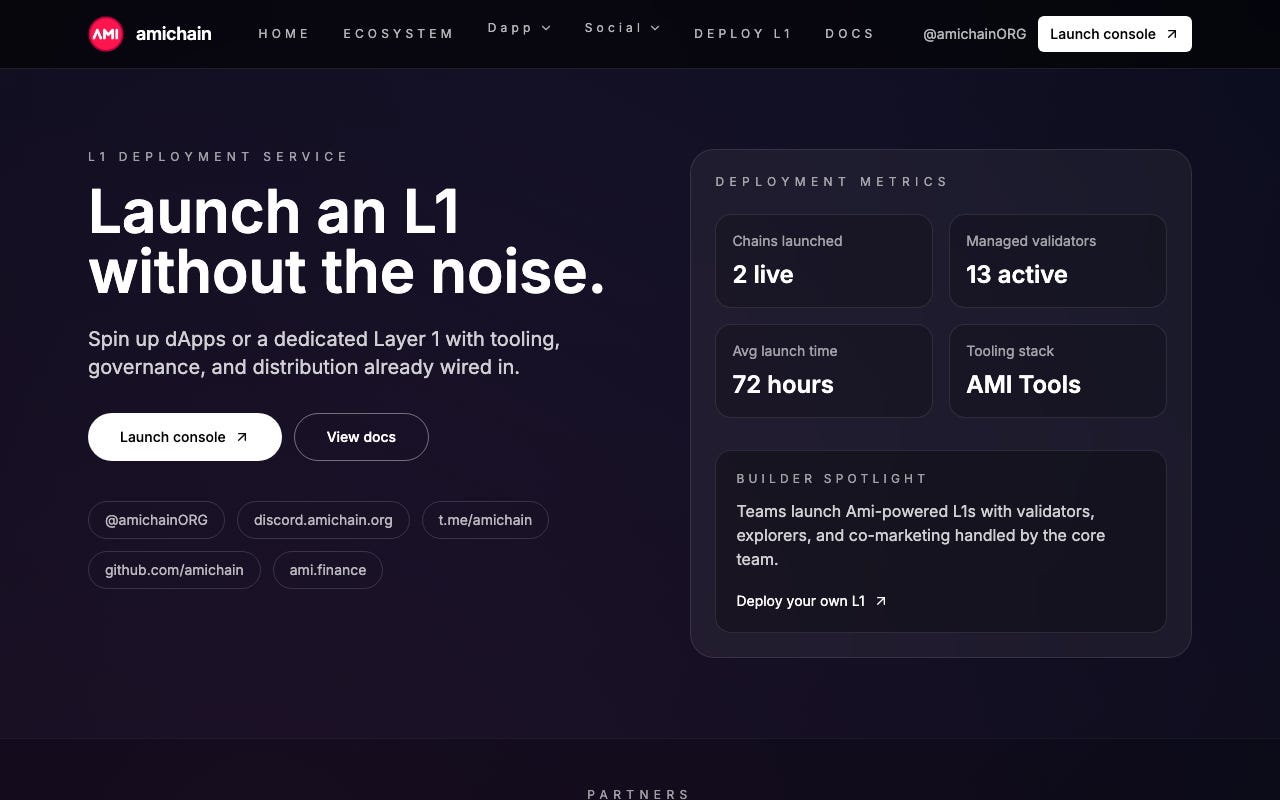
Today amichain.org opens with four words: Launch an L1 without the noise. The project describes itself as an L1 deployment and node-hosting service, and its own documentation is blunt about the lineage: AmiChain “originates from the AMI (Avax Meme Index) project.”
The scoreboard operator went into stadium management. Avalanche made launching an L1 accessible, and any team can now spin up its own chain with its own gas token and its own validator set. The launch is the easy part. After it, somebody has to watch the validators, replace failed hardware at 3 a.m., keep the explorer online, and sit through every upgrade.
Most teams that launch an L1 have no interest in doing that work themselves. AMI is betting they will pay someone else to do it.
What Changed From Index to Infrastructure
The pivot happened in two visible stages, and the GitHub org is where it is easiest to trace.
Stage one was building the map. Through early 2025 the org filled with the unglamorous pieces of EVM plumbing: a chainlist SDK published as @amichain/chainlist, a companion app, a set of chain icons, a fork of the Blockscout explorer. This is the tooling a project needs when it stops tracking chains and starts running them.
Stage two was selling the operation. By 2026 the site had stopped talking about memecoins and started quoting deployment metrics: two chains live, thirteen managed validators, and an average launch time of 72 hours, as listed on the homepage as of September 1, 2026. Ami engineers deploy and operate the L1 stack, and validators, explorers, and co-marketing come bundled.
Why would a team hand that over? Because running validators is mostly a staffing problem. It needs monitoring, an on-call rotation, and a hosting bill that arrives whether or not anyone is using the chain. A team of five building a game does not want to become a team of five running a datacenter.
AMI’s answer to the trust question is the substrate. The site lists SOC 2 Type 1 and Type 2, ISO 27001, PCI-DSS, and HITRUST alongside its validator hosting, but the wording matters: AMI says it uses compliant infrastructure, which means those certifications describe the hosting providers underneath rather than an audit of AMI itself. Any institution doing diligence will care about that difference.
Three Things That Stand Out
The tooling bundle is the real product. At app.ami.finance, the L1 Manager sits alongside a wallets manager, bulk transactions, an airdrop tool, and a C-chain/P-chain bridge. Launching a chain takes a weekend. The reason to stay is that the wallet, explorer, and dashboards arrive white-labeled on day one.
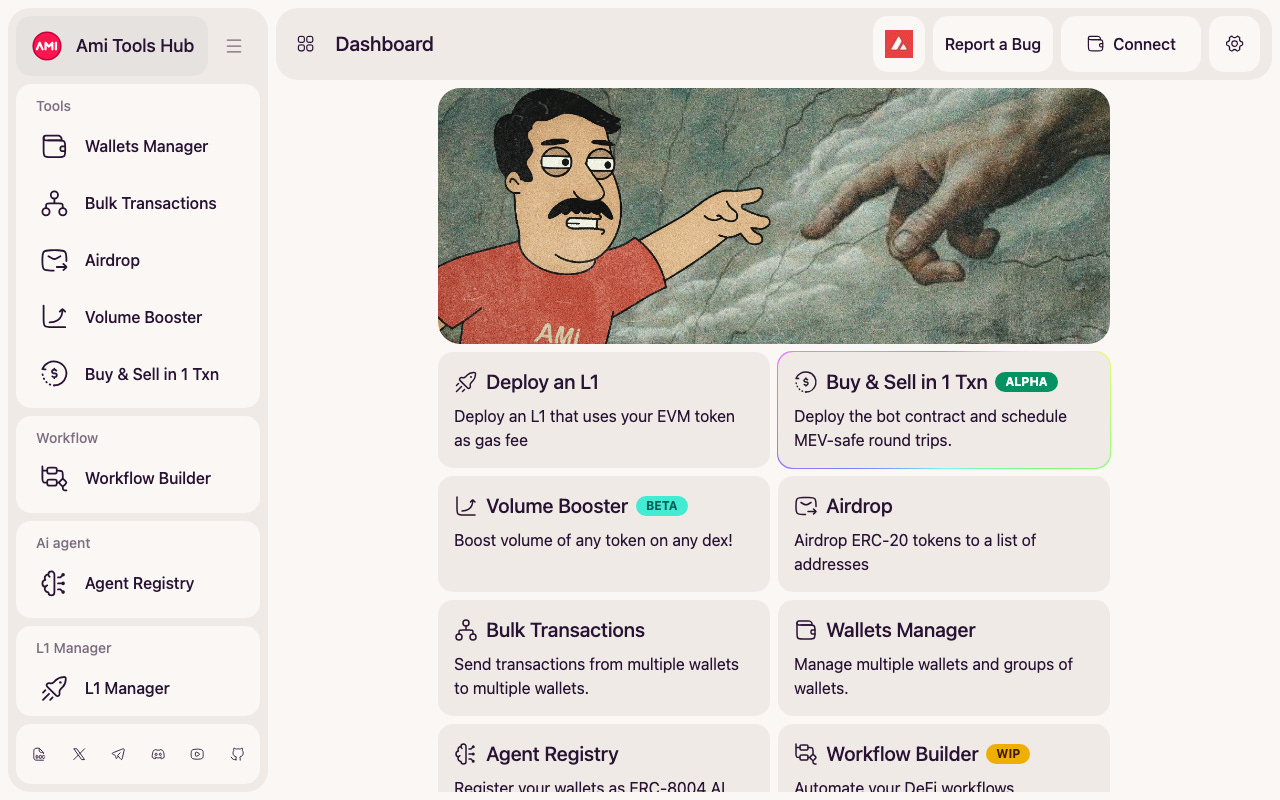
The workflow builder is an unusual idea. AMI is building visual DeFi automation, and its own site compares the result to n8n, the tool that lets people chain services together without writing code. You drag a trigger, connect an action, and let it run. Applied onchain, the idea fills a real gap, and it is still listed as in development.
The agent registry is a bet on what comes next. The app lets users register wallets as ERC-8004 AI agents onchain. The team promotes it hard: a February 2026 post framed the feature as giving bots a “passport” to interact with other AI agents, and AMI joined Agent Community, a network built around that same “agentic web” idea. It all points at the same territory as the x402 payment work now appearing across Avalanche: machines holding wallets and paying each other without a human clicking approve. Whether that demand arrives is an open question, and AMI is positioned for it either way.
Who AMI Is Actually For
Small teams that want a chain without running one. A studio shipping a game, or a consumer app that needs its own gas token, can hand the stack over and keep its engineers on the product. That is what the managed launch program is built around, and it is the clearest fit for what AMI sells.
Token projects that need distribution tooling. The airdrop tool, bulk transactions, and wallets manager have little to do with running a chain. They are launch-day plumbing for getting a token into a lot of hands quickly, and they are the clearest surviving trace of the memecoin business AMI came from.
Builders experimenting with onchain agents. This is the newest of the three and the least proven. Anyone building a bot that needs an onchain identity can register one today, though the demand for that is still mostly theoretical.
The audience the site implies but has not yet earned is the institutional one. Enterprise validator hosting and a wall of compliance badges suggest a bank or a fund on the other side of the sales call, and nothing AMI has published shows one. Two live chains is a book of business a single mid-size customer could double.
What the Numbers Do Not Support Yet
Two chains and thirteen validators is a small operation. Every managed-infrastructure business starts with its first customers, so this is not a failure, but it is nowhere near the scale the enterprise framing on the site implies. The stadium is built and mostly empty.
The public repositories are quiet. The last push to any of the org’s eight repos was August 16, 2025, and across all of them GitHub counts seven stars and four forks in total. Much of the real work may be happening in private repos, which is normal for a managed-services company, but a builder evaluating AMI has little public code to judge it by. The quiet code sits oddly next to an active account: AMI’s X posts continue through 2026, including a June 29 update claiming fourteen managed Avalanche L1 nodes. The site, checked two months later, lists thirteen managed validators. The two counts use different words and point in different directions, and neither is auditable from outside.
That gap gets one real correction. In June 2025, the Avalanche Foundation named Ami to the first cohort of nineteen Retro9000 grantees, a program that pays out specifically for L1s and infrastructure tooling already live on mainnet. That is third-party recognition from the one party best positioned to judge whether a chain is actually running, though it confirms only that AMI is a real, live project the Foundation is willing to fund, not the specific deployment numbers on the site, which still have no independent source to check them against.
Then there is the toolkit. Two of the tools in the app are a Volume Booster, in beta, which offers to “boost volume of any token on any dex,” and a Buy & Sell in 1 Txn tool, in alpha, that deploys a bot contract to schedule round trips. A bot buying and selling the same token inflates the volume figure that everyone downstream reads as organic demand. Nothing about it is hidden, it sits on the product page under its own name, and it is a direct inheritance from the memecoin-marketing business AMI started in.
The framing shifts depending on where you read about it. The dashboard is blunt: boost volume on any dex. A forum post introducing AMI Finance in February 2026 pitches the same tool to builders in gentler language: MEV-protected, coordinated trading. It is the same feature described two different ways.
It still sits awkwardly next to SOC 2 badges and enterprise validator hosting. Those two products are pitched to two different customers, and the second one has reason to ask about the first.
Where AMI Fits in the Avalanche Ecosystem
AMI’s business exists because of a protocol change. Before Avalanche9000 activated on December 16, 2024, running a subnet validator meant staking 2,000 AVAX and validating the Primary Network alongside it. ACP-77 removed both requirements and replaced the stake with a recurring fee starting at 1.33 AVAX per validator per month.
That turned launching a chain from a capital decision into an operating expense, and it moved the hard part along with it. The 2,000 AVAX lockup used to be what stopped teams. The obstacle now is staffing a chain for years.
AMI opened its GitHub organization five days after the upgrade went live. Whatever the intent behind that timing, the pivot tracks the opportunity: a market for post-launch operations was only worth entering once launching stopped being the obstacle.
AMI is a small entrant in that market, and what it has to sell is experience. A team that has already run its own chain, published its own chain metadata, and forked its own explorer knows what breaks.
Final Thoughts
What makes AMI worth watching is the direction of travel. Plenty of projects spent this cycle chasing attention, which got crowded and cheap. AMI went the other way, into work that is dull, hard to fake, and that somebody has to do regardless of what the market is paying for.
Whether AMI is the team that does it at scale is undecided. Two chains does not make a track record, and the volume tooling is a question the project will have to answer as it moves upmarket. The pivot is real. The proof is not in yet.
Explore for yourself: amichain.org · docs · GitHub · X · Discord · AMI on Cascade

Looking to join the global community live? Registration is now open for Avalanche Summit NYC. Secure your pass today for 2 days of exclusive keynotes and networking.