



On July 15, 2026, Aave rolled out its V4 lending protocol on Avalanche, marking the first deployment of its redesigned architecture outside Ethereum. The move follows V4’s Ethereum debut in March and signals Aave’s plan to expand chain by chain, tailoring each deployment to ecosystems where it already has traction rather than replicating the same setup everywhere.
For Avalanche, being chosen as the first expansion beyond Ethereum reflects the network’s combination of an established Aave lending market and a fast-growing ecosystem for tokenized real-world assets such as Treasuries and corporate bonds.
What Is Aave?
Aave is one of the largest decentralized lending platforms in crypto. Unlike a bank, it isn’t run by a company holding your money and approving loans behind closed doors. It runs on smart contracts, self-executing code on a blockchain, that let people lend crypto to earn interest or borrow against crypto they own, without a middleman.
Aave has facilitated more than $1 trillion in cumulative loan volume since launching, making it one of the most established lending protocols in decentralized finance.
From Monolithic Pools to Hub and Spoke
The biggest change in V4 is architectural.
Previous versions relied on a single shared pool of funds per network. That was efficient, but it also concentrated risk: a problem with one asset could affect the whole pool.
V4 introduces a Hub and Spoke model. The Hub works like a central vault, holding reserves and managing liquidity across the network. Spokes work like individual branches, each with its own collateral rules, risk settings, and liquidation parameters, while drawing on liquidity from the Hub through controlled credit lines.
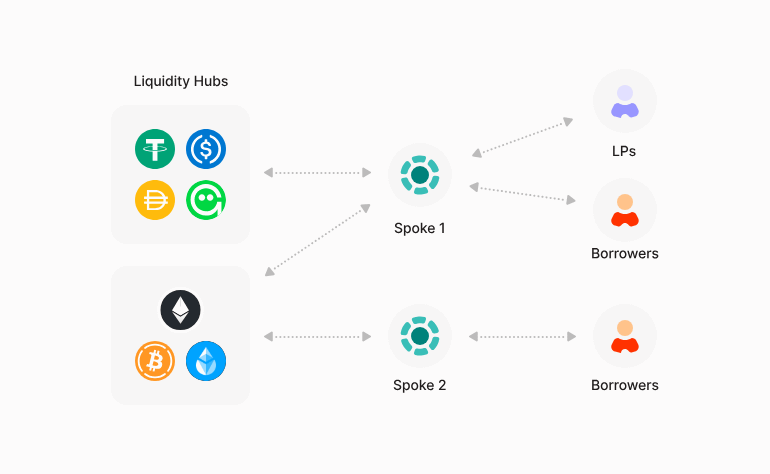
Different markets can share liquidity while the impact of problems in any single Spoke stays contained. That structure supports ordinary crypto lending, liquid staking, stablecoin markets, and eventually tokenized real-world assets, all on the same underlying capital.
Why Avalanche?
Aave first launched on Avalanche in 2021 via V2 during the Avalanche Rush incentive program, before Avalanche became one of the early networks to support Aave V3 in 2022. Since then, Aave has processed more than $15 billion in all-time cumulative inflows across V2 and V3 deployments on Avalanche. Today, the V3 market supports 18 assets, with stablecoin utilization running above 90%.
That track record made Avalanche a natural candidate for V4’s debut beyond Ethereum. Avalanche has also spent the past few years positioning itself around institutional finance, tokenized assets, stablecoins, and enterprise blockchain use, a direction that aligns with V4’s modular design as lending extends beyond crypto-native assets.
What Launched on Avalanche
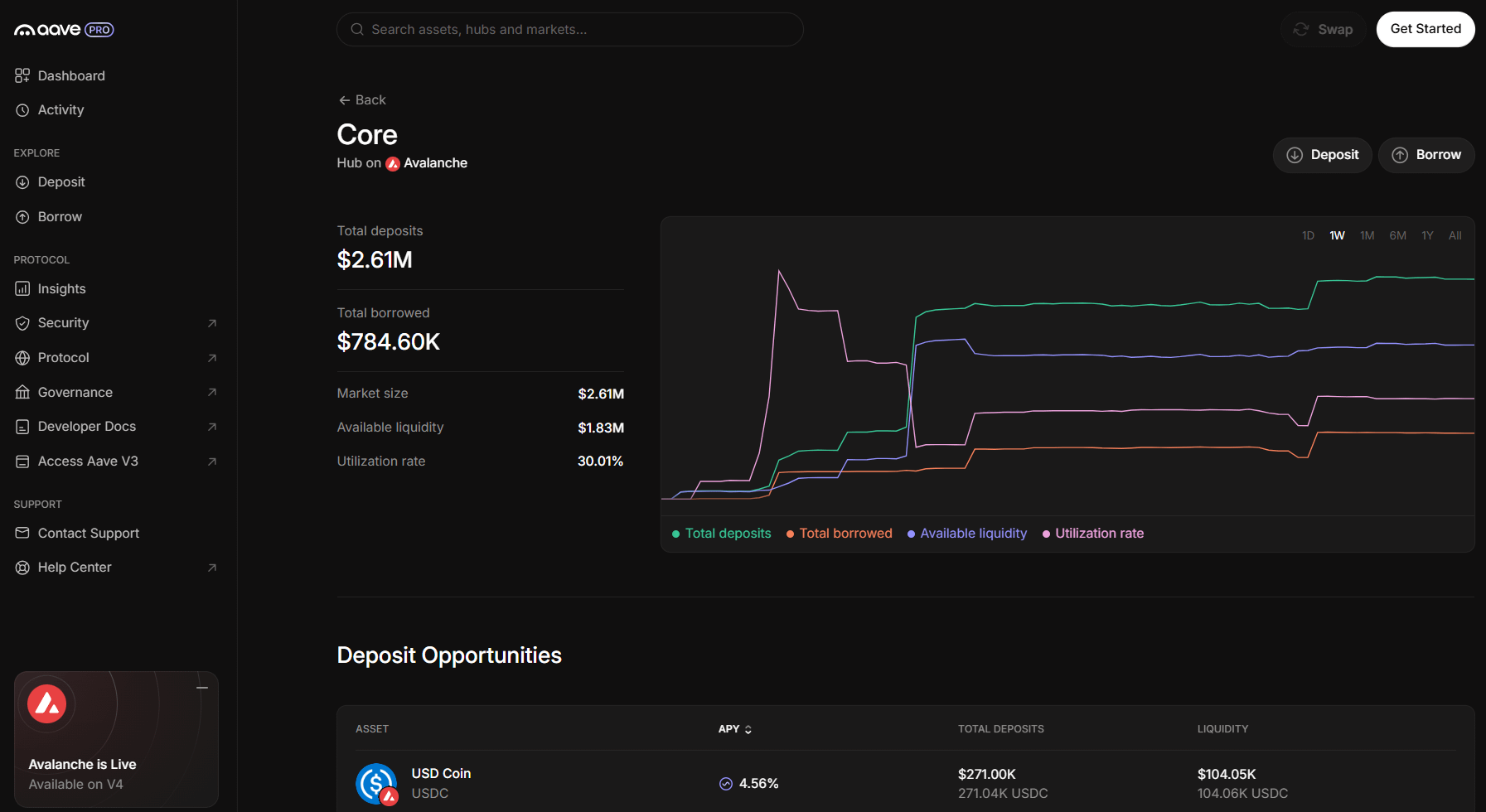
The deployment includes one Core Liquidity Hub connected to three markets:
Main market: General-purpose lending and borrowing, expected to hold most of the deployment’s liquidity.
AVAX Correlated market: Built for liquid staking. Users can supply sAVAX, a token representing staked AVAX, at a 95% collateral factor and borrow wAVAX exclusively.
Forex market: Stablecoin strategies involving EURC, USDC, and USDT, with conservative caps on EURC given its thinner liquidity.
As with Ethereum’s V4 launch, risk limits start conservatively and can expand as usage grows.
The Bigger Opportunity: Tokenized Assets
The feature Aave has promoted most isn’t live yet: a dedicated market for borrowing against tokenized Treasuries, money market funds, private credit, and corporate bonds.
Founder Stani Kulechov described Avalanche as a natural fit given its established lending market and growing tokenized asset ecosystem. Ava Labs President John Wu made a similar point: institutions adopting tokenized assets will need infrastructure that allows those assets to become more useful, not simply remain held onchain.
The network has already attracted tokenization efforts spanning industrial assets, Japanese financial products, and tokenized cash funds. The next challenge is making these assets more productive once they are onchain. Aave’s planned RWA market could provide lending infrastructure that allows tokenized assets to eventually be used as collateral, giving them access to Avalanche’s liquidity while maintaining separate risk parameters through the Hub and Spoke design.
Incentives Built for the Long Term
Avalanche has committed up to $15 million in incentives tied to milestones like total value locked, borrowing volume, and protocol revenue, rather than unconditional rewards.
Earlier DeFi incentive programs often saw users deposit funds temporarily to farm rewards before leaving once emissions slowed. Milestone-based incentives are structured to align rewards with sustained usage instead.
New Mechanics Under the Hood
V4 also changes how lending itself works.
Borrowing costs now include a dynamic risk premium, meaning safer collateral receives better borrowing terms while riskier assets carry higher rates.
Liquidations are also more adaptive. Instead of a fixed penalty, the incentive scales up as a position deteriorates, easing pressure on borrowers early while still prompting timely action from liquidators.
A More Competitive Landscape
The AVAX Correlated market puts Aave in direct competition with BENQI, which has built a strong position around Avalanche lending and liquid staking, particularly in the sAVAX ecosystem.
The added competition deepens liquidity and widens the options available to Avalanche users.
The Bigger Picture
Aave treats Avalanche as a template for future V4 expansions, not a one-off. For Avalanche, the network has spent years building toward institutional finance and tokenized assets, and V4 adds the credit layer those markets will eventually require.
The RWA market has not launched yet, so this deployment mostly proves the architecture rather than the final use case.
By making Avalanche the first network outside Ethereum to run V4, Aave is signaling where it expects the next generation of onchain lending to grow. If tokenized assets become a meaningful part of global finance, this launch may be remembered for the foundation it laid on Avalanche as much as for what shipped on day one.

Looking to join the global community live? Registration is now open for Avalanche Summit NYC. Secure your pass today for 2 days of exclusive keynotes and networking.
Great article, I've already created a Dune dashboard to analyze AAVE V4 Exclusively on Avalanche:
https://dune.com/alik110/aave-v4-avalanche